Category: Automation

  • Cut CS Operational Costs by 60% with WhatsApp Chatbots

    Cut CS Operational Costs by 60% with WhatsApp Chatbots

    Key Advantages

    • Support Operational Cost Reduction: Deploys automation technology to eliminate repetitive headcount expenditures when customer messaging volumes surge.
    • Peak-Hour Message Loss Prevention: Guarantees incoming customer inquiries receive instant replies in seconds without creating queue backlogs on support dashboards.
    • Automated Inbound Lead Qualification: Screens high-intent prospective buyers before escalating conversations to sales representatives, boosting team efficiency by up to 80%.
    • Protected Official API Connectivity: Operates automated conversational workflows over official Meta WhatsApp Business API infrastructure without account ban risks.

    Surging inbound messaging volume during commercial scaling is often a double-edged sword for executive management. On one hand, elevated conversation traffic signals expanding market demand. On the other hand, linearly increasing customer service (CS) headcount to maintain response SLA standards inflates enterprise operational cost structures rapidly.

    Cost Analysis: Human Headcount vs. Conversational Automation

    In traditional support operations, handling 10,000 daily customer conversations requires at least 10 to 15 support agents working across multiple shifts. This manual approach creates several direct and indirect financial burdens, including:

    • Continuous Recruitment & Training Costs: Substantial time and financial resources are expended onboarding new staff on frequently updated product catalogs.
    • High Risk of Human Error: Increased likelihood of communicating inaccurate stock levels, shipping calculations, or pricing tiers when agents operate under queue backlog pressure.
    • Working Hour Constraints: Escalating overtime labor expenses required to keep support channels responsive outside standard office hours.

    By deploying an AI-powered WhatsApp chatbot, enterprises can automate up to 80% of repetitive, Tier-1 inquiries. This allows core human support staff to concentrate their energy strictly on complex customer complaints and high-value commercial negotiations.

    WhatsApp Chatbot Workflow for Sales and Support Efficiency

    Conversational automation does not mean eliminating human agents entirely; it creates a balanced hybrid collaboration between intelligent systems and frontline specialists. Here is an optimized operational workflow:

    1. Instant Greeting & Intent Recognition: The system greets incoming inquiries instantaneously and identifies conversational intent using Natural Language Processing (NLP).
    2. Autonomous Tier-1 FAQ Resolution: Foundational inquiries such as branch locations, product catalogs, shipping fee estimates, and order tracking numbers resolve automatically without human intervention.
    3. Automated Lead Qualification: The bot guides buyers through structured qualification questions to verify budget parameters, timeline urgency, and specific product requirements.
    4. Specialist Agent Escalation: Qualified, purchase-ready conversations route automatically to active sales specialists within an omnichannel application dashboard alongside full interaction histories.

    Core Criteria for Enterprise-Grade WhatsApp Chatbot Platforms

    Before integrating a conversational platform, verify that candidate solutions support your organizational scalability and data governance requirements:

    1. Official WhatsApp Business API Infrastructure

    Ensure the platform operates directly on Meta’s official WhatsApp Business API network, guaranteeing high-throughput message delivery and protecting primary business phone numbers from security bans.

    2. Dynamic Contextual AI Processing

    Avoid rigid, legacy chatbots that depend solely on numerical menu trees or exact keyword triggers. Choose generative AI Agents capable of interpreting natural language context, slang, and unstructured customer inquiries dynamically.

    3. Real-Time CRM and Enterprise Database Integration

    The messaging engine must integrate natively with your sales CRM, e-commerce backend, and internal ticketing databases to query live transaction and inventory data in real time.

    Strategic Conclusion

    Optimizing operational support costs is not about cutting service quality, but about allocating human resources to workflows that deliver the highest ROI. Transitioning toward conversational automation is a foundational investment to scale your enterprise sustainably in fast-moving digital markets.

    Ready to discover how conversational automation reduces operational costs while improving response SLA times? Consult Your Business Needs with the Cekat.ai Team and test the live demo today!

  • Lead Management Software: 9 Automations to Boost Sales

    Lead Management Software: 9 Automations to Boost Sales

    Many sales teams spend the majority of their working hours not pursuing deal closings, but manually inputting prospect records, sorting repetitive incoming inquiries, and guessing which buyers possess genuine purchasing intent. Meanwhile, leads arriving from digital advertisements, web forms, and instant messaging channels frequently face delayed follow-ups.

    Industry research indicates that responding to an inbound lead within the first 5 minutes increases conversion likelihood by up to 9 times. However, in daily practice, most scaling enterprises suffer significant “lead leakage” along conversational sales funnels due to reliance on manual, disconnected workflows.

    Why 70% of Inbound Leads Are Lost Despite Using a CRM

    Many companies assume their sales pipeline is secure simply because they use a popular CRM platform to log contacts. Yet, their conversion numbers remain stagnant.

    This breakdown happens due to intent decay in unmanaged lead pipelines. Three primary leak points frequently go unnoticed:

    1. Inbound Channel Response Latency

    Modern buyers rely heavily on instant messaging apps like WhatsApp to inquire about products. When an incoming lead requires manual copy-pasting into a CRM system first, a 10 to 15-minute delay is often enough to drive the buyer directly to faster competitors.

    2. Manual Qualification Draining Sales Capacity

    Sales representatives waste valuable hours repeatedly asking basic administrative questions (such as regional location, company size, or budget thresholds). Consequently, their capacity to engage Sales Qualified Leads (SQLs) who are ready to buy becomes severely constrained.

    3. Context-Free, Unautomated Follow-Ups

    Prospects require an average of 3 to 5 touchpoints before finalizing a purchase decision. When follow-ups depend on an agent’s memory or physical sticky notes, dozens of high-value opportunities slip through the cracks.

    What Is Lead Management Software?

    Lead management software is a purpose-built system designed to capture, track, qualify, and route commercial prospects from initial touchpoint through final customer conversion.

    Unlike traditional CRMs that often function as static, passive databases, lead management software operates actively on the frontline of sales operations to guarantee that no commercial opportunity is left unattended.

    Core Workflow of Modern Lead Management:

    • Lead Capture: Aggregates prospect data across multiple acquisition channels into a unified database (Meta/Google ads, web forms, and WhatsApp).
    • Lead Scoring & Qualification: Automatically filters high-intent buyers from casual, top-of-funnel inquiries.
    • Lead Distribution: Routes qualified prospects instantly to the most relevant sales representative.
    • Nurturing & Follow-Up: Executes structured multi-touch message cadences to keep prospects engaged until closing.

    9 Essential Automations to Accelerate Sales Closing

    To eliminate costly manual friction, modern lead management platforms incorporate these core operational automations:

    1. Centralized Lead Capture

    Consolidates all incoming prospects across disparate marketing campaigns into a unified dashboard without data loss.

    2. Automated Qualification via AI Chatbots

    Deploys an AI Chatbot to greet inbound inquiries and execute structured qualification logic 24/7, ensuring only verified opportunities advance to sales reps.

    3. Instant Round-Robin Lead Assignment

    Distributes qualified leads equitably and immediately to available sales staff as soon as predefined criteria are satisfied.

    4. Automated Call Transcription & Summarization

    Utilizes voice intelligence like WhatsApp Call AI to transcribe voice interactions and automatically append key discussion summaries directly to the CRM deal card.

    5. Automated Follow-Up Sequences

    Schedules dynamic nurturing message cadences triggered by specific prospect behaviors or pipeline stage transitions.

    6. Dynamic Lead Scoring

    Assigns real-time lead scores based on chat responsiveness, product catalog engagement, or explicit budget indicators inside an enterprise customer database.

    7. Official WhatsApp Business API Integration

    Connects conversational lead pipelines directly via the official WhatsApp Business API to synchronize conversation logs and contact details bi-directionally in real time.

    8. Real-Time Sales Funnel & SLA Analytics

    Monitors team First Response Time (FRT), channel conversion rates, and stage drop-off points to optimize pipeline health continuously.

    9. Unified Visual Pipeline Management

    Visualizes every prospect’s exact position across sales stages using responsive, drag-and-drop Kanban boards inside a sales CRM workspace.

    Comparison: Manual Lead Management vs. AI-Powered Lead Management

    Operational Parameter Manual Lead Management AI-Powered Lead Management
    First Response Speed 15 minutes to several hours Under 1 minute (Instant 24/7)
    Data Logging Manual entry (Prone to errors and missed data) Automated bi-directional CRM synchronization
    Qualification Process Conducted manually by sales representatives Automated via AI conversational logic & scoring
    Operational Scalability Constrained by manual agent working hours Processes thousands of concurrent inquiries seamlessly
    Pipeline Visibility Fragmented across disparate personal spreadsheets Centralized within a unified management dashboard

    Integrating Lead Management Software with Core Communication Channels

    Effective lead management software must never operate as an isolated system. Peak efficiency relies on seamless synchronization between customer databases (CRM) and primary business messaging channels.

    Integrating lead management architecture with official messaging APIs and conversational AI delivers tangible benefits:

    • Sales representatives stop toggling between separate CRM tabs and mobile handsets.
    • Every message, call transcript, and negotiation note is securely archived as corporate data assets.
    • Leadership maintains full visibility over lead pipelines without risk of contact loss when staff transitions occur.

    Capture, Qualify, and Close Leads Faster with Cekat.ai

    To discover how intelligent sales automation accelerates response speeds and deal closing rates, explore our operational analysis on 9 Essential AI CRM Automations for Sales Teams or see how the Cekat.ai platform integrates messaging channels directly into your commercial pipeline today.

  • Checklist & Guide to Choosing Customer Service Software for Modern Business

    Checklist & Guide to Choosing Customer Service Software for Modern Business

    Executive Summary & Evaluation Criteria

    • Operational Efficiency: Evaluating software based on its ability to reduce response lag and manual workloads.
    • Unified Architecture: Ensuring messaging platforms connect directly with customer databases without app-switching.
    • AI Automation Readiness: Adopting technology that understands conversational context rather than rigid auto-replies.
    • Cost Scalability (ROI): Choosing an investment model aligned with improved conversion rates and operational efficiency.

    Choosing the right customer service software requires a thorough analysis of operational needs. As businesses grow, expanding communication channels across WhatsApp, Instagram DM, and Webchat often leads to message backlogs and customer dissatisfaction due to delayed responses.

    Many management teams realize that continuously adding staff is no longer cost-effective. Evaluating available customer service applications becomes vital to find a system that automates repetitive inquiries while providing centralized analytics.

    7 Must-Have Criteria Before Adopting Customer Support Software

    To ensure your software investment yields maximum returns, evaluate candidate platforms against these seven essential criteria:

    • Centralized Inbox Support: Providing a single primary workspace where all WhatsApp, Instagram, and Webchat messages aggregate automatically.
    • AI Automation Capabilities: Resolving Tier-1 inquiries independently and accurately around the clock.
    • Structured Ticket Management: Simplifying issue allocation and tracking when inquiries require specialized escalation.
    • CRM Database Integration: Connecting directly with internal databases to display customer purchasing histories during live chats.
    • Setup Speed & API Reliability: Requiring minimal IT development with near-zero system downtime.
    • Data Security & Privacy: Meeting consumer data protection standards and official messaging policy compliance.
    • Team Performance Analytics: Delivering transparent metrics on average response times, resolution rates, and CSAT scores.

    Assessing Needs: Helpdesk Software vs. Omnichannel Inbox

    During evaluation, companies often struggle to distinguish between rigid helpdesk tools and modern omnichannel conversational platforms:

    Looking for the Right Customer Service Software for Your Business?

    Consult your WhatsApp, Instagram, and Webchat workflows with the Cekat.ai team.

    Schedule a Free Consultation

    Practical Steps for Transitioning Your Support Software

    Migrating to new support software can be executed smoothly without disrupting daily operations by following these steps:

    1. Automate Repetitive Inquiries: Identify the 80% of basic inquiries that dominate message volume and hand them over to agentic AI solutions[cite: 2]. Read our guide on customer service automation for practical execution.
    2. Synchronize Transaction Data: Link chat workflows with your CRM application so agents have full context before responding.
    3. Set SLAs & Escalation Rules: Define explicit guidelines for when chats should escalate to human agents to handle sensitive issues empathetically.

    Selecting the right software is about building an efficient operational foundation built to scale. You can also explore top customer service tools and align them with your company’s omnichannel customer service strategy.

    Build a smarter, more structured customer service system today with Cekat.ai.


    Frequently Asked Questions (FAQ)

    1. When is the right time for a business to adopt dedicated customer service software?

    The right time is when support teams become overwhelmed managing messages across separate apps, response times increase, or prospective leads begin dropping off due to missed messages.

    2. Can customer service software connect with the Official WhatsApp API?

    Yes. Modern platforms like Cekat.ai are built to integrate directly with the Official WhatsApp API, Instagram Graph API, and Webchat within a single dashboard.

    3. How do you calculate the ROI of customer service software?

    ROI is measured through saved team working hours from automating repetitive chats, reduced handle times, and higher sales conversion rates driven by faster responses.

    4. Does implementing this software require coding or IT expertise?

    Most modern cloud-based platforms are no-code solutions, allowing support managers and operational teams to configure chat flows and integrations without programming skills.


  • WhatsApp Bot for Business: How It Works & Setup Guide

    WhatsApp Bot for Business: How It Works & Setup Guide

    Key Advantages

    • Deploying an official WhatsApp Bot empowers businesses to respond to incoming messages instantly and automatically without queue backlogs to protect sales conversion rates.
    • 24/7 Operational Availability: Continues serving prospective buyer inquiries and processing transactions outside office hours, weekends, and holidays.
    • Operational Cost Reduction: Handles thousands of concurrent customer conversations without drastically inflating support team headcount.
    • High Information Accuracy: Delivers product specifications, pricing catalogs, and payment instructions consistently without human error.
    • Enhanced Customer Satisfaction: Delivers instant reply speeds that build buyer trust and elevate overall brand satisfaction.

    A WhatsApp bot is an automated software application integrated with the WhatsApp messaging platform—specifically through the official WhatsApp Business API infrastructure—to handle incoming messages, process information requests, and execute conversational workflows automatically without requiring manual human intervention.

    This conversational automation technology is designed to simulate natural human interactions. Depending on the sophistication of the underlying architecture, bots can operate on structured, rule-based scripts or leverage Natural Language Processing (NLP) and Artificial Intelligence (AI) to understand complex conversational context dynamically.

    How Does a WhatsApp Bot Work in Daily Business Operations?

    To understand how a whatsapp bot processes hundreds or thousands of concurrent chats in milliseconds, it is essential to explore the underlying data pipeline. Architecturally, the system operates across five core stages:

    1. Message Ingestion: A customer dispatches a message via the WhatsApp application. The message is received by Meta’s official WhatsApp Business API server and forwarded to the chatbot management platform via secure Webhooks.
    2. Intent & Entity Recognition: The Natural Language Processing (NLP) engine parses the text payload to identify buyer intent—such as checking inventory, requesting pricing catalogs, or tracking delivery receipts.
    3. Database Querying: The bot queries connected business databases (such as ERP systems, CRM platforms, or inventory software) to retrieve relevant records in real time.
    4. Response Generation: The bot compiles an automated response based on retrieved data, formatting the payload with product imagery, interactive buttons, or secure checkout links.
    5. Message Delivery: The compiled response is delivered directly back to the customer’s WhatsApp chat window in milliseconds.

    Comparison: Rule-Based WhatsApp Bots vs. AI-Powered WhatsApp Bots

    Selecting the appropriate chatbot technology directly determines the end-user customer experience. Here is a technical comparison between rigid rule-based bots and intelligent AI-driven conversational assistants:

    Evaluation Parameter Rule-Based WhatsApp Bot AI-Powered WhatsApp Bot
    Message Interpretation Restricted to exact keyword matches or numerical menu selections. Interprets natural conversational phrasing, regional slang, and typos (NLP).
    Conversational Flexibility Rigid. If a customer enters unstructured input outside pre-set scripts, the bot stalls. Highly adaptive. Answers random, complex inquiries dynamically using an ingested knowledge base.
    Interaction Style Feels like interacting with a rigid phone IVR tree. Emulates natural dialogue with an empathetic, well-trained human support agent.
    Training & Maintenance Requires manual visual decision-tree mapping for every conceivable conversation path. Trained instantly by uploading FAQ documents, PDF product manuals, or website URLs.
    Best-Fit Use Cases Basic menu branching, branch selection, and simple numerical verifications. Product consultations, personalized recommendations, and complex complaint handling.

    Essential Features to Look for in a Modern WhatsApp Bot

    Before selecting a conversational automation provider, ensure the system includes the following enterprise-standard capabilities:

    1. Interactive Buttons & List Messages

    This functionality allows bots to dispatch interactive quick-reply buttons and dropdown list menus. Customers select desired options with a single tap, eliminating friction and manual text entry.

    2. Seamless Human Agent Escalation (Handover)

    An effective bot never traps customers in circular automated loops. When the system detects sensitive inquiries, high-tier complaints, or complex sales requests, it routes the conversation seamlessly to an active human representative with complete chat history.

    3. Native Integration Across the Cekat.ai Ecosystem

    To establish a complete, compliant customer support infrastructure, businesses can combine integrated modules from Cekat.ai:

    • Deploy the WhatsApp AI Chatbot to automate intelligent, context-grounded responses trained directly on proprietary business documents.
    • Connect your organization to the official WhatsApp Business API to secure verified Green Tick status and execute compliant high-volume broadcasts protected from account bans.
    • Manage both automated bot interactions and human-assisted inquiries from a unified workspace using an Omnichannel Application.

    4. Broadcast & Campaign Automation Integration

    Connecting your bot to outbound messaging workflows enables automated transactional dispatches, abandoned cart reminders, and promotional campaigns triggered dynamically by buyer behavior.

    Strategic Business Applications for WhatsApp Bots

    Implementing conversational automation drives measurable operational cost reductions and revenue growth across various commercial industries:

    1. E-Commerce & Retail

    The bot serves as an autonomous personal shopping assistant, helping buyers browse product catalogs, recommending sizing options, verifying real-time stock levels, and generating checkout payment links directly inside the chat window.

    2. Services, Healthcare, & Hospitality

    For service businesses such as medical clinics, automotive repair centers, and hotel properties, bots facilitate automated appointment scheduling. Customers select preferred dates, service tiers, and branch locations independently without waiting for administrative staff.

    3. Education & Training Institutions

    Bots streamline enrollment inquiries by answering tuition fee questions, providing curriculum overviews, detailing examination schedules, and sharing downloadable admission brochures 24/7.

    5-Step Guide to Building an Official WhatsApp Bot for Your Business

    To construct a stable automated messaging system protected from Meta account penalties, follow this structured onboarding roadmap:

    1. Provision a Dedicated Business Number: Secure a clean phone number that has never been registered on consumer WhatsApp or standard WhatsApp Business apps.
    2. Integrate with an Official WhatsApp BSP: Submit business verification documents through an approved solution provider like Cekat.ai to obtain API licensing and Green Tick eligibility.
    3. Upload Your Knowledge Base: Ingest corporate FAQ manuals, pricing sheets, product catalogs, and operating policies into the AI engine to ground the bot in your brand’s data.
    4. Configure Conversational Workflows & Escalation Triggers: Define intent triggers, inquiry flows, and specific conditions requiring handoffs to live agents.
    5. Conduct Simulation Testing & Deployment: Run internal test conversations to verify accuracy, conversational flow, and adherence to your organizational brand tone.

    To automate your customer messaging workflows with context-aware AI intelligence, explore how the WhatsApp AI Chatbot accelerates response speeds without writing code.

    Frequently Asked Questions (FAQ)

    Can a business phone number get banned for using a WhatsApp bot?

    Business lines are fully protected from ban risks when operating on the official WhatsApp Business API network. Account bans typically occur when organizations use unauthorized third-party scraping tools that violate Meta terms of service.

    Can an AI-powered WhatsApp bot process payment transactions directly?

    Yes. Through secure API integrations, the bot generates verified checkout payment links from authorized payment gateways and delivers them directly into the customer’s chat thread.

    How long does it take to deploy a WhatsApp bot on Cekat.ai?

    Configuration is rapid. Powered by cloud infrastructure, Cekat.ai allows organizations to upload company documents and activate automated bot workflows within days without complex custom development.

    Conclusion

    Deploying a dedicated whatsapp bot is no longer just a technical luxury; it is a vital operational necessity to maintain competitive responsiveness in modern digital commerce. By delivering instant 24/7 response capabilities, serving precise data, and automating multi-turn conversations, your organization scales sales conversions while keeping support costs lean.

    Do not allow prospective buyers to abandon transactions due to delayed replies. Modernize your customer support infrastructure with a scalable whatsapp bot today and manage thousands of customer interactions effortlessly.

  • How to Automate Lead Qualification on WhatsApp to Drive Closing Rates

    How to Automate Lead Qualification on WhatsApp to Drive Closing Rates

    Executive Summary & Value Proposition

    • Rapid Prospect Screening: Identifies buyer needs and purchasing intent automatically upon initial inquiry reception.
    • Sales Team Time Savings: Focuses sales rep energy on high-intent hot leads without getting bogged down by routine questions.
    • Targeted Chat Assignment: Routes prospective buyers directly to relevant sales specialists based on region or product category.
    • Higher Closing Conversions: Accelerates prospect movement through the sales pipeline via structured initial engagement.

    High incoming message volume does not automatically translate into revenue growth. A primary challenge faced by sales teams is spending time managing basic inquiries from contacts who lack immediate buying intent or budget. Deploying an automated lead qualification system is an essential strategy for separating high-potential buyers from passive window shoppers in real time.

    By automating early screening workflows, sales representatives can dedicate their energy to prospects ready for deal closing, significantly raising conversion rates.

    Why Manual Prospect Qualification Fails at Scale

    Relying on manual question-and-answer interactions to gather basic prospect details creates operational friction for expanding companies.

    Core limitations of manual qualification include:

    • Delayed First Responses: High-intent prospects switch to competitors when waiting hours for manual replies regarding basic service criteria.
    • Inconsistent Data Capture: Sales reps frequently forget to capture crucial variables like budget thresholds, project scope, or purchase timelines.
    • Senior Rep Queue Overloads: Experienced account executives spend valuable hours answering routine questions instead of negotiating deals.
    • Disorganized Prospect Profiling: Prospect attributes fail to synchronize into an enterprise customer database, making pipeline tracking difficult.

    Actionable Steps for In-Chat Lead Screening

    Transforming initial chat flows into automated qualification engines requires combining structured inquiry logic with automated routing rules.

    Key steps to implement structured in-chat lead screening include:

    1. Defining Core Qualification Variables (BANT Framework)

    Identify essential buyer attributes to capture, such as Budget, decision-making Authority, core Need, and purchase Timeline.

    2. Deploying Interactive Data Capture Assistants

    Deploy a WhatsApp AI chatbot to ask concise qualification questions upon initial message arrival. Assistants capture location, product requirements, and order scale without frustrating prospects.

    3. Implementing Automated Scoring Logic (WhatsApp Lead Scoring)

    Assign point values to prospect responses using a structured whatsapp lead scoring model. High-scoring prospects are automatically flagged as hot leads, while lower-scoring inquiries route into automated nurturing workflows.

    4. Establishing Instant Assignment Rules (Sales Chat Routing)

    Once qualification completes, trigger automated sales chat routing rules. Systems assign high-value prospect threads alongside summary data directly to active sales reps inside a sales crm platform.

    Integrating Qualification into Your WhatsApp Marketing Funnel

    Automated screening functions as an integral component of a complete whatsapp marketing funnel architecture.

    Automated screening routes prospects into appropriate downstream paths:

    • Hot Leads (Purchase-Ready): Transferred immediately to sales reps for consults or proposal delivery.
    • Warm Leads (Evaluating Options): Enrolled into automated content sequences sharing case studies and product guides to build trust.
    • Cold Leads (Low Immediate Intent): Retained inside contact databases for long-term marketing dispatches without cluttering daily active queues. Managing cold channels is explored in our guide on cold lead outreach automation techniques.

    Automate Your WhatsApp Lead Qualification with Cekat.ai

    Filter prospects automatically and empower your sales team to focus on deal closing using Cekat.ai. Cekat.ai provides interactive qualification chatbots, automated lead scoring, and intelligent chat routing integrated with official Meta WhatsApp APIs.

    Automate your sales qualification pipeline and boost conversion rates with Cekat.ai today.


    Frequently Asked Questions (FAQ)

    Do prospective buyers mind answering bot questions upon initial contact?

    No, provided questions remain brief, interactive, and deliver immediate value, such as surfacing relevant product recommendations based on their inputs.

    What happens if a prospect skips qualification questions?

    The automated workflow directs the conversation to a general help menu or presents an option to connect directly with a human representative.

    Are lead qualification scores logged directly into Cekat.ai CRM?

    Yes. All prospect responses and qualification scores log automatically onto the contact profile card within the Cekat.ai dashboard in real time.


  • WhatsApp Automation for E-Commerce: Cart Recovery & Sales Growth

    WhatsApp Automation for E-Commerce: Cart Recovery & Sales Growth

    Executive Summary & Value Proposition

    • Automated Abandoned Cart Recovery: Dispatches automated reminder messages to prospective buyers leaving items prior to checkout completion.
    • Real-Time Transaction Alerts: Sends automated payment verifications and order tracking numbers transparently to buyer mobile devices.
    • Accelerated Checkout Experience: Provides interactive payment links directly inside chat windows to simplify buyer conversion steps.
    • Retention & Repeat Purchases: Builds long-term buyer relationships through personalized offers tailored to past purchase histories.

    In digital commerce operations, prospective buyers abandoning online shopping carts prior to completing payment represents a primary driver of lost revenue. Friction during checkout steps, unexpected shipping costs, or technical payment issues frequently cause leads to halt transactions. Deploying an integrated whatsapp automation e-commerce framework serves as a critical strategy for re-engaging intent buyers and recovering abandoned carts into completed orders automatically.

    Compared to traditional email recovery dispatches featuring low open rates, instant messaging channels deliver open rates exceeding 90%, making outreach significantly more effective for driving checkout completions.

    Why Carts Are Abandoned in Online Storefronts

    Understanding buyer motivations behind checkout delays is essential when designing effective recovery outreach workflows.

    Primary drivers of cart abandonment include:

    • Unexpected Shipping Costs: Prospective buyers encounter unexpected delivery fees at the checkout summary stage.
    • Complex Registration Steps: Storefronts require buyers to complete lengthy account creation forms prior to payment access.
    • Limited Payment Options: Absence of preferred local payment options like e-wallets or instant bank transfers.
    • Intent Postponement: Buyers use digital shopping carts as temporary wishlists to revisit later.

    Strategies to Deploy Abandoned Cart WhatsApp Recovery

    Executing cart recovery outreach requires connecting e-commerce storefront databases with event-triggered messaging engines.

    Here is a structured abandoned cart whatsapp recovery deployment framework:

    1. Connecting E-Commerce Storefronts to WhatsApp APIs

    Complete an e-commerce storefront API integration to link shopping cart activity with your messaging engine. This connection enables platforms to detect checkout drop-offs in real time.

    2. Structuring Multi-Stage Reminder Sequences

    Design multi-stage outreach sequences with natural intervals using an automated follow up module:

    • First Dispatch (1 Hour Post-Abandonment): Send a friendly reminder displaying the specific items remaining inside their cart.
    • Second Dispatch (24 Hours Post-Abandonment): Offer a time-sensitive incentive, such as a discount code or free shipping voucher, to encourage conversion.
    • Third Dispatch (48 Hours Post-Abandonment): Deliver a final notification indicating cart expiration before items return to general inventory.

    3. Simplifying Payments via WhatsApp API Payment Links

    Incorporate an interactive sales crm payment link directly within recovery dispatches. Buyers click the link to authorize payment instantly without repeating web registration procedures.

    4. Providing Instant In-Chat Support Access

    Offer support options for buyers encountering technical checkout friction. Inquiries can be resolved by a WhatsApp AI chatbot or escalated to human reps via an omnichannel application when complex assistance is needed.

    Post-Purchase Automation: Shipping Receipts & Order Alerts

    Messaging automation extends beyond checkout completion. A superior buyer experience must continue through package delivery.

    Systems dispatch automated order tracking alerts automatically once items transfer to logistics providers. Transparent fulfillment updates reduce repetitive tracking inquiries sent to support teams. Technical architecture frameworks for this setup are detailed in our resource on WhatsApp API architecture for e-commerce enterprises[cite: 1].

    Furthermore, transaction data logged inside an enterprise customer database can trigger automated re-order recommendations over defined post-purchase intervals. Specialized recovery strategies are further explored in our guide on AI-powered abandoned cart recovery methodologies[cite: 1].

    Recover Lost E-Commerce Revenue with Cekat.ai

    Automate abandoned cart recovery and scale your e-commerce revenue significantly with Cekat.ai. The Cekat.ai platform delivers instant storefront integrations, automated reminder workflows, interactive payment links, and fulfillment tracking alerts powered by Meta’s official WhatsApp API.

    Recover abandoned storefront revenue and boost checkout conversions with Cekat.ai today.


    Frequently Asked Questions (FAQ)

    Is dispatching abandoned cart recovery reminders on WhatsApp safe from account bans?

    Yes, provided dispatches route through official Meta WhatsApp API infrastructure using approved transactional or utility message templates.

    Which e-commerce platforms integrate directly with Cekat.ai?

    Cekat.ai supports integrations with WooCommerce, Shopify, Shopify Plus, and custom storefronts via connected API webhooks.

    What is the average recovery conversion rate for WhatsApp cart automation?

    Average cart recovery conversion rates using WhatsApp reminders range between 15% and 35%, significantly outperforming traditional email recovery channels.


  • What Is an AI Chatbot? Architecture, Working Principles, & Business Guide

    What Is an AI Chatbot? Architecture, Working Principles, & Business Guide

    Executive Summary & Value Proposition

    • Conversational Interface & NLU Processing: Combines natural language processing, enterprise knowledge bases, business logic, and API integrations to deliver instant responses.
    • Beyond Human-Like Text Generation: Focuses on guiding customers toward actionable outcomes (lead capture, order tracking, booking) rather than just casual conversation.
    • Seamless Human Handoff Mechanics: Guarantees smooth escalation pathways to human agents for complex, sensitive, or high-value inquiries with full historical context.
    • Omnichannel Execution: Operates natively across websites, WhatsApp, Instagram, and social channels via an omnichannel application.

    An AI chatbot combines a conversational user interface with natural language processing, enterprise knowledge bases, operational business rules, and backend system integrations. The core goal is not merely generating natural-sounding answers, but helping customers obtain accurate information or complete their next operational step consistently—with human agents remaining available for sensitive, complex, or high-risk cases.

    What Is an AI Chatbot? Definition and Core Concepts

    A chatbot is a software application designed to interact with human users through text or voice conversations. Basic chatbots present clickable buttons, structured menus, or hardcoded answers. An AI chatbot adds the capability to interpret natural language, recognize user intent, maintain conversational context, and autonomously generate or select appropriate responses.

    Leading cloud platforms explain that AI chatbots leverage natural language understanding (NLU), natural language processing (NLP), machine learning, and modern large language models (LLMs). Unlike rigid rule-based bots, conversational AI interprets fluid language variations, maintains multi-turn context, and handles diverse conversation paths effortlessly.

    The practical difference becomes evident when customers express the same intent using different phrasing. A rule-based bot might only recognize explicit syntax like “Check Order”. An AI chatbot interprets fluid variations like “Where is my package?”, “Did my order ship yesterday?”, or “Can I get my tracking number?”—provided the system holds the required data and backend integrations.

    Evaluation Aspect Rule-Based Chatbot AI Chatbot
    Input Processing Pre-defined buttons, structured menus, or explicit keywords. Natural language with sentence variations, typos, and slang.
    Context Maintenance Strictly restricted to current step in a decision tree. Utilizes multi-turn conversation history and authorized CRM data.
    Response Engine Hardcoded, pre-written script outputs. Selects or composes responses dynamically via NLU & knowledge base.
    Operational Flexibility High for fixed workflows; breaks on unscripted scenarios. Handles wide variations; requires guardrails and continuous evaluation.
    Action Execution Executes pre-programmed branching logic. Triggers API integrations when permissions and validations exist.
    Best Suited For Simple service menus and highly structured processes. Complex FAQs, lead capture, product advice, & contextual service.

    However, the term “AI chatbot” is often used broadly. Not all chatbot applications share identical technical capabilities. Some rely solely on intent classification, others retrieve answers from grounded knowledge bases, and advanced systems call external tools to execute actions. Evaluation must be grounded in real technical capabilities rather than marketing labels.

    How Does an AI Chatbot Work? (7-Step Architecture)

    While platform implementations vary, the fundamental architectural flow operates across seven core stages:

    1. Inbound Channel Message Reception

    Conversations originate from websites, mobile apps, WhatsApp, Instagram, Messenger, or other touchpoints. The system captures the message along with authorized metadata—such as user identity, campaign source, timestamp, language, and historical chat logs.

    The communication channel determines available capabilities. A website chatbot, for instance, renders interactive widgets and reads page context. Implementations on messaging networks must comply with official infrastructure guidelines, such as the WhatsApp Business API features.

    2. Natural Language Processing (NLP)

    The system cleanses and interprets raw user inputs—normalizing typos, abbreviations, code-switching, incomplete sentences, or compound inquiries. NLP translates human conversation into structured machine-readable data.

    3. Intent, Entity, and Context Recognition

    Intent represents the user’s goal (e.g., asking for pricing, checking order status, or booking an appointment). Entities represent critical details within the message—such as product names, locations, dates, order IDs, or quantities. Context bridges current inquiries to previous turns in the conversation.

    For example, if a chatbot presents two product options and the user replies “Is the second one available in size L?”, context enables the system to know precisely which product “the second one” refers to.

    4. Knowledge Base Retrieval

    The chatbot searches approved organizational repositories—such as product catalogs, FAQ repositories, SOP manuals, policy docs, or live databases. In generative architectures, Retrieval-Augmented Generation (RAG) ensures answers ground themselves in validated business data rather than general model knowledge.

    A structured knowledge base prevents hallucination risks. Outdated docs, conflicting information, or overly permissive access controls will compromise output quality.

    5. Response Generation and Guardrailing

    Rule-based bots pull static pre-approved copy. Generative AI chatbots compose dynamic answers based on system prompts, context, and retrieved knowledge. System guardrails enforce brand tone, response boundaries, blacklisted topics, and unauthorized action blocks.

    6. Automated Action Execution

    When integrated with backend enterprise systems, chatbots retrieve or update records—such as checking inventory, calculating shipping rates via shipping cost automation, generating support tickets, scheduling appointments, or logging leads to a CRM application.

    Executing backend actions bridges conversational interfaces with autonomous agentic patterns. For a deeper breakdown on structural differences, review our analysis on chatbot vs AI Agent fundamental differences.

    7. Confidence Evaluation and Human Escalation

    If required data is missing, confidence scores drop below thresholds, or users request human assistance, the chatbot initiates a handoff. Human representatives receive complete chat logs, intent summaries, collected entity fields, and escalation reasons inside a ticketing management system.

    Types of Chatbots Used in Business

    Chatbot classifications frequently overlap. Modern enterprise applications often combine multiple technical approaches:

    • Rule-Based Chatbots: Follow decision trees, static buttons, and keyword triggers. Highly predictable and ideal for simple, rigid workflows, but break when users deviate from scripted paths.
    • Intent-Based / Conversational AI Chatbots: Use NLU to parse user intent and entities without forcing rigid menu navigation. Ideal for high-volume FAQ handling and structured support routing.
    • Generative AI Chatbots: Utilize language models to compose flexible, context-aware responses. They summarize documents and adapt tone dynamically, requiring grounding guardrails and human review mechanisms.
    • Hybrid Chatbots: Combine generative AI for flexible natural dialogue with deterministic rules for high-risk transactional steps (e.g., payment authorizations or account changes).
    • Agentic Chatbots: Use conversation as an operational interface to execute multi-step workflows across integrated tools via workflow automation engines.

    Core Business Use Cases for AI Chatbots

    Use Case Required System Data Primary Output Human Escalation Trigger
    FAQ Handling FAQs, SOPs, Product Catalogs Instant answers & next steps Missing data or sensitive complaint
    Lead Qualification Qualification criteria, CRM Structured lead records & routing High-value lead or consult request
    Product Recommendations Catalog, Inventory, Rules Tailored product selections Complex custom requirements
    Order Tracking OMS, Logistics APIs, Auth Real-time shipment status Delivery exceptions or lost packages
    Appointment Booking Calendars, Slot availability Confirmed booking & sync Custom schedules or conflict resolution
    Complaint Triage Categories, SLAs, Ticketing Ticket creation & SLA priority High sentiment anger or critical dispute

    Key Benefits of AI Chatbots for Organizations

    • Instant Response Speeds & 24/7 Capacity: Handles thousands of concurrent conversations seamlessly outside office hours, eliminating customer queue bottlenecks.
    • Consistent Service Quality: Centralizes grounded knowledge, ensuring customers receive accurate answers rather than conflicting information from individual rep memories.
    • Structured Lead & Data Logging: Automatically captures, tags, and syncs prospect details directly to CRM pipelines via an automated follow-up system.
    • Data-Driven Customer Insights: Chat logs reveal high-frequency friction points, missing SOP documentation, and popular product inquiries to inform business strategy.

    How to Select the Right AI Chatbot Platform

    Avoid choosing software based on feature list length. Focus on specific operational bottlenecks, channel requirements, and business goals:

    • Channel Support: Verify native support for your primary customer messaging channels (WhatsApp, Instagram, Web Chat).
    • Local Language NLU: Test platform performance against local language nuances, slang, typos, and code-switching phrases.
    • Knowledge Base Governance: Evaluate how easily non-technical teams can upload, update, and restrict knowledge sources.
    • API Integrations: Confirm seamless connectivity with your CRM, order management, calendar, and payment systems via Open API access.
    • Human Handoff Workflow: Ensure smooth escalation transitions to human agents with full conversation history preserved.

    For conversational solutions built for high-growth enterprise scale, explore the Cekat.ai AI Chatbot platform. For dedicated WhatsApp deployments, review our specialized WhatsApp AI Chatbot solution.

    8-Step AI Chatbot Implementation Roadmap

    1. Identify High-Impact Use Cases: Begin with high-volume, repetitive processes with measurable baselines.
    2. Map Conversation Flows & Exceptions: Document intents, required data entities, fallback responses, and escalation rules.
    3. Structure Your Knowledge Base: Cleanse SOPs, FAQs, and product guides—removing outdated information.
    4. Define Guardrails & Access Roles: Set strict boundaries on topics, authorized backend actions, and data access limits.
    5. Connect Messaging Channels & Systems: Integrate the chatbot with your unified inbox, CRM, and order databases.
    6. Test Standard & Edge Cases: Test typos, ambiguous prompts, mid-conversation topic shifts, and human handoff requests.
    7. Deploy a Controlled Pilot: Roll out to a subset of traffic or specific working hours while actively monitoring live chat logs.
    8. Evaluate & Iterate Continuously: Review unresolved intents, refine knowledge base assets, and expand use cases gradually.

    Core AI Chatbot Performance Metrics (KPIs)

    KPI Metric Definition Operational Significance
    First Response Time Duration from user message to initial bot reply. Measures initial user experience speed.
    Resolution Rate Percentage of chats resolved without human intervention. Measures end-to-end task completion.
    Handoff Rate Percentage of chats escalated to human agents. Evaluates bot scope and escalation design.
    Unanswered Intent Rate Frequency of queries triggering fallback responses. Highlights knowledge base improvement gaps.
    Goal Completion Rate Percentage of chats reaching business goals (leads, bookings). Connects chatbot usage directly to business ROI.
    CSAT Score Post-conversation customer satisfaction rating. Measures service quality from the user perspective.

    Start with Clear Business Goals, Not Just Technology

    An effective AI chatbot is not one that attempts to answer everything. A well-designed system understands its operational boundaries, leverages verified business data, guides users to their next logical step, and knows precisely when to step aside for human expertise.

    Start with a single clear use case, establish performance baselines, and track measurable outcomes. Explore how Cekat.ai powers intelligent conversational automation for modern enterprises today.


    Frequently Asked Questions (FAQ)

    Is an enterprise AI chatbot the same as ChatGPT?

    No. ChatGPT is a general-purpose conversational AI application. A business AI chatbot is grounded in company-specific knowledge bases, bound by strict operational guardrails, integrated with internal CRMs, and equipped with structured human handoff workflows.

    How long does an AI chatbot implementation take?

    A simple FAQ or lead capture chatbot can be deployed within 1 to 2 weeks using no-code platforms. Complex multi-system enterprise integrations typically require 3 to 6 weeks depending on data readiness and API availability.

    Can an AI chatbot completely replace human customer service teams?

    No. AI chatbots automate high-volume, repetitive inquiries and routine processes. Human agents remain essential for handling complex exceptions, emotional disputes, negotiations, and high-touch relationship management.

    When should an AI chatbot escalate a conversation to a human agent?

    Escalations should trigger when users explicitly request human help, confidence scores fall below thresholds, negative sentiment is detected, or transactional steps require manager approval.

  • WhatsApp Multi-Agent for Business: The Complete Guide & Architecture

    WhatsApp Multi-Agent for Business: The Complete Guide & Architecture

    Many growing businesses face a critical bottleneck: a single WhatsApp account handled by one phone or one admin, leading to slow responses, lost leads, and chaotic communication.

    Implementing a WhatsApp Multi-Agent system allows your team to manage customer chats from a single official WhatsApp Business number across multiple devices simultaneously.

    This guide breaks down how WhatsApp Multi-Agent works, its technical architecture, key benefits, and how to implement it to scale your customer support and sales operations.

    What is WhatsApp Multi-Agent?

    WhatsApp Multi-Agent is a system that enables multiple customer service (CS) or sales agents to access, reply to, and manage incoming messages from a single WhatsApp Business API number using a centralized dashboard.

    Unlike standard WhatsApp Web (which has strict multi-device limits and lacks advanced management tools), a multi-agent system powered by the WhatsApp Business API offers:

    • Unlimited Agent Logins: Assign dozens or hundreds of team members to one official number.
    • Automated Chat Routing: Distribute incoming leads automatically based on agent availability or intent.
    • Centralized Data & Analytics: Track response times, resolution rates, and individual agent performance.

    Key Benefits of Implementing WhatsApp Multi-Agent for Business

    Switching to an enterprise-grade multi-agent architecture resolves major operational headaches:

    • Zero Missed Leads: No more queuing or waiting for one phone to be passed around the office.
    • Faster First Response Time (FRT): Automated routing instantly assigns inquiries to available team members.
    • Seamless Team Collaboration: Agents can transfer chats, leave internal notes, and escalate complex issues without interrupting the customer experience.
    • Complete Oversight & Compliance: Business owners and team leads can monitor chat histories, prevent data leaks, and maintain quality assurance.

    Technical Architecture: How WhatsApp Multi-Agent Works

    Understanding the underlying architecture ensures your business builds a scalable and reliable setup:

    1. Official WhatsApp Business API Layer

    The foundation relies on Meta’s official cloud API. Unlike unofficial scraping tools, the official API ensures data compliance, high delivery rates, and green tick verification eligibility.

    2. Centralized Customer Communication Platform (CCaP)

    The API streams inbound and outbound messages through webhooks into a centralized dashboard (such as Cekat.ai). This software layer handles:

    • Identity Resolution: Matching phone numbers to existing customer profiles.
    • Queue Management: Managing high-volume incoming message streams without server lag.

    3. Intelligent Chat Distribution & Routing

    Incoming chats are assigned using predefined operational logic:

    • Round-Robin: Distributes chats equally among online agents.
    • Skill-Based Routing: Directs technical queries to support teams and pricing inquiries to sales.
    • Load Balancing: Prevents burnout by capping the maximum active chats per agent.

    How to Set Up WhatsApp Multi-Agent Step-by-Step

    Step 1: Secure an Official WhatsApp Business API Account

    To unlock multi-agent capabilities without device limitations, apply for a WhatsApp API account through an official Meta Business Solution Provider (BSP) like Cekat.ai.

    Step 2: Configure Your Centralized Inbox & Workspace

    Set up your team hierarchy, define roles (Admins, Supervisors, Agents), and establish operational permissions to protect sensitive customer data.

    Step 3: Define Routing & Assignment Rules

    Establish how incoming messages will be handled:

    • Create auto-assignment rules for new leads.
    • Set up interactive decision menus (interactive buttons/list messages) to pre-qualify user intent before routing.

    Step 4: Integrate with Your CRM

    Connect your multi-agent WhatsApp system with your CRM (e.g., HubSpot, Zoho, or native Cekat.ai CRM) to ensure all chat histories, contact updates, and sales stages sync automatically.

    Step 5: Monitor, Evaluate, and Scale

    Track key performance metrics via your analytics dashboard:

    • Average Response Time
    • Chat Resolution Time
    • Customer Satisfaction Score (CSAT)

    Scale Your Business Communication with Cekat.ai

    Managing high-volume customer conversations shouldn’t mean sacrificing response speed or support quality.

    Cekat.ai provides an all-in-one WhatsApp API and multi-agent platform designed to streamline team collaboration, automate lead distribution, and integrate seamlessly with your CRM.

    Transform your WhatsApp operations into an efficient sales and support engine with Cekat.ai today.

  • AI for Social Commerce: How to Automate Chat Into Sales

    AI for Social Commerce: How to Automate Chat Into Sales

    Executive Summary & Value Proposition

    • 24/7 Instant Response SLA: Reply to prospective buyers on WhatsApp and Instagram DM within seconds to prevent customer drop-off to competitors.
    • Automated Abandoned Cart Recovery: Dispatch automated checkout reminders powered by AI to recover pending transactions effortlessly.
    • Centralized Multi-Channel Support: Consolidate buyer messages across WhatsApp, Instagram, and marketplaces inside a unified omnichannel application.
    • Hyper-Personalized Product Recommendations: Deploy an AI Agent to recommend relevant catalog items matching individual buyer preferences automatically.

    Many online businesses in Indonesia face an identical operational bottleneck. Daily notification alerts flood WhatsApp and Instagram, prospective buyers inquire about products, yet completed sales transactions fail to grow proportionally.

    The root problem rarely stems from product quality, but rather from how conversational inquiries are managed at scale.

    Common operational friction points include:

    • Buyers waiting long hours just to confirm stock availability or product specifications.
    • Human support agents buried in repetitive daily typing tasks for basic inquiries.
    • High-intent leads remaining unengaged due to lack of structured follow-up routines.
    • Shopping carts left incomplete without automated checkout reminders (abandoned carts).
    • High chat conversation volumes yielding consistently low sales closing ratios.

    As inquiry volumes rise, the risk of losing high-intent sales opportunities inflates. This is where adopting AI social commerce in Indonesia becomes a critical growth engine for modern digital brands.

    Social commerce AI represents applying artificial intelligence to automate conversational sales workflows across messaging apps and social media channels. The technology automates chat replies, delivers dynamic product recommendations, and executes follow-up triggers across WhatsApp, Instagram, TikTok, and e-commerce platforms.

    Operating as an always-on digital administrator, AI handles thousands of buyer conversations concurrently without compromising service quality.

    What Is Social Commerce AI?

    Consumer shopping behaviors across digital channels have shifted fundamentally. Decision-making and product discovery now originate directly within messaging threads rather than traditional web catalog browsing.

    Messaging channels like WhatsApp and Instagram have evolved into primary transaction environments, particularly for fashion, skincare, food and beverage (F&B), and lifestyle verticals.

    However, as inquiry volumes surge, human support teams struggle to maintain rapid response SLAs. When prospective buyers encounter response delays during peak purchase intent, they switch instantly to alternative online merchants.

    Integrating AI for online stores overcomes these capacity limits by reading incoming buyer messages, interpreting purchase intent, and dispatching contextual responses automatically through an integrated CRM application. Rather than merely answering queries, AI guides buyers through to checkout completion.

    6 Ways AI Boosts Sales Conversions in Social Commerce

    Artificial intelligence functions as an automated sales engine, ensuring every buyer conversation maintains maximum conversion potential.

    1. Ultra-Fast Chat Response Speed

    Response SLA speed is the single most critical conversion variable in social commerce. When buyers ask about stock sizes or color options, slow replies cause immediate interest drop-offs.

    With AI automation:

    • Inbound chats receive instant replies within seconds.
    • Conversational momentum remains active and uninterrupted.
    • Sales closing opportunities increase significantly as buyer intent is captured immediately.

    2. Drastically Reduced Support Admin Workload

    The vast majority of daily buyer inquiries are highly repetitive—focusing on pricing, size charts, shipping rates, and payment methods. Utilizing intelligent WhatsApp auto reply systems resolves routine questions automatically, freeing human support staff to focus on high-value sales negotiations and complex consultations.

    3. Automated Customer Lead Follow-Up

    Not all prospective buyers complete transactions during their initial chat session. Without structured re-engagement, these warm sales leads disappear. Deploying an automated follow-up workflow enables the system to dispatch:

    • Timely checkout completion reminders.
    • Limited-time promotional vouchers tailored to hesitant leads.
    • Restock notification alerts for buyers’ favorite items.

    4. Precise & Personalized Product Recommendations

    Buyers frequently require guidance tailored to their personal preferences. AI analyzes chat context and presents relevant product catalog recommendations. For instance, when a buyer inquires about skincare solutions for oily skin, the system displays matching skincare bundles complete with direct purchase links.

    5. Handling Inbound Chat Spikes During Sales Campaigns

    During mega-sale campaigns or new product launches, inquiry volumes spike by up to 10x. Without scalable automation infrastructure, hundreds of messages remain unread. AI stabilizes response SLAs seamlessly during heavy chat volume surges.

    6. Deep Integration with E-Commerce Platforms & Marketplaces

    Modern AI solutions connect directly with e-commerce backends and marketplaces such as Tokopedia and Shopee. Live inventory data and order statuses synchronize in real-time, allowing buyers to view catalogs and complete orders directly from chat threads.

    WhatsApp Abandoned Cart Recovery — How AI Works

    Uncompleted checkout orders (abandoned carts) represent one of the largest lost revenue opportunities in e-commerce, despite buyers having already demonstrated high purchase intent.

    AI automatically re-engages these buyers through personalized WhatsApp reminders. Learn complete strategies in our guide on abandoned cart recovery via WhatsApp with AI.

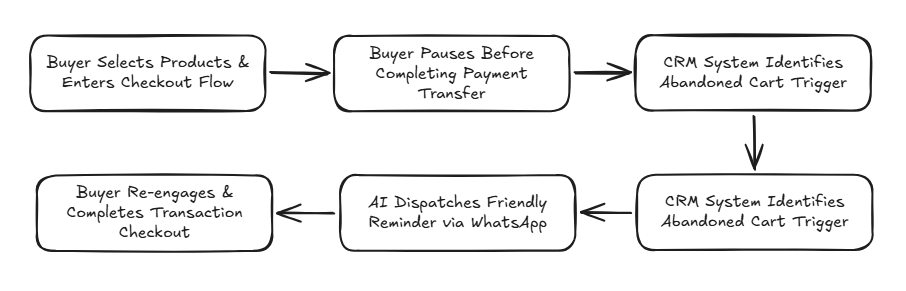
    Automated cart recovery sequence:

    ai social commerce flow

    Automated Product Recommendations in Instagram DMs

    Instagram serves as a primary visual storefront for modern consumer brands. However, lacking automated messaging integrations leaves Instagram Direct Messages (DMs) unaddressed during peak hours.

    Integrating AI-powered messaging engines allows post comments and DMs to receive instant catalog recommendations matching user intent, creating a frictionless shopping journey.

    Case Study: Online Store Increases Conversions by 35% with AI

    An Indonesian online fashion brand faced massive daily chat volumes across social channels. Prior to adopting automation, main friction points included delayed response times during peak hours and unaddressed buyer leads.

    After deploying an integrated AI messaging system across their core channels, key operational results achieved within weeks included:

    • 100% of inbound customer chats handled 24/7 with zero delay.
    • Automated payment reminders and lead follow-ups executed without manual intervention.
    • Precise sizing recommendations and catalog matching delivered automatically.
    • Sales conversion rates (closing ratios) increased by up to 35%.
    • Operational workload for support teams dropped substantially.

    Key Criteria for Selecting an AI Social Commerce Platform

    Selecting the right AI platform is vital for digital transformation success. Ensure your provider delivers these core capabilities:

    1. Multi-Channel Messaging Consolidation

    The platform must consolidate chats across primary sales channels—including official WhatsApp API, Instagram DM, TikTok Shop Chat, and Web Live Chat—inside a single unified inbox.

    2. Comprehensive Sales Automation Capabilities

    Verify that the system offers chat automation, dynamic catalog recommendations, automated re-engagement triggers, and checkout reminders out of the box.

    3. Seamless Marketplace & API Integrations

    Robust integrations with major e-commerce marketplaces and flexible connectivity via Open API ensure real-time inventory and order data synchronization.

    Start Automating Your Social Commerce Sales with Cekat.ai

    Social commerce has established itself as an essential revenue pillar in Indonesia, where direct conversational messaging drives the digital sales funnel. The primary challenge is no longer just generating traffic, but ensuring every buyer conversation is converted into completed sales.

    Powered by Cekat.ai, your business can respond to buyer inquiries instantly 24/7, deliver dynamic personalized product recommendations, and execute automated lead follow-ups consistently. Deep integrations with official WhatsApp API, Instagram, and marketplaces maximize sales conversions while minimizing operational support overhead.

    Accelerate your social commerce sales performance today with Cekat.ai.


    Frequently Asked Questions (FAQ)

    1. What is AI social commerce?

    AI social commerce is applying artificial intelligence to automate buyer communication, product recommendations, and order transactions across social media and messaging platforms like WhatsApp and Instagram.

    2. Is AI social commerce technology suitable for small businesses and MSMEs?

    Yes. MSMEs utilize AI as a 24/7 digital assistant to handle hundreds of daily routine queries automatically without expanding operational headcount.

    3. Can AI increase sales closing ratios?

    Yes. Instant response SLAs within seconds combined with automated follow-up sequences keep buyer intent active, boosting conversion rates by up to 35%.

    4. Does Cekat.ai integrate directly with the official WhatsApp Business API?

    Yes. Cekat.ai fully integrates with Meta’s official WhatsApp Business API, ensuring secure bulk messaging and automation without account suspension risks.


  • WhatsApp API Automation: Rule-Based vs AI

    WhatsApp API Automation: Rule-Based vs AI

    Key Advantages

    • Rational Hybrid Automation Framework: Unifies the deterministic reliability of rule-based logic with the conversational flexibility of modern generative AI.
    • Zero Error Tolerance on Critical Paths: Guarantees instantaneous delivery for OTPs, payment verifications, and order tracking without data hallucination risks.
    • Operational Cost Optimization: Prevents unnecessary AI computing overhead on static workflows by deploying AI exclusively where contextual reasoning is required.
    • Centralized CRM Integration: Synchronizes automation triggers directly with sales deal pipelines, customer profiles, and support ticketing queues.

    WhatsApp API automation has evolved into a vital operational pillar for modern commercial enterprises. However, many business leaders operate under the assumption that every messaging workflow must deploy artificial intelligence to be considered cutting-edge. This assumption requires objective scrutiny. In practice, not every operational task demands cognitive AI processing.

    In the domain of WhatsApp API automation, two primary methodologies exist: rule-based automation and AI-driven automation. Understanding the core technical distinctions in our guide to how the WhatsApp API differs from standard WhatsApp is an essential prerequisite before architecting your messaging stack.

    This guide provides a comprehensive comparison of both approaches, examining when AI delivers tangible commercial value and when static, rule-based logic serves as the superior, cost-effective solution.

    Understanding WhatsApp API Automation

    WhatsApp API automation refers to the programmatic orchestration of inbound and outbound messaging workflows executed via the official WhatsApp Business Platform. These automations integrate bi-directionally with internal operational stacks—including CRMs, OMS platforms, payment gateways, and support helpdesks—using webhook event listeners and workflow automation engines.

    The two foundational paradigms powering messaging automation:

    • Rule-Based Automation: Governed by deterministic, static logic (if-this-then-that conditional trees).
    • AI Automation: Powered by Natural Language Processing (NLP), semantic context comprehension, and automated intent recognition.

    Rule-Based Automation: Reliable, Deterministic, and Highly Efficient

    Rule-based automation functions according to predefined decision trees. The system processes incoming triggers or customer keywords and returns explicitly programmed outputs.

    Key Architectural Characteristics

    • Deterministic, predictable execution (if condition A occurs, immediately execute action B).
    • Triggered by discrete system events, webhook payloads, or keyword matching.
    • Operates without semantic interpretation, focusing purely on exact data patterns.

    Ideal Operational Use Cases

    • Automated tracking alerts deployed via WhatsApp API notification systems.
    • One-Time Password (OTP) dispatch and multi-factor authentication codes.
    • Payment milestone reminders and digital transaction receipts.
    • Static FAQ auto-replies for operating hours and office addresses.

    Core Benefits and Operational Limitations

    The primary strength of rule-based workflows lies in their unmatched stability, auditability, and negligible compute cost. However, their limitations are strict: they cannot parse unstructured conversational phrasing and fail immediately when customer inputs deviate from scripted options.

    AI Automation: Adaptive, Context-Aware, and Scalable

    AI automation leverages Natural Language Processing (NLP) and Large Language Models (LLMs) to interpret conversational intent dynamically, mimicking human-level communication.

    Key Architectural Characteristics

    • Autonomous intent recognition and dynamic entity extraction.
    • High tolerance for typographical errors, informal slang, and complex compound questions.
    • Retrieves dynamic answers grounded in a centralized enterprise knowledge base.

    Ideal Operational Use Cases

    • 24/7 autonomous customer inquiry resolution using WhatsApp AI chatbots.
    • Executing automated lead qualification workflows to triage high-intent buyers.
    • Consultative product discovery tailored to individual buyer constraints.
    • Generating conversational handoff summaries for human support agents.

    Benefits and Real-World Constraints

    Conversational AI creates fluid, engaging customer journeys and manages non-linear dialogue effortlessly. Nonetheless, enterprise deployment demands rigorous knowledge grounding to prevent hallucinations and incurs higher infrastructure overhead compared to simple script logic.

    When Is AI Genuinely Essential in Commercial Messaging?

    Many organizations fall prey to confirmation bias, assuming AI is universally superior for every touchpoint. Evaluate your workflows using this decision framework:

    Operational Scenario Recommended Architecture Strategic Justification
    Transactional alerts, OTPs, and payment confirmations Rule-Based Automation Requires 100% deterministic accuracy, sub-second latency, and zero tolerance for hallucination.
    Pre-sales consultation and consultative product discovery AI-Driven Automation Customer questions are varied, ambiguous, and require multi-turn contextual reasoning.
    Scheduled replenishment alerts and restock reminders Rule-Based Automation Easily executed using database schedule triggers and customer segmentation.
    Initial tier-1 customer complaint triage AI-Driven Automation Evaluates emotional sentiment before routing tickets into complaint management.

    The Hybrid Paradigm: Balancing Rule-Based Stability with AI Intelligence

    For expanding commercial enterprises, the most cost-effective architecture is a hybrid messaging ecosystem:

    • Rule-Based Foundation: Manages transactional notifications, initial queue routing, form validation, and data synchronization with your CRM application.
    • Conversational AI Layer: Handles exploratory inquiries, product recommendations, buying intent detection, and ticket summaries.
    • Human Escalation Tier: Resolves high-value negotiations and sensitive customer escalations within a collaborative WhatsApp multi-agent inbox.

    Deploying this hybrid structure actively prevents paid conversation waste as outlined in our guide on how to reduce WhatsApp API costs.

    Frequently Asked Questions (FAQ)

    1. When should a business prioritize rule-based automation over AI for WhatsApp?

    Prioritize rule-based automation for linear, repetitive workflows that require absolute data precision—such as OTP code delivery, payment receipts, order tracking updates, and appointment confirmations.

    2. What are the commercial advantages of hybrid WhatsApp automation?

    A hybrid approach optimizes operational expenditure: high-volume transactional tasks are executed at low cost via rule-based systems, while conversational AI is reserved for context-heavy customer engagements.

    3. Does AI automation on WhatsApp require CRM integration?

    Yes. Integrating conversational AI with a centralized CRM ensures customer preferences, transaction histories, and pipeline stages synchronize in real time to deliver accurate, personalized responses.

    Architect Efficient WhatsApp Automation with Cekat.ai

    High-performing WhatsApp API automation is not measured by the sheer complexity of the underlying technology, but by how effectively it eliminates operational friction and accelerates long-term customer retention.

    The enterprise platform at Cekat.ai delivers a unified infrastructure powered by Agentic AI technology and visual workflow builders, enabling your team to orchestrate rule-based and AI automation seamlessly. Explore our plan tiers on our pricing and plans page or consult directly with our growth engineering team today.