Blog

  • Multi-Agent Systems in WhatsApp API

    Multi-Agent Systems in WhatsApp API

    Executive Summary & Architectural Benefits

    • Specialized Task Division: Replaces monolithic chatbots by dividing conversational duties among dedicated, task-based AI agents.
    • Intelligent Orchestration: Employs a central controller to direct context, prevent agent overlap, and maintain ultra-low latency.
    • Higher Contextual Accuracy: Eliminates model hallucination and context overload by scoping data access to individual agent roles.
    • Seamless Human Escalation: Monitors user sentiment in real time to transfer complex cases to human support reps with full context.

    A Multi-Agent System (MAS) in WhatsApp API is an advanced AI architectural approach where multiple AI agents with specialized roles collaborate through an intelligent orchestration mechanism. This modular design is specifically engineered to overcome the inherent operational limits of single-model chatbots when managing complex, high-volume, and multi-contextual business conversations.

    Many organizations adopt the Official WhatsApp Business API under the flawed assumption that a single, generalized chatbot can manage every incoming customer interaction. While this monolithic approach seems simple on the surface, it is architecturally fragile. When one single AI model is forced to interpret intent, query knowledge bases, execute transaction APIs, evaluate sentiment, and manage human handovers simultaneously, system prompt drift and response hallucination increase exponentially.

    Multi-Agent Systems did not emerge as a passing tech trend—they developed as a direct technical response to real-world enterprise complexity. By decoupling a massive “does-everything” bot into targeted, specialized agents, businesses achieve a conversational setup that is measurably more scalable, controllable, and reliable.

    What Is a Multi-Agent System in WhatsApp API?

    A Multi-Agent System is a distributed software architecture where several autonomous AI agents work in concert rather than isolation. Under this framework, each individual agent possesses:

    • A strictly bounded operational task scope
    • A well-defined domain objective
    • Data access restricted strictly to its function (principle of least privilege)

    Within the WhatsApp Business API ecosystem, MAS separates conversational responsibilities so that each sub-system excels at a specific workflow. This contrasts fundamentally with traditional monolithic chatbots, which stack intent classification, database lookups, and business logic into a single bloated prompt context.

    Why Does the Single-Agent Approach Become an Operational Bottleneck?

    Single-agent chatbots rarely fail due to a lack of underlying model intelligence; rather, they fail because they are overburdened with competing responsibilities. Primary architectural points of failure include:

    1. Context Overload: Supplying excessive instructions and reference documents into one prompt window degrades output precision, inflates token costs, and induces hallucinations.
    2. Restricted Scalability: Introducing new business capabilities requires modifying core system prompts, risking systemic breakage instead of modular expansion.
    3. Poor Observability: When conversational errors occur, diagnosing whether the failure stemmed from intent misclassification, missing knowledge data, or flawed execution logic becomes nearly impossible.

    Multi-agent systems resolve these bottlenecks by breaking operational complexity down into independent units that can be tested, monitored, and optimized individually.

    Task-Based Agents: The Core Building Blocks of MAS

    The task-based agent principle structures each AI component as a domain specialist. Typical functional role divisions in a WhatsApp API deployment include:

    • Intent Agent: Analyzes incoming user messages in real time to categorize the primary inquiry type.
    • Knowledge Agent: Queries enterprise documentation to deliver factual answers from verified reference sources.
    • Transaction Agent: Interfaces with backend systems to process orders, payment links, booking confirmations, and account lookups.
    • Sentiment Agent: Continuously evaluates user tone to detect frustration, urgency, or dissatisfaction.
    • Human Handover Agent: Manages smooth routing to human customer support representatives alongside a structured interaction history.

    This division mirrors professional human organization: specialized roles ensure clear accountability, tighter security boundaries, and consistent output quality.

    Orchestration: The Engine Behind Multi-Agent Coordination

    Without an intelligent orchestrator, a multi-agent environment risks becoming a chaotic set of overlapping models. The orchestrator functions as the primary routing engine, responsible for:

    • Determining which specialized agent should activate based on real-time context
    • Sequencing multi-step task execution across backend endpoints
    • Maintaining and passing state context between conversational nodes
    • Enforcing fallback procedures and human escalation triggers

    In messaging environments like WhatsApp, orchestration is crucial because user interactions are synchronous and highly sensitive to latency. Customers do not see the underlying multi-agent workflows they only experience the speed and accuracy of the final reply.

    A Practical Example of a Multi-Agent Flow on WhatsApp

    1. An incoming customer message is processed instantly by the Intent Agent.
    2. The Orchestrator routes the request along the optimal execution path (e.g., FAQ retrieval, transactional lookup, or complaint escalation).
    3. The assigned Specialist Agent executes the task using its bounded knowledge or API integration.
    4. The Sentiment Agent continuously monitors the user’s emotional tone in the background.
    5. If sentiment thresholds drop or complex issues arise, the Human Handover Agent transfers the thread to live agents using an omnichannel inbox without losing context.

    While this workflow appears seamless to the user, its underlying strength lies in structural isolation: system complexity is handled internally without degrading user experience.

    Measurable Business Impact of Multi-Agent Deployments

    Deploying a structured multi-agent architecture yields clear operational benefits:

    • Consistent, Factual Responses: Dramatically reduces false information by isolating knowledge sources per task.
    • Accelerated Resolution Times: Directs inquiries to targeted processing logic instantly, reducing conversation steps.
    • Precise Human Escalations: Transfers only complex cases to human teams, improving ticket containment rates.
    • Predictable Compute Costs: Minimizes token consumption per interaction by deploying smaller, specialized prompts.
    • Enhanced Customer Satisfaction (CSAT): Delivers fast, contextual replies that closely mimic interactions with expert human specialists.

    To evaluate system health accurately, teams should measure metrics like containment rate, routing accuracy, and prompt token efficiency alongside basic response volume.

    A Balanced Perspective: When Is a Multi-Agent Setup Over-Engineering?

    Despite its architectural strengths, a Multi-Agent System is not mandatory for every use case. For organizations with low chat volumes or straightforward FAQ requirements, implementing MAS can introduce unnecessary technical overhead. Primary implementation challenges include:

    • Suboptimal orchestration logic that introduces artificial response latency
    • Complex data governance requirements across multiple system agents
    • Higher initial monitoring overhead to track inter-agent handoffs

    Architectural decisions must be guided by actual operational needs rather than technology trends alone.

    Multi-Agent Systems in WhatsApp API represent a mature evolution in enterprise conversational AI architecture. By pairing specialized task-based agents with central orchestration, organizations can manage enterprise-scale communication securely, accurately, and efficiently. The core business value lies not in technological novelty, but in the precision of an architectural design aligned directly with operational workflows.

    Build Conversational AI That Works Like a High-Performing Team

    Cekat.ai delivers a enterprise-grade multi-agent WhatsApp API solution featuring native agentic AI capabilities, intelligent orchestration, and no-code workflow builders tailored for real business operations.

    Explore how Cekat.ai can elevate your conversational sales and customer support infrastructure today.


    Frequently Asked Questions (FAQ)

    1. What is the difference between a single-agent chatbot and a Multi-Agent System (MAS)?

    A single-agent chatbot relies on one general prompt and model to process all incoming requests, leading to context overload and hallucinations. A Multi-Agent System breaks tasks down among specialized agents (such as Intent, Knowledge, or Transaction agents) managed by a central orchestrator for higher accuracy.

    2. How does orchestration work in a Multi-Agent WhatsApp API setup?

    The orchestrator acts as a traffic controller. It analyzes the user’s message, selects the appropriate specialized agent, manages data flow between agents, and ensures responses are delivered without adding noticeable latency.

    3. Can Multi-Agent Systems integrate with existing enterprise CRMs?

    Yes. Specialized Transaction and Knowledge agents can connect to external CRM platforms, inventory databases, and payment gateways via webhooks and REST APIs to fetch real-time data automatically.

    4. Does a Multi-Agent System slow down WhatsApp response speeds?

    When properly architected, MAS can actually decrease latency. By using smaller, highly targeted prompts for specific tasks instead of massive system prompts, individual agent processing times are significantly reduced.


  • AI Agent for Property Businesses: Lead Qualification and Automated Follow-Up

    AI Agent for Property Businesses: Lead Qualification and Automated Follow-Up

    In the property business, the biggest challenge isn’t just getting leads, but making sure every incoming lead is really handled quickly, in a structured way, and guided into the right sales process. Property developers and agents can receive hundreds to thousands of inquiries from digital ads, WhatsApp, Instagram, the website, property portals, and referrals. But not every prospective buyer has the same level of readiness. Some already have a budget, have decided on a location, and are ready to visit a unit. Others are still comparing prices, looking for area references, waiting for a promo, or don’t yet know which property type suits their needs.

    The problem is, when every lead is treated the same way, the sales team ends up spending too much time chasing prospective buyers who aren’t ready yet, while hot leads risk a late response. This is where a property AI agent becomes a strategic solution to help property businesses handle lead qualification and automated follow-up more effectively. Through Cekat.AI, property developers and agents can build an automated conversation system capable of understanding prospective buyers’ needs, collecting important data, prioritizing the most promising leads, and making sure every prospect keeps getting consistent follow-up.

    Why the Property Industry Needs an AI Agent for Lead Qualification

    The customer journey in a property purchase is usually long, complex, and full of consideration. Prospective buyers don’t make a decision right away just because they saw an ad for a house, apartment, shophouse, or commercial unit. They usually ask about price, location, building size, land size, payment scheme, mortgage installments, down payment promos, legal status, area facilities, transportation access, and investment potential. Every one of these questions needs a fast, accurate response, because in the property industry, momentum of interest largely determines the quality of the sales opportunity.

    Many developers and property agents still manage inquiries manually. The sales team has to read chats one by one, ask for the same basic information again, record prospective buyer data separately, and remember on their own when to follow up. A process like this easily leaks opportunities. A genuinely promising lead can get buried among other chats. A prospective buyer who just asked a question can feel ignored because the response took too long. Prospects who aren’t ready to buy yet also often disappear entirely because they never enter a consistent nurturing flow.

    A property AI agent helps solve this problem by acting as the first layer in the conversation with prospective buyers. An AI agent can welcome leads automatically, ask about their main needs, identify unit preferences, understand budget, record the target location, and guide the prospect to the next stage. With this system, the sales team no longer has to start every conversation from zero. They can go straight to focusing on leads that are already qualified, have clear needs, and show stronger buying intent.

    Automated Lead Qualification Based on Budget, Location, and Unit Type

    In property sales, basic information such as budget, location, and unit type strongly determines lead quality. A prospective buyer with a budget of Rp800 million naturally needs a different approach than a prospective buyer with a budget of Rp3 billion. A prospect looking for a family home is also different from an investor looking for a unit with capital gain or rental yield potential. The same goes for prospective buyers looking for a landed house, an apartment, a shophouse, a land plot, or a commercial unit.

    Through Cekat.AI, an AI agent can help perform automated lead qualification from the very start of the conversation. When a prospective buyer comes in from an ad or contacts via WhatsApp, an AI agent can ask about budget range, area of interest, property type being sought, purpose of purchase, estimated purchase timeline, and payment scheme preference. This information can then be used to group leads by their potential level.

    For example, a prospective buyer who already has a clear budget, wants to buy soon, and is willing to schedule a unit visit can be categorized as a hot lead. Meanwhile, a prospect who’s still gathering general information, hasn’t decided on a budget, or has no purchase timeline yet can be placed into a warm or cold lead category. With this classification, the sales team doesn’t need to guess which lead to prioritize. They can immediately see which prospects are most ready to be contacted further.

    For property developers, this system matters a great deal because lead volume from digital campaigns is often high, but quality varies widely. Without a tidy qualification process, ad spend can appear to be generating a lot of leads, but not all of them move toward site visits, booking fees, purchase intent forms, or transactions. An AI agent helps make sure every lead not only comes in, but also gets processed into data that’s more ready to act on.

    Faster, More Structured Unit Visit Scheduling

    In the property business, a site visit or unit tour is one of the most crucial moments in the sales process. A prospective buyer who’s already willing to see the show unit, sample house, cluster, or project area usually has higher intent than someone who’s only asking about price. Because of that, the visit scheduling process needs to be made as easy as possible. The more friction there is in booking a schedule, the higher the chance a prospective buyer delays their decision or moves to a competitor.

    An AI agent for property can help automate the unit visit scheduling process. Once the AI agent identifies that a prospective buyer is interested in seeing a unit, the system can offer schedule options, confirm the visit time, record the name and contact number, and then send location details or arrival instructions. If needed, the AI agent can also remind the prospective buyer before the scheduled visit.

    With a flow like this, the sales team no longer has to go back and forth manually checking time availability. Sales can also get fuller context before meeting the prospective buyer, such as the unit type they’re interested in, budget range, and main needs. The result: the conversation during the visit becomes more relevant, and the chance of closing gets stronger because sales walks in with information already in hand.

    For property agents handling many listings, an AI agent also helps filter prospective buyers based on the most suitable property. If someone is looking for a house in a certain area within a specific budget, an AI agent can help direct the conversation to the relevant listing. This makes the agent’s work more efficient because their time isn’t wasted answering repeated questions from prospects who don’t match the available listings.

    Property Buyer Follow-Up That No Longer Depends on Sales’ Memory

    Follow-up is one of the most decisive factors in property sales. Many prospective buyers don’t make a decision right after the first conversation. They may need to discuss it with a spouse, compare several locations, check their mortgage eligibility, wait for an annual bonus, or consider a specific promo. In situations like this, consistent follow-up can keep the relationship warm until the prospective buyer is ready to move to the next stage.

    But manual follow-up is often inconsistent. Sales can forget to reach back out. Conversation notes can get scattered across personal WhatsApp. Prospects who aren’t ready to buy yet often don’t get further nurturing. As a result, sales opportunities that could actually still be developed gradually end up lost simply because there’s no system maintaining the communication.

    With Cekat.AI, property buyer follow-up can be made more automated and structured. An AI agent can help send follow-up messages based on lead status, such as after a prospective buyer asks about price, after receiving a brochure, after scheduling a visit, after a site visit, or after saying they’re still considering. Follow-up messages can be tailored to the conversation’s context, making them feel more relevant rather than generic.

    For example, a prospective buyer who already asked about a 60-square-meter house type in a certain area can get a follow-up about unit availability, down payment promos, estimated installments, or an invitation to see the show unit. A prospect who’s already visited the location but hasn’t booked can get a reminder about unit benefits, area facilities, or the promo deadline. Meanwhile, cold leads who aren’t ready to buy yet can still stay in a nurturing flow with education about the location, investment potential, or tips for choosing a first property.

    Nurturing Cold Leads So They Don’t Just Disappear

    In the property industry, a cold lead doesn’t mean a worthless lead. Many prospective property buyers need months before they’re finally ready to buy. They may not have enough funds yet, are still comparing locations, or aren’t confident yet about a big decision like buying their first home. If a developer or property agent only focuses on leads that are immediately hot, a lot of long-term potential goes untapped.

    A property AI agent helps keep cold leads within the business’s communication ecosystem. Through automated nurturing, prospective buyers can periodically receive relevant information, such as price updates, limited promos, new units, construction progress, area facilities, buyer testimonials, mortgage guides, or property investment insights. With this approach, the property brand stays present in the prospective buyer’s mind without sales having to manually chase them all the time.

    Cekat.AI helps property businesses build a more segmented nurturing flow. Prospects interested in a family home can get different messages than apartment investors. Prospective buyers with a mid-range budget can receive different unit recommendations than premium buyers. With this kind of segmentation, communication becomes more personal and long-term conversion opportunities stay better protected.

    Good nurturing also helps strengthen trust. Buying property is a major decision involving a sense of security, developer credibility, location quality, and asset value prospects. When prospective buyers get consistent, educational, and relevant information, it becomes much easier for them to build confidence in the project or listing being offered.

    More Targeted Property Promo Notifications

    Promotions play a big role in driving property purchase decisions, especially when a prospective buyer is still hesitant. Low down payment promos, booking fee discounts, free mortgage processing fees, installment subsidies, furniture bonuses, or early-bird pricing can trigger a prospect to move faster. But promos sent in bulk without segmentation are often less effective because not every prospective buyer has the same needs.

    AI agent and automation from Cekat.AI help developers and property agents send promo notifications more precisely. A prospective buyer who previously searched for a unit under Rp1 billion can receive promos for units matching that budget. A prospect interested in a specific cluster can receive availability updates for units in that same cluster. A prospective buyer who once asked about mortgages can receive information about installment programs or bank partnerships.

    This way, a promo isn’t just a generic broadcast message, but communication that’s relevant to the prospective buyer’s needs. This relevance is exactly what drives a higher response rate. For property businesses, this approach also helps maintain database quality and reduces reliance on large, untargeted promotions.

    Property AI Agent ROI: Sales Focus on Hot Leads, Not All Leads

    The biggest ROI from a property AI agent lies in sales time efficiency and improved follow-up quality. In a manual process, sales has to handle every inquiry with the same intensity, from simple questions to prospects who are genuinely ready to buy. As a result, a lot of sales time gets consumed answering repetitive questions like price, location, unit type, promos, and payment schemes. Yet sales’ greatest value should really be in strategic conversations with prospective buyers who have already shown high intent.

    For example, imagine a developer receiving 1,000 leads in a month from digital ads and WhatsApp. Without an AI agent, the sales team has to sort through all of them manually. If only 20 percent of the total leads are truly promising, a lot of sales time gets spent processing 800 leads that aren’t ready to buy yet. With a property AI agent, initial steps like welcoming prospective buyers, asking about needs, gathering budget, recording target location, and identifying purchase timeline can be done automatically. The sales team can then immediately prioritize the 200 hotter leads to contact more intensively.

    This efficiency doesn’t just reduce workload — it also improves conversion chances because hot leads get attention faster. Sales can spend their time on consultation, negotiation, unit presentations, post-visit follow-up, and closing. Meanwhile, warm and cold leads still get managed through automation so they don’t fall out of the pipeline. In other words, an AI agent helps create a property sales system that’s more balanced between response speed, lead quality, and nurturing consistency.

    For management, ROI also shows up in clearer data. Developers and property agents can understand where leads come from, which unit type is most in demand, the most common budget range among prospective buyers, the most frequently searched location, and how many leads move from inquiry to site visit or booking. This data helps the business make better decisions on campaigns, pricing, promotions, and sales priorities.

    Cekat.AI as an AI Agent Solution for Property Businesses

    Cekat.AI is here to help property developers and agents build an engagement system that’s faster, more measurable, and more scalable. We understand that the property business needs more than just a chatbot. What’s needed is a system capable of managing conversations, qualifying leads, recording prospect data, automating follow-up, and helping the sales team focus on the most valuable opportunities.

    Through Cekat.AI, property businesses can manage conversations from various channels within one tidier ecosystem. An AI agent can be used to answer initial questions, gather prospective buyer information, recommend the next flow, help with visit booking, and activate automated follow-up based on lead status. With integrated CRM and automation, every conversation can be turned into actionable data, not just chats piling up in an inbox.

    For property developers, Cekat.AI helps improve lead management quality from digital campaigns. Every lead coming in from an ad can be welcomed, processed, and categorized by potential right away. For property agents, Cekat.AI helps save time answering repetitive questions and keeps prospects active through consistent follow-up. For sales teams, Cekat.AI helps them work with more focus because they don’t have to chase every lead manually.

    Ultimately, a property AI agent isn’t just about automating conversations. It’s about building a sales system that’s more responsive, more personal, and better prepared for prospective buyers’ increasingly digital behavior. When a prospective buyer contacts your business, they expect a fast response. When they show interest, they need to be guided properly. When they’re not ready to buy yet, they need to be nurtured until the timing is right. All of these processes can become more efficient with an AI agent and automation designed for the needs of the property industry.

    Start Qualifying Property Leads Automatically

    Property businesses that want to grow can no longer rely on lead volume alone. What matters more is how each lead is managed once it comes in. A lead that gets qualified quickly is easier to prioritize. A prospective buyer who receives consistent follow-up is more likely to move toward a visit. A prospect who isn’t ready to buy yet can still be nurtured through automation. And the sales team can focus on the hot leads most likely to turn into transactions.

    With Cekat.AI, property developers and agents can start building a more structured lead qualification and automated follow-up system. From a prospective buyer’s first question to unit visit scheduling, from nurturing cold leads to promo notifications, Cekat.AI helps property businesses create a more efficient and measurable sales flow.

    Start qualifying property leads automatically with Cekat.AI, and help your sales team focus on the prospects most ready to become buyers.

  • Business Automation with AI: How to Boost Efficiency & Competitiveness in 2026

    Business Automation with AI: How to Boost Efficiency & Competitiveness in 2026

    The Problem Isn’t a Lack of Hard Work

    Many businesses feel like they’re already working hard, even too hard. The team is busy, chats keep coming in, reports get done, follow-ups happen. But the results still feel stagnant.

    If we’re honest, the problem is often not the effort, but a way of working that’s still manual and inefficient.

    This is where AI business automation starts to become relevant. Not as a technology trend, but as a way to fix the work processes that have been holding back growth.

    AI Business Automation

    AI business automation is the use of artificial intelligence to run repetitive business processes independently, from customer service and sales follow-ups to performance reports and inventory management, so that human teams can focus on higher-value work.

    Many people think AI is just a chatbot. But what matters more is actually the system behind it, the system that keeps every process running even when the team isn’t active.

    Why Automation Is Becoming Important in 2026

    There’s a pattern that happens often. As a business starts to grow, owners usually add more people to keep up with the workload.

    The problem is, this doesn’t always solve anything. Sometimes it actually makes the workflow more complicated.

    AI offers a different approach. Not adding more people, but fixing the system.

    Across various implementations, a fairly consistent pattern emerges:

    • Operational costs can drop by around 30 percent

    • Customer response times can improve by up to 5 times faster

    This means the real advantage today is no longer about who has the biggest team, but who has the neatest and fastest system.

    Benefits That Are Truly Felt on the Ground

    1. Operations Become Lighter

    Small things like data entry, sending follow-ups, or making reports often seem trivial. But added up, they take a huge amount of time.

    With AI for business efficiency, tasks like these can run on their own.

    The impact is quite noticeable. Many businesses can cut operational costs by up to 30 percent without having to reduce the quality of their work.

    2. Fast Response Keeps Opportunities From Slipping Away

    It happens often: a prospective customer is already interested but doesn’t follow through simply because the reply took too long.

    AI can help here. Chats can be replied to instantly, without having to wait for an admin to be available.

    In many cases, response times become 5 times faster. And that has a direct impact on sales.

    3. The Team Can Focus on What Matters More

    If the team is too busy with administrative tasks, they don’t have time to think further ahead.

    With AI for productivity, repetitive work can be handed off. The team gets room to focus on strategy, not just execution.

    4. Decisions Are No Longer Just Guesswork

    Many business decisions are still made based on intuition. That’s not wrong, but it’s often not very accurate.

    AI helps by providing data that’s clearer and faster to read. So decisions can be more targeted.

    5 Business Processes Most Commonly Automated with AI in Indonesia

    Based on real-world use across Indonesia, there are a few areas that get automated most often because the impact is felt right away:

    1. Customer Service

    The common problem is usually the same: lots of chats, limited admins.

    AI can help answer basic questions, screen prospective customers, and make sure no chat gets missed.

    The result is responses that are much faster and more consistent.

    2. Sales Follow-Up

    Many sales fall through not because the product is bad, but because follow-ups aren’t done well.

    AI can help send reminders, even run automated follow-up flows without needing manual prompting.

    3. Lead Management

    Not all leads have the same potential. AI can help sort out which ones are more ready to be followed up on.

    This makes the sales team’s work more focused.

    4. Reports and Analysis

    When still done manually, reports are often late and lacking in detail.

    With AI, reports can be generated automatically and are easier to understand.

    5. Operations and Stock

    For businesses with physical products, stock management is often a challenge.

    AI can help predict demand so the risk of running out of stock or overstocking can be reduced.

    Common Challenges

    Not every AI implementation goes smoothly. There are a few things that often become obstacles.

    For example:

    • Legacy systems that are hard to connect

    • Expectations that are too high from the start

    • Not knowing where to start

    What’s important to understand is that AI isn’t an instant solution. The results will show if it’s implemented the right way.

    How to Get Started Without Overcomplicating It

    If you want to get started, you don’t need to go big right away.

    Just do this first:

    1. Find the process that repeats most often

    2. Pick one area to try it on

    3. Use tools that are easy to use

    4. Look at the results, then move on to other processes

    This kind of approach is much safer and more realistic.

    FAQ: AI Business Automation

    1. What is AI business automation

    It’s a way of using AI to run business processes automatically.

    2. Can small businesses use AI

    Yes. In fact, the impact is often felt even faster.

    3. What are the main benefits

    Cost efficiency, faster work, and a more focused team.

    4. Is it expensive

    These days there are many quite affordable solutions.

    5. Does AI replace humans

    No. AI helps with the work, it doesn’t replace the important role of humans.

    6. Where to start

    Usually with customer service or follow-ups, since the results are the easiest to see.

    Work Smarter, Not Harder

    In 2026, hard work alone isn’t enough. What makes the difference is how you work.

    AI business automation helps businesses run more smoothly, faster, and more ready to grow.

    With potential cost savings of around 30 percent and response speed improvements of up to 5 times, the impact isn’t just felt, it’s measurable.

    Time to Start in a More Efficient Way

    If you want to get started without having to build everything from scratch, you can use a solution that’s already ready to go.

    Cekat.ai provides an AI Agent that can be used right away to help with customer service, follow-ups, and lead management without complicated technical processes.

    In the end, the businesses that grow aren’t the busiest ones, but the ones that work most efficiently.


  • WhatsApp API Automation: Rule-Based vs AI

    WhatsApp API Automation: Rule-Based vs AI

    Key Advantages

    • Rational Hybrid Automation Framework: Unifies the deterministic reliability of rule-based logic with the conversational flexibility of modern generative AI.
    • Zero Error Tolerance on Critical Paths: Guarantees instantaneous delivery for OTPs, payment verifications, and order tracking without data hallucination risks.
    • Operational Cost Optimization: Prevents unnecessary AI computing overhead on static workflows by deploying AI exclusively where contextual reasoning is required.
    • Centralized CRM Integration: Synchronizes automation triggers directly with sales deal pipelines, customer profiles, and support ticketing queues.

    WhatsApp API automation has evolved into a vital operational pillar for modern commercial enterprises. However, many business leaders operate under the assumption that every messaging workflow must deploy artificial intelligence to be considered cutting-edge. This assumption requires objective scrutiny. In practice, not every operational task demands cognitive AI processing.

    In the domain of WhatsApp API automation, two primary methodologies exist: rule-based automation and AI-driven automation. Understanding the core technical distinctions in our guide to how the WhatsApp API differs from standard WhatsApp is an essential prerequisite before architecting your messaging stack.

    This guide provides a comprehensive comparison of both approaches, examining when AI delivers tangible commercial value and when static, rule-based logic serves as the superior, cost-effective solution.

    Understanding WhatsApp API Automation

    WhatsApp API automation refers to the programmatic orchestration of inbound and outbound messaging workflows executed via the official WhatsApp Business Platform. These automations integrate bi-directionally with internal operational stacks—including CRMs, OMS platforms, payment gateways, and support helpdesks—using webhook event listeners and workflow automation engines.

    The two foundational paradigms powering messaging automation:

    • Rule-Based Automation: Governed by deterministic, static logic (if-this-then-that conditional trees).
    • AI Automation: Powered by Natural Language Processing (NLP), semantic context comprehension, and automated intent recognition.

    Rule-Based Automation: Reliable, Deterministic, and Highly Efficient

    Rule-based automation functions according to predefined decision trees. The system processes incoming triggers or customer keywords and returns explicitly programmed outputs.

    Key Architectural Characteristics

    • Deterministic, predictable execution (if condition A occurs, immediately execute action B).
    • Triggered by discrete system events, webhook payloads, or keyword matching.
    • Operates without semantic interpretation, focusing purely on exact data patterns.

    Ideal Operational Use Cases

    • Automated tracking alerts deployed via WhatsApp API notification systems.
    • One-Time Password (OTP) dispatch and multi-factor authentication codes.
    • Payment milestone reminders and digital transaction receipts.
    • Static FAQ auto-replies for operating hours and office addresses.

    Core Benefits and Operational Limitations

    The primary strength of rule-based workflows lies in their unmatched stability, auditability, and negligible compute cost. However, their limitations are strict: they cannot parse unstructured conversational phrasing and fail immediately when customer inputs deviate from scripted options.

    AI Automation: Adaptive, Context-Aware, and Scalable

    AI automation leverages Natural Language Processing (NLP) and Large Language Models (LLMs) to interpret conversational intent dynamically, mimicking human-level communication.

    Key Architectural Characteristics

    • Autonomous intent recognition and dynamic entity extraction.
    • High tolerance for typographical errors, informal slang, and complex compound questions.
    • Retrieves dynamic answers grounded in a centralized enterprise knowledge base.

    Ideal Operational Use Cases

    • 24/7 autonomous customer inquiry resolution using WhatsApp AI chatbots.
    • Executing automated lead qualification workflows to triage high-intent buyers.
    • Consultative product discovery tailored to individual buyer constraints.
    • Generating conversational handoff summaries for human support agents.

    Benefits and Real-World Constraints

    Conversational AI creates fluid, engaging customer journeys and manages non-linear dialogue effortlessly. Nonetheless, enterprise deployment demands rigorous knowledge grounding to prevent hallucinations and incurs higher infrastructure overhead compared to simple script logic.

    When Is AI Genuinely Essential in Commercial Messaging?

    Many organizations fall prey to confirmation bias, assuming AI is universally superior for every touchpoint. Evaluate your workflows using this decision framework:

    Operational Scenario Recommended Architecture Strategic Justification
    Transactional alerts, OTPs, and payment confirmations Rule-Based Automation Requires 100% deterministic accuracy, sub-second latency, and zero tolerance for hallucination.
    Pre-sales consultation and consultative product discovery AI-Driven Automation Customer questions are varied, ambiguous, and require multi-turn contextual reasoning.
    Scheduled replenishment alerts and restock reminders Rule-Based Automation Easily executed using database schedule triggers and customer segmentation.
    Initial tier-1 customer complaint triage AI-Driven Automation Evaluates emotional sentiment before routing tickets into complaint management.

    The Hybrid Paradigm: Balancing Rule-Based Stability with AI Intelligence

    For expanding commercial enterprises, the most cost-effective architecture is a hybrid messaging ecosystem:

    • Rule-Based Foundation: Manages transactional notifications, initial queue routing, form validation, and data synchronization with your CRM application.
    • Conversational AI Layer: Handles exploratory inquiries, product recommendations, buying intent detection, and ticket summaries.
    • Human Escalation Tier: Resolves high-value negotiations and sensitive customer escalations within a collaborative WhatsApp multi-agent inbox.

    Deploying this hybrid structure actively prevents paid conversation waste as outlined in our guide on how to reduce WhatsApp API costs.

    Frequently Asked Questions (FAQ)

    1. When should a business prioritize rule-based automation over AI for WhatsApp?

    Prioritize rule-based automation for linear, repetitive workflows that require absolute data precision—such as OTP code delivery, payment receipts, order tracking updates, and appointment confirmations.

    2. What are the commercial advantages of hybrid WhatsApp automation?

    A hybrid approach optimizes operational expenditure: high-volume transactional tasks are executed at low cost via rule-based systems, while conversational AI is reserved for context-heavy customer engagements.

    3. Does AI automation on WhatsApp require CRM integration?

    Yes. Integrating conversational AI with a centralized CRM ensures customer preferences, transaction histories, and pipeline stages synchronize in real time to deliver accurate, personalized responses.

    Architect Efficient WhatsApp Automation with Cekat.ai

    High-performing WhatsApp API automation is not measured by the sheer complexity of the underlying technology, but by how effectively it eliminates operational friction and accelerates long-term customer retention.

    The enterprise platform at Cekat.ai delivers a unified infrastructure powered by Agentic AI technology and visual workflow builders, enabling your team to orchestrate rule-based and AI automation seamlessly. Explore our plan tiers on our pricing and plans page or consult directly with our growth engineering team today.

  • State of AI for Indonesian Businesses 2026: Data, Trends, and Predictions

    State of AI for Indonesian Businesses 2026: Data, Trends, and Predictions

    Key Advantages

    • Unrivaled Commercial Scale Across ASEAN: Anchored by a national digital economy exceeding USD 110 billion with domestic artificial intelligence markets projected to hit USD 4 billion.
    • Verifiable Operational Overhead Reduction: Trims customer support expenses by up to 30 percent while compressing incoming response latencies by 70 percent.
    • Frontline Commercial Capacity Acceleration: Expands representative productivity by 30 to 50 percent through automated qualification and intent telemetry.
    • Frictionless Enterprise Software Onboarding: Overcomes localized engineering talent deficits via no-code platforms connected natively to commercial messaging endpoints.

    Commercial artificial intelligence adoption across Indonesian enterprises is expanding rapidly, yet a pronounced structural division persists between strategic technology awareness and operational execution. Approximately 28 percent of domestic enterprises report deploying conversational or analytical software tools, yet merely 9 percent have integrated autonomous models into their core commercial operations. Roughly 45 percent of organizations linger in isolated pilot phases, while 27 percent have yet to introduce machine learning into their workflows. These dynamics mirror patterns examined in our industry analysis on the state of AI for business in Indonesia.

    This implementation divide represents a transformative commercial opportunity for early-moving enterprises. Organizations executing structured automation roadmaps achieve operational efficiency gains reaching 40 percent. Implementing robust ai for business software linked directly to verified communication infrastructure unlocks measurable revenue expansion. This technological foundation builds upon frameworks outlined in our guide on what is an AI agent for business.

    Core Telemetry and Market Benchmarks of Indonesian AI Adoption

    The operational landscape of digital intelligence adoption across Indonesian business sectors exhibits the following benchmarks:

    Commercial Market Indicator Empirical Market Telemetry Primary Source Authority
    Enterprise AI Adoption Rate Estimated at 28 percent of active enterprises IDC Asia Pacific AI Adoption Outlook
    Deep Core Process Integration Recorded at 9 percent of enterprise operations IDC Asia Pacific AI Adoption Outlook
    Pilot and Experimental Stage Encompasses 45 percent of organizations McKinsey Global AI Survey
    National Digital Economy Gross Value Exceeds USD 110 billion Google Temasek e-Economy SEA Report
    Projected Domestic AI Market Value Forecast to surpass USD 4 billion Statista AI Market Data
    Regional Enterprise Spending Growth Expands beyond 24 percent annually in APAC IDC AI Spending Guide

    Primary High-Impact Commercial Use Cases

    Technology deployments within domestic commercial environments focus heavily on functions that generate direct revenue impact:

    • Autonomous 24/7 Omnichannel Support: Conversational agents resolving incoming customer inquiries instantly across messaging networks.
    • Algorithmic Opportunity Scoring: Systems that evaluate buyer transaction readiness prior to routing accounts to account executives.
    • Segmented Marketing Dispatches: Personalizing promotional campaigns based on verified order histories to maintain domain reputation.
    • Unified CRM Activity Logging: Recording interaction histories directly into customer timelines through integrated workflow automation engines.

    Industry Sector Adoption Velocity Rankings

    The pace of software integration varies based on customer conversation volumes and speed-to-lead requirements:

    Industry Vertical Adoption Velocity Dominant Functional Implementation
    Fintech & Digital Banking Very High Automated fraud mitigation, credit scoring models, and client support bots.
    Digital Commerce & Retail High Predictive basket recommendations, stock checks, and chat order checkouts.
    Healthcare & Clinical Services Medium to High Automated doctor consultation bookings and patient appointment reminders.
    Real Estate & Distribution Medium Prospect budget qualification and automated purchase order confirmations.

    Structural Roadblocks to Scale and Practical Resolutions

    Gartner research reveals that over 55 percent of commercial machine learning projects fail to transition into full operational production. Addressing these systemic vulnerabilities is essential to protect enterprise capital:

    • Specialized Engineering Talent Deficits (67%): Organizations struggle to hire dedicated technical data science teams. Overcome this gap by deploying no-code SaaS workspaces that bypass manual coding requirements.
    • Misalignment with Commercial Objectives (58%): Deployments frequently stall when treated as experimental IT novelties rather than revenue tools. Focus on high-intent workflows like automated follow-up software.
    • Fragmented Operational Data Stores (54%): Customer interaction histories remain scattered across disconnected spreadsheets. Consolidating contact records inside a unified CRM is a non-negotiable prerequisite.

    Maintaining responsive communication cadences delivers immediate cost containment, reflecting benchmarks detailed in our fast response standards guide.

    Empirical Return on Investment (ROI) Metrics

    Cross-industry enterprise reporting verifies the financial impact generated by modern conversational automation:

    Operational Implementation Area Reported Performance Impact Authoritative Data Source
    Broad Operational Efficiency Productivity enhancements reaching 40 percent McKinsey Global AI Survey
    Support Service Overhead Direct operational expenditure reduction of 30 percent Gartner CX Research
    Commercial Sales Capacity Representative throughput expansion of 30 to 50 percent Salesforce State of Sales
    Inbound Response Speed Customer wait times reduced by up to 70 percent Aggregate Cekat.ai Client Telemetry
    Concurrent Inbound Capacity Expands by over 5x without adding administrative payroll Aggregate Cekat.ai Client Telemetry

    Indonesia’s Position in the ASEAN Commercial Landscape

    Within Southeast Asia, Indonesia ranks fourth in baseline enterprise artificial intelligence adoption (28 percent), behind Singapore (45 percent), Malaysia (35 percent), and Thailand (30 percent). However, Indonesia demonstrates the highest growth potential across the region, driven by a digital population surpassing 215 million users and a commercial base of over 64 million small and medium enterprises.

    A crucial distinction separates domestic commercial operations from mature regional markets: Indonesian commerce relies almost entirely on direct mobile messaging channels. Western-centric enterprise tools built around corporate email fail to capture buyer attention. Successful enterprise architectures demand native conversational processing tailored to regional languages and direct integration with official messaging APIs.

    Strategic Implementation Framework for Enterprise Scale

    Commercial leaders initiating operational transformations should execute across four disciplined phases:

    1. Target Direct-to-Revenue Touchpoints First: Automate inbound customer support and initial lead qualification cadences to establish immediate, measurable ROI.
    2. Bypass Custom Ground-Up Development: Deploy proven cloud-native software ecosystems equipped with pre-configured industry conversation models.
    3. Centralize Customer Interaction Histories: Unify inbound chat logs, quotation documents, and payment milestones into a single auditable CRM database.
    4. Foster Rep-to-Bot Collaboration: Train account executives to leverage automated intent scoring, shifting human capital entirely to negotiation and closing.

    Scale Your Enterprise Operations with Cekat.ai

    Integrating artificial intelligence to expand commercial operations no longer requires protracted development cycles or dedicated internal software engineering squads. Selecting unified, purpose-built infrastructure unlocks scalable operational productivity.

    The enterprise platform at Cekat.ai delivers commercial AI Agent solutions tailored for the Indonesian market, unifying official WhatsApp Business API integration, autonomous 24/7 customer service, and CRM deal tracking inside an intuitive workspace.

    Visit the official Cekat.ai website to evaluate our platform capabilities or book an introductory discovery consultation with our technical solutions team to accelerate your business operations today.

    Frequently Asked Questions (FAQ)

    1. What percentage of Indonesian businesses utilize AI technologies?

    IDC reporting indicates that approximately 28 percent of Indonesian enterprises leverage artificial intelligence in some operational capacity, while roughly 9 percent have integrated these technologies deeply into core workflows.

    2. Which commercial industry verticals lead AI adoption in Indonesia?

    Fintech and digital banking sectors lead adoption due to fraud prevention and automated underwriting demands, followed closely by digital commerce, modern retail, and clinical healthcare operations.

    3. What represents the primary barrier to deploying commercial AI locally?

    The three most prevalent challenges include deficits in specialized technical data talent (67%), strategic misalignment between software tools and revenue goals (58%), and fragmented internal customer records (54%).

    4. What measurable cost savings are unlocked by conversational customer care automation?

    Enterprise benchmarks show that automating customer service via AI Agents lowers operational support expenditures by up to 30 percent while compressing incoming inquiry wait times by 70 percent.

  • Customer Service Automation: How to Handle 80% of Questions Without Growing Your Team

    In many businesses, customer service problems aren’t always caused by an incompetent team. Often the issue is simpler: question volume rises, but most of the incoming questions are actually repetitive. Customers ask about order status, business hours, prices, promos, payment methods, or the same product information every day.

    On the other hand, adding more CS staff isn’t always the most efficient solution. When workload increases because of repetitive questions, businesses actually need to re-examine how their team works. Does every question really need to be answered manually by a human? Or can most of them be handled by a system that’s faster, more consistent, and always active?

    At Cekat.ai, we see customer service automation as a way to help businesses handle conversations at scale without sacrificing the quality of the customer experience. AI Agent can take over repetitive tier-1 questions, while the human team stays focused on cases that require empathy, analysis, negotiation, and decision-making.

    80% of Customer Questions Usually Don’t Need a Manual Answer

    In customer service operations, incoming questions often look numerous, but the pattern isn’t always complex. When analyzed, most questions usually revolve around the same categories. Customers want to know whether their order has shipped, whether the store is still open, which product suits their needs, how much a service costs, what promo is currently running, or how to make a payment.

    Questions like these matter, but they don’t always need human intervention from start to finish. Precisely because these questions come up so often, businesses should be able to build a system that answers them quickly and consistently.

    For example, if a business receives 1,000 chats in a week and 80% of them are repetitive questions, that means around 800 conversations could potentially be automated. If each chat takes an average of three minutes to read, answer, and log, the CS team could spend around 40 working hours just answering questions that already have a clear answer pattern.

    This number shows that the customer service bottleneck often isn’t just about headcount, but about workflow design. Without automation, the team keeps staying busy handling repetitive work. With the right automation, that same time can be redirected toward work that’s more valuable to the business.

    Repetitive Questions Don’t Mean Unimportant Questions

    One common mistake in thinking about CS automation is treating repetitive questions as minor questions. In reality, for the customer, a simple question can still shape their decision.

    A customer asking about order status wants certainty. A customer asking about price is considering a purchase. A customer asking about promos is looking for a reason to transact. A customer asking about payment methods may already be ready to buy, but needs one last bit of guidance.

    That’s why repetitive questions still need to be answered quickly, clearly, and accurately. The difference is, businesses don’t have to rely on humans to manually answer everything. AI Agent can help make sure basic questions are still handled well, even when chats come in outside business hours or when volume is high.

    With this approach, customer service automation doesn’t replace the quality of human service. Automation helps maintain speed and consistency on basic questions, so humans can show up for the moments that truly need a deeper touch.

    How CS Automation Works: AI Agent for Tier-1, Human Agent for Complex Cases

    An effective customer service automation workflow shouldn’t be built to answer everything automatically. A good system needs to know when to answer and when to hand the conversation over to a human.

    In a simple flow, AI Agent handles tier-1 questions first. When a customer asks about business hours, AI can immediately provide the relevant information. When a customer asks about payment methods, AI can send payment instructions. When a customer asks about promos, AI can explain what’s currently active. When a customer asks about order status, AI can help direct them or pull information based on available data.

    However, if a conversation starts showing more complex context, the system needs to escalate to a human. For example, when a customer files a complaint, requests a refund, asks about a problematic order, wants to negotiate something specific, or shows negative emotion. In situations like these, a human agent needs to take over because the customer doesn’t just need an answer — they need to feel heard and get the right resolution.

    This is where the escalation workflow plays an important role. AI doesn’t work alone, and humans are no longer burdened with every conversation. Both work within a more structured flow: AI handles repetitive questions, humans handle conversations that require judgment, empathy, and decision-making.

    The Impact: The CS Team Can Focus on Value-Adding Work

    When 80% of repetitive questions can be handled automatically, the impact isn’t just faster response times. The biggest impact is actually on the quality of the CS team’s work.

    The team no longer spends most of its time answering the same questions over and over. They can focus on customers who genuinely need help, improve the customer experience, resolve complaints more effectively, follow up more personally, and provide insight to the sales, product, or operations teams.

    For CS managers, automation also makes team performance easier to control. Response times can be more stable, answer quality more consistent, and conversations that need escalation can be prioritized more clearly. For business owners, this means the business can serve more customers without immediately having to grow headcount.

    Customer service efficiency doesn’t mean making service feel cold. In fact, by freeing the team from repetitive work, humans can focus more on the interactions that genuinely need human attention.

    Question Categories That Are Easiest to Automate

    The first type of question that’s easiest to automate is order status checks. Customers usually just want to know whether their order has been processed, shipped, or reached a certain stage. If the chat system is connected to order data or a CRM, AI Agent can help provide updates or direct customers to relevant information.

    The next category is business hours. This looks simple, but it comes up often, especially in retail, F&B, healthcare, education, and appointment-based businesses. With AI Agent, customers can get an immediate answer without waiting for an admin to be active.

    Product and service info is also very well suited for automation. AI can help explain features, benefits, variants, availability, or initial recommendations based on customer needs. For price and promo questions, AI can provide standardized information so that answers stay consistent across agents.

    Payment methods are also among the most frequently repeated questions. AI can send payment instructions, available methods, or next steps after a customer completes a transaction. This way, customers aren’t held up just because they’re waiting for a manual reply about basic information.

    All these categories share one thing in common: the questions come up often, the answers can be mapped out, and the risk is relatively low when handled by AI with clear guardrails.

    Why Adding More Staff Isn’t Always the Best Answer

    When customer chat volume starts to rise, many businesses’ first reaction is to add more CS staff. That makes sense if the volume of complex conversations is also increasing. But if the volume increase is dominated by repetitive questions, adding people will only increase operational costs without fixing the root problem.

    Without automation, a new team will still be answering the same questions manually. Training needs to happen all over again, answer quality needs to be monitored, and the potential for inconsistency remains. In the end, the business is just shifting the problem from a capacity shortage to a team management challenge.

    Customer service automation helps businesses build more scalable service capacity. When chat volume rises, AI Agent can handle basic questions first. A new human agent only steps in when a conversation requires a decision or special handling. This way, businesses can grow without CS costs ballooning linearly.

    Cekat.ai Helps Businesses Build Faster, More Structured CS

    Cekat.ai helps businesses connect AI Agent, omnichannel chat, CRM, human agents, and workflow automation within one ecosystem. That means customer service automation doesn’t stop at auto-reply. AI can help answer customer questions, read conversation context, update customer information, and hand off chats to the human team when needed.

    For business owners, this makes customer service easier to control without having to add separate, disconnected systems. For CS managers, Cekat.ai helps create a tidier workflow between AI and humans. Repetitive questions can be resolved faster, while complex cases still get attention from the right team.

    With a system like this, businesses don’t just become faster at replying to chats. Businesses also become more prepared to handle growing customer volume without overwhelming the team.

    Time to Turn CS from a Cost Center into Growth Support

    Customer service is often seen as an operational function whose only job is to answer questions. In reality, every customer conversation is an opportunity to build trust, speed up purchase decisions, and improve retention.

    When repetitive questions are automated, the CS team gets room to work more strategically. They can identify patterns in customer problems, see which questions come up most often, understand purchase barriers, and provide relevant input for the business.

    This is the key shift that customer service automation brings. The goal isn’t just to reduce workload, but to make the CS team more valuable. AI handles the repetitive work, humans handle the work that requires understanding, empathy, and business impact.

    If your business wants to handle more customer questions without immediately growing your team, now is the time to build a more efficient CS workflow.

    Automate your CS with Cekat.ai.

  • AI Agent for Online Stores: Automating from Order to After-Sales

    Online stores in Indonesia are in a highly competitive phase. Sales no longer depend only on appealing products, competitive prices, or lively ads. Today, buyers can come from anywhere: they see a product on Instagram, ask about it on WhatsApp, compare prices on a marketplace, check promos on a website, then come back to chat to confirm stock, shipping cost, variants, payment methods, or delivery estimates. This shopping journey looks simple from the customer’s side, but on the online store’s operational side, every conversation touchpoint is a task that must be answered quickly, neatly, and consistently.

    The problem is, the bigger the order volume, the bigger the burden on the customer service team. The same questions come in repeatedly. Admins have to check stock, send catalogs, confirm payments, update tracking numbers, respond to complaints, remind customers who haven’t checked out, and follow up with customers after they receive their items. When all these processes are still manual, online stores often experience a bottleneck at the most crucial point: conversations with customers. Yet in e-commerce, a delayed chat reply isn’t just a customer service issue. It can turn directly into a lost order.

    This is where an AI agent for online stores becomes a relevant solution. Unlike an ordinary chatbot that only answers based on templates, an AI agent can help run business workflows in a more contextual way. An AI agent can understand customer questions, provide answers based on product information, help confirm orders, send shipping updates, carry out after-sales follow-ups, and even help recover abandoned carts. In other words, an AI agent is not just an automatic chat-reply tool, but an operational layer that helps online stores manage conversations from the initial purchase interest all the way to the customer buying again.

    For Cekat.AI, the future of e-commerce isn’t just about bringing more traffic to an online store. The bigger challenge is making sure that every bit of traffic that comes in can be handled quickly, that every intent can be steered into an order, and that every customer can be managed all the way to repeat purchase. That’s why an AI agent for online store e-commerce order automation is becoming an increasingly important need for businesses that want to grow without continually adding to the manual workload of their operations team.

    Why Online Stores Need an AI Agent, Not Just Another Admin

    Many online store owners initially think that the solution to piling-up chats is to add another admin. On a small scale, this approach might feel sufficient. But as orders start to grow, sales channels multiply, campaigns run across many platforms, and customers reach the business from WhatsApp, Instagram, a website, or a marketplace, simply adding admins doesn’t always solve the root problem. New problems often emerge instead: training admins takes time, answer quality becomes inconsistent, follow-ups become unreliable, customer data gets scattered, and operational processes remain dependent on manual work.

    An AI agent works with a different logic. This system doesn’t just add response capacity, it also helps build a more scalable working structure. When a customer asks about a product, the AI agent can answer automatically. When a customer is already interested, the AI agent can help guide them into the ordering process. When an order comes in, the system can help confirm it. When the item is shipped, the customer can receive an update. When the item is received, the store can carry out after-sales follow-up. When a customer drops off before checkout, the AI agent can help remind them with a more relevant message.

    With this approach, an AI agent helps online stores reduce their dependence on manual responses for repetitive work. The CS team no longer has to spend most of their time answering the same questions, checking the same statuses, or sending follow-ups one by one. They can focus on more complex conversations, priority customers, sensitive complaints, and closing opportunities that need a human touch. With the right implementation, a CS team can handle up to 3x more orders because repetitive work is already being helped by automation and the AI agent.

    For e-commerce managers, the impact isn’t only felt in efficiency. An AI agent also helps maintain consistency in the customer experience. Customers don’t have to wait too long. Product information can be answered to the same standard every time. Follow-ups don’t depend on an admin’s memory. Customer status is easier to track. Conversation data can flow into a CRM. Ultimately, the online store has a system that is not only faster, but also more measurable.

    Use Case 1: Auto-Reply to Product Questions on WhatsApp and Instagram

    One of the biggest tasks in online store operations is answering product questions. Customers typically ask about stock, size, color, material, price, promos, shipping cost, how to order, payment methods, warranty, delivery estimates, or product recommendations that suit their needs. These questions seem simple, but when they come in large volumes every day, the burden on the CS team can increase drastically.

    With an AI agent for online stores, product questions can be answered automatically via WhatsApp and Instagram. When a customer asks a question, the AI agent can read the context of the question, match it against product information, then provide a relevant answer. For example, when a customer asks, “Hi, is size M in black still available?” the AI agent can help answer product availability if the stock data is already connected. When a customer asks, “Is this product suitable for sensitive skin?” the AI agent can provide an explanation based on product information already prepared by the brand. When a customer asks, “Is there a promo if I buy two?” the AI agent can answer according to the rules of the campaign currently running.

    Auto-reply like this is very important because e-commerce customers are often in an impulsive mode. They ask because they’re interested right then. If the response takes too long, purchase intent can drop, the customer may move to a competitor, or they may choose to buy a similar product on a marketplace instead. In the context of an online store, response speed is part of a conversion strategy. An AI agent helps make sure basic questions don’t wait too long for an admin, especially during busy hours, at night, on weekends, or when a campaign is running.

    Through Cekat.AI, online stores can manage conversations from various channels within one, more structured system. WhatsApp, Instagram, and other channels can be managed more neatly, so admins don’t have to jump between dashboards just to answer customers. The AI agent can help provide an initial response, while the CS team can still take over the conversation when needed. This combination of AI and human handoff is important so that online stores stay fast without losing service quality.

    Use Case 2: Automatic Order Confirmation for a Smoother Purchase Process

    After a customer shows purchase interest, the next stage is order confirmation. This is where many online stores start to experience operational friction. Admins have to ask for the name, phone number, address, product choice, variant, quantity, payment method, and sometimes have to reconfirm order details all over again. If this process is slow or messy, the customer may change their mind before the order is actually completed.

    An AI agent can help automate the order confirmation process more systematically. Once a customer is ready to buy, the AI agent can guide them to complete their order details. The system can ask for the required information in sequence, make sure no data is missed, then help pass the order on to the next workflow. With a more structured process, the chance of errors can be reduced. Admins don’t have to keep typing the same questions for every customer, and customers get a faster ordering experience.

    In e-commerce, the checkout experience doesn’t always happen on a website or marketplace. Many transactions still happen through chat, especially for brands that sell via WhatsApp, Instagram, or social commerce. That’s why order automation in conversations is so important for e-commerce. Chat is no longer just a place to ask questions, it has become a transaction point. If chat isn’t managed well, an online store can lose revenue at a stage that’s actually very close to closing.

    Cekat.AI helps online stores build a conversation process that’s more transaction-ready. From product questions, order detail collection, to handoff to the relevant team, everything can be made neater through workflow automation. For online store owners, this means the ordering process no longer depends entirely on how fast an admin can type. For customers, it means the shopping experience feels more responsive, clear, and to the point.

    Use Case 3: Shipping Status Updates Without Overloading the CS Team

    After a customer makes a purchase, the next questions are usually very predictable: “Has my order shipped yet?”, “Where’s the tracking number?”, “When will it arrive?”, “Why hasn’t it updated?”, or “Where is my package right now?” Shipping-related questions are one of the biggest sources of chat volume for an online store. Even though the answers are often administrative in nature, customers still need a fast response because they want certainty.

    If every shipping status update is answered manually, the CS team will spend a lot of time on repetitive work. They have to check the system, find the order number, check the tracking number, copy-paste the status, then answer each customer one by one. As order volume grows, this work can hold back responses to other conversations that have greater sales potential.

    An AI agent can help online stores provide shipping status updates more automatically. When a customer asks about their order status, the AI agent can help guide the conversation based on available order and shipping data. Customers can get information faster, while admins don’t have to handle every status question manually. This makes for a better customer experience because customers feel taken care of after making a payment, not only when the store is chasing a close.

    Shipping updates also play an important role in building trust. Many customers feel anxious after buying, especially if it’s their first time transacting with a particular online store. A fast, clear response can reduce that worry, cut down complaints, and boost the brand’s perceived professionalism. In the long run, a good after-purchase experience can influence repeat orders because customers feel the shopping process is safe and easy to track.

    With Cekat.AI, this process can become part of a broader automation flow. The conversation doesn’t stop once the customer pays. The system keeps helping the online store maintain communication until the order is received, so the customer journey feels more complete from start to finish.

    Use Case 4: After-Sales Follow-Up to Drive Repeat Purchases

    Many online stores focus too much on the first transaction, forgetting that healthier revenue often comes from repeat purchases. After an item is received, the customer is actually still in an important phase. They may need product usage guidance, want to give feedback, have follow-up questions, or have potential to buy additional products. If the brand doesn’t follow up, these opportunities often disappear just like that.

    After-sales automation helps online stores maintain relationships with customers after an order is completed. An AI agent can help send a follow-up message after the product is received, ask whether the item arrived in good condition, provide usage guidance, direct customers to contact CS if there’s an issue, or offer relevant follow-on product recommendations. For certain categories such as skincare, fashion, non-medical supplements, electronics, household items, or mother-and-baby products, after-sales is very important because the product usage experience can influence the next purchase decision.

    After-sales follow-up can also help brands gather customer insights. From customer responses, an online store can understand whether the product met expectations, whether there were shipping issues, whether packaging needs improvement, or whether the customer is interested in buying again. Data like this often goes unseen if conversations are only managed manually and never make it into a CRM system.

    Cekat.AI helps online stores turn after-sales into part of the revenue workflow, not just a customer service activity. Customers who have already purchased can be tagged, segmented, and followed up based on their status or behavior. With this approach, an online store isn’t just chasing new orders, it’s also building longer-lasting customer relationships. In an increasingly competitive e-commerce market, the ability to retain existing customers is one of the most effective ways to lower acquisition costs and increase lifetime value.

    Use Case 5: Abandoned Cart Recovery So Intent Doesn’t Get Lost Along the Way

    Abandoned cart is one of the most common problems in e-commerce. The customer was already interested, already asked questions, already chose a product, may have even reached the checkout stage, but didn’t complete the purchase. The reasons can be many: they forgot, they were unsure about shipping cost, they were still comparing prices, waiting for payday, confused about how to pay, or got distracted by something else. If not followed up, intent that was expensive to acquire through ads and content can simply disappear.

    An AI agent can help online stores automatically recover abandoned carts. When a customer hasn’t completed their order, the system can send a relevant reminder. Not just a generic message like “Hi, are you still going to order?”, but a more contextual message based on previous interactions. For example, a customer interested in a certain product can be reminded again about stock, product benefits, an ongoing promo, or a checkout deadline. With the right approach, the follow-up feels helpful rather than intrusive.

    Abandoned cart recovery is important because the cost of acquiring new customers keeps rising. If an online store has already spent budget on ads, created content, driven customers to chat, and gotten them interested, then losing the customer at the final stage is a very expensive revenue leak. An AI agent helps close this leak by making sure customers who have already shown purchase intent aren’t simply left behind.

    Through Cekat.AI, abandoned cart recovery can become part of an automated workflow connected to customer data. Online stores can build segmentation based on order status, product interest, or conversation history. That way, follow-up isn’t done randomly, but based on clearer conversion opportunities. This helps the sales and CS teams work more effectively because they know which customers need to be prioritized.

    From a WhatsApp Sales Chatbot to an AI Agent That Manages Revenue Flow

    Many businesses look for a WhatsApp chatbot for selling because they want to reply to customers faster. However, the needs of online stores have actually grown well beyond simple auto-reply. Online stores need a system that can help manage the revenue flow from the first conversation all the way through to the transaction and after-sales. This is where the difference between an ordinary chatbot and an AI agent becomes increasingly important.

    An ordinary chatbot generally works based on simple rules. If the customer types a certain word, the chatbot gives a certain answer. This model is useful for basic FAQs, but it’s often limited once the conversation becomes more complex. An AI agent has much broader capabilities because it can understand context, run workflows, help with operational processes, and work together with customer data. For online stores that want to grow, this capability is far more relevant because the challenge isn’t just answering chats, it’s making sure every chat can be steered toward a business outcome.

    Cekat.AI positions the AI agent as part of the e-commerce operating system. With an AI agent, CRM, omnichannel inbox, marketing automation, and workflow management, online stores can connect conversations with customer data and business processes. That means a customer who asks a question on WhatsApp, Instagram, or another channel doesn’t just become a chat that passes by unnoticed. They can enter a more structured pipeline, get tagged based on their needs, get followed up automatically, and get analyzed as part of revenue performance.

    This approach matters because online stores often run a lot of marketing activity but don’t always have clear visibility once a customer enters a chat. A campaign can look busy, traffic can go up, leads can pile up, but if conversations aren’t handled quickly and neatly, sales can still leak away. An AI agent helps make sure marketing activity doesn’t stop at awareness or inquiry, but continues into a more measurable conversion process.

    Operational Impact: The CS Team Can Handle 3x More Orders

    One of the biggest impacts of an AI agent for online stores is increased operational capacity. When product questions, order confirmation, shipping updates, after-sales follow-up, and abandoned cart recovery are helped by automation, the CS team no longer drowns in repetitive work. They can handle more customers without always having to add headcount at the same ratio.

    In a properly implemented scenario, a CS team can handle up to 3x more orders because most of the basic activities are already being helped by the AI agent and workflow automation. This doesn’t mean humans are no longer needed. Quite the opposite, the human role becomes more strategic. Admins and the CS team can focus on cases that need empathy, negotiation, problem-solving, or special decisions. Meanwhile, the AI agent handles the work that is high in volume, repetitive in pattern, and requires a fast response.

    This efficiency has a direct impact on cost and speed of growth. Online stores can increase their order-handling capacity without immediately having to expand the team. Response time can be more stable. Follow-ups can be more consistent. Order opportunities that used to slip through can be recovered. Customer data can be better organized. Ultimately, automation doesn’t just save time, it also helps protect revenue that used to leak away due to manual processes.

    For e-commerce managers, this is a strong reason to start viewing an AI agent not as a technology experiment, but as operational infrastructure. As chat volume rises and customer expectations move faster, online stores need a system that can keep pace with the rhythm of business growth.

    Why Cekat.AI Is Relevant for Indonesian Online Stores

    Indonesian online stores have unique characteristics. Many transactions still depend heavily on chat. Customers want to ask questions first before buying. They want fast responses, natural language, an easy ordering process, and certainty after payment. On the other hand, business owners need a system that not only helps customer service, but can also support sales, marketing, and operations.

    Cekat.AI was built for exactly these needs. As an AI agent platform for businesses, Cekat.AI helps online stores manage customer conversations faster, more centrally, and more automatically. With support from the AI agent, omnichannel inbox, CRM, workflow automation, and campaign management, Cekat.AI helps businesses connect customer conversations with the order and after-sales process.

    Through Cekat.AI, online stores can answer customer questions from WhatsApp and Instagram faster, help with the order confirmation process, manage customer status, automate follow-ups, and maintain communication after purchase. This system helps online stores reduce repetitive manual work, increase service consistency, and expand the conversion opportunity from every customer conversation.

    For online store owners, Cekat.AI helps answer practical questions: how do you serve more customers without overwhelming your team? How do you make sure no chat gets missed? How do you turn an inquiry into an order? How do you follow up with customers without doing it manually one by one? And how do you make the customer journey neater from start to after-sales?

    The answer isn’t just adding more admins, but building a smarter system. An AI agent helps online stores work faster, more consistently, and more scalably.

    An AI Agent Helps Online Stores Move from Reactive to Proactive

    In manual operations, online stores are usually reactive. The customer asks, the admin answers. The customer complains, the admin responds. The customer forgets to check out, the admin might remind them if they have time. The customer has received their item, the admin might follow up if they remember. This pattern leaves a lot of opportunity dependent on manual capacity and discipline.

    With an AI agent, an online store can move from reactive to proactive. The system can help greet customers, answer questions, guide orders, send payment reminders, provide shipping updates, ask for feedback, and carry out repeat-purchase follow-ups. Processes that used to be scattered can be organized into a clearer customer journey.

    This shift matters because e-commerce isn’t just about selling once. A healthy business needs to build a recurring relationship with its customers. An AI agent helps online stores maintain communication momentum from the discovery, consideration, purchase, delivery, and after-sales phases all the way to repeat purchase. The neater this journey is, the greater the opportunity for an online store to increase its conversion rate, repeat orders, and customer lifetime value.

    Conclusion: E-Commerce Order Automation Is No Longer an Optional Extra

    An AI agent for online stores is no longer just an add-on feature for replying to chats. In an increasingly fast-moving e-commerce competition, an AI agent is becoming an operational necessity for maintaining response speed, follow-up consistency, team efficiency, and revenue opportunity. From auto-replying to product questions on WhatsApp and Instagram, automatic order confirmation, shipping status updates, after-sales automation, to abandoned cart recovery, an AI agent helps online stores manage the sales process in a more scalable way.

    For online stores still relying on manual processes, the challenge will only grow as chat volume increases. The more campaigns run, the more customers come in, the more potential orders can be missed if not handled with the right system. On the other hand, online stores that start building automation will have an operational advantage: faster responses, a more efficient team, neater data, and a more measurable customer journey.

    Cekat.AI is here to help Indonesian online stores move into the next stage. With an AI agent, omnichannel, CRM, and automation in one platform, Cekat.AI helps businesses manage customer conversations from order to after-sales faster, more neatly, and more scalably.

    If your online store wants to serve more customers without overwhelming your CS team, now is the time to try Cekat.AI. Try Cekat.AI for your online store and start automating the process from chat, order, shipping, after-sales, all the way to repeat purchase.

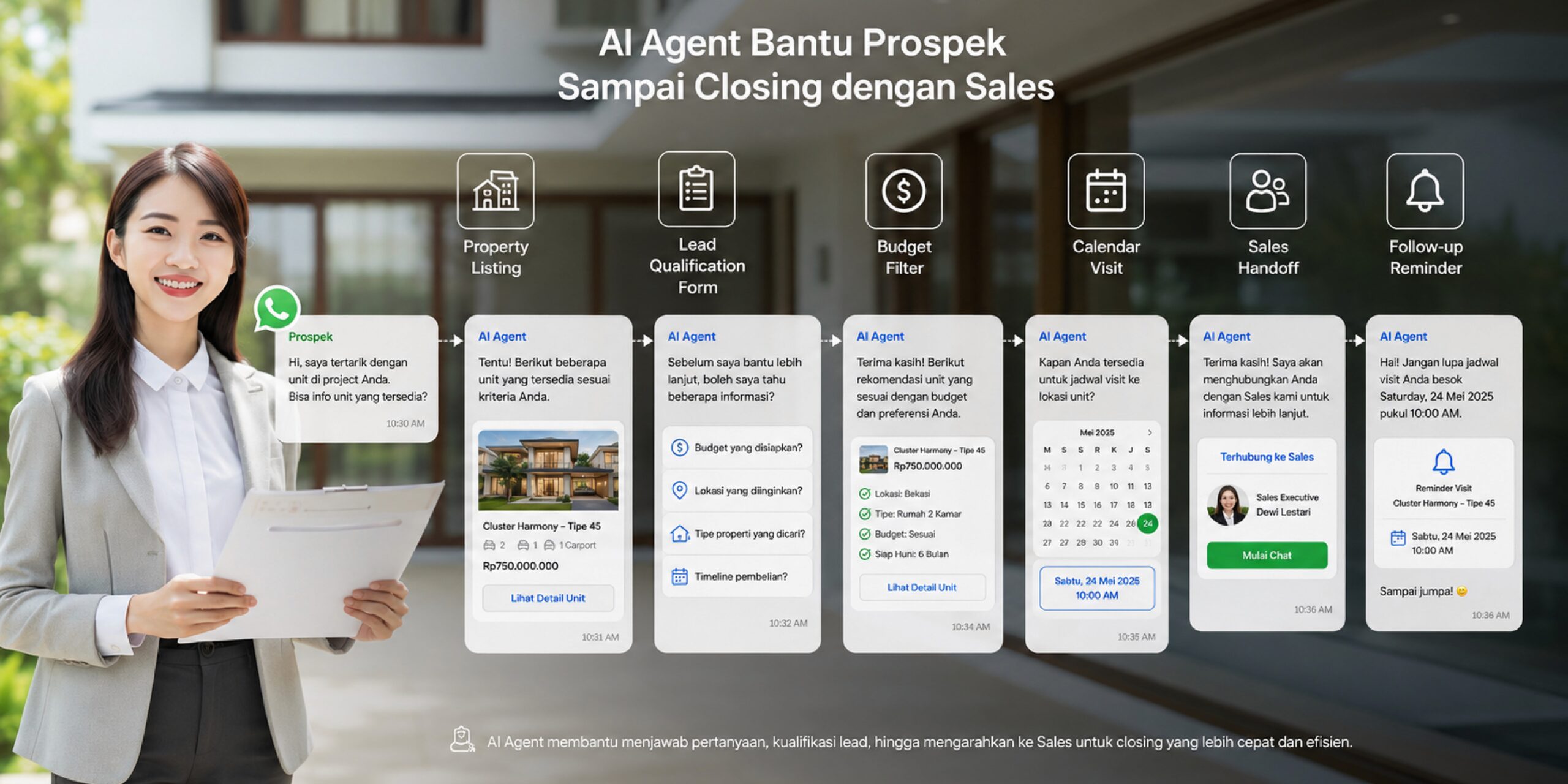
  • WhatsApp API Notification Systems for Business

    WhatsApp API Notification Systems for Business

    Key Advantages

    • Event-Driven Automated Messaging: Dispatches real-time transaction receipts, fulfillment alerts, and billing confirmations only when explicit backend milestones occur.
    • Enterprise Webhook Reliability: Enforces idempotency handling, automated retry queues, and telemetry logging to eliminate message loss or duplicate notifications.
    • Meta Category Compliance: Secures template approvals under Utility and Authentication categories, optimizing delivery speed and reducing conversation costs.
    • 98% Verified Message Open Rates: Ensures mission-critical alerts bypass legacy email spam folders and carrier-level SMS delivery delays.

    A modern WhatsApp API notification infrastructure has become an essential pillar for commercial enterprises requiring real-time, automated, and dependable communication. Relying exclusively on conventional SMS or email notifications introduces operational friction due to low engagement rates and carrier delivery latency. Understanding foundational platform boundaries in our guide on how the WhatsApp API differs from standard WhatsApp is essential before deploying notification pipelines.

    Unlike outbound promotional campaigns, WhatsApp API notification systems focus strictly on event-driven information actively anticipated by users, such as payment confirmations, fulfillment tracking, or security passcodes. This operational approach aligns directly with official Meta messaging governance while reinforcing customer trust.

    What Is an Enterprise WhatsApp API Notification System?

    A WhatsApp API notification system is an automated messaging architecture powered by the official WhatsApp Business Platform that dispatches programmatic notifications triggered by specific events inside internal business software (such as e-commerce platforms, ERPs, or payment gateways).

    Core architectural characteristics:

    • Event-Triggered Architecture: Dispatches messages automatically upon state changes without manual intervention.
    • Pre-Approved Template Standards: Operates using verified message templates categorized strictly under Utility or Authentication.
    • Deep Enterprise Stack Integration: Connects bi-directionally with billing gateways, transaction databases, and centralized CRM applications.
    • High Delivery Assurance: Tracks granular real-time delivery telemetry (sent, delivered, read, and failed statuses).

    This operational framework connects directly with our comprehensive guide to WhatsApp API transactional messages.

    Primary Enterprise Use Cases for WhatsApp API Notifications

    A well-architected notification pipeline conveys critical operational status updates across three primary workflows:

    1. Transaction & Payment Notifications (Billing Telemetry)

    Provides immediate financial clarity following customer checkouts:

    • Instant order receipts and digital invoice PDF attachments.
    • Payment status updates (successful, pending, or failed) with direct remediation links.
    • Structured invoice milestone reminders managed through payment reminder workflows.

    2. Event-Based Fulfillment & Appointment Updates

    Eliminates repetitive inquiry volume directed at customer support teams:

    • Logistics milestones: warehouse packaging, courier dispatch, and live tracking links.
    • Appointment confirmations and automated T-24h and day-of reminders.
    • Subscription renewal confirmations and account status updates.

    3. Authentication & Security Alerts

    Safeguards user account integrity with sub-second delivery speed:

    • One-Time Passwords (OTPs) for registration, login, and multi-factor authentication.
    • High-value transaction authorization passcodes.
    • Security alerts regarding unrecognized device logins or password reset requests.

    Notification Channel Comparison: WhatsApp API vs SMS vs Email

    Performance Dimension WhatsApp API Notifications Transactional SMS Transactional Email
    Open Rate Telemetry Averages 98% (Opened within 3 minutes of delivery). Averages 50% – 60% (Frequently flagged by carrier filters). Averages 15% – 25% (Vulnerable to spam/promotions tabs).
    Delivery Latency Sub-second delivery over Meta global cloud infrastructure. Variable latency during telecom network congestion. Subject to Mail Transfer Agent (MTA) queue delays.
    Sender Credibility Verified green-badged profile displaying official business branding. Unverified numeric shortcodes vulnerable to phishing suspicion. Company domain name (Subject to spoofing risks).
    Message Interactivity Supports interactive Quick Reply buttons and dynamic URL links. Static unformatted plain text. Rich HTML formatting requiring external email client software.

    Event Trigger Architecture: The Engine of Automated Messaging

    The operational effectiveness of an automated notification system depends entirely on its event trigger architecture. An event trigger represents an explicit logical condition that executes an API request automatically when an internal system state updates.

    Internal Backend Event Meta Template Category Dynamic Payload Parameters
    payment.status = "SUCCESS" Utility Amount paid, invoice reference number, and receipt download URL.
    shipment.status = "OUT_FOR_DELIVERY" Utility Courier agent name, estimated delivery time, and tracking link.
    user.auth = "REQUEST_OTP" Authentication Encrypted 6-digit passcode with native Copy Code CTA button.
    appointment.schedule = "T-24H" Utility Service time, practitioner name, and interactive confirmation buttons.

    Structuring clean event parameters prevents message fatigue and protects phone number quality ratings. Review category rate structures in our guide to WhatsApp API conversation categories.

    Webhook Infrastructure and Delivery Assurance Protocols

    Achieving enterprise-grade delivery reliability requires implementing resilient bi-directional webhook protocols between internal databases and WhatsApp API endpoints:

    • Idempotency Enforcement: Assigns a unique idempotency key to each transaction event, ensuring duplicate webhook payloads from payment gateways never trigger duplicate notifications to the customer.
    • Exponential Backoff Retry Queues: Implements automated retry algorithms if destination devices are temporarily offline or outside coverage areas.
    • Status Callback Telemetry: Tracks granular webhook receipt statuses (sent, delivered, read, and failed) to guarantee SLA compliance.
    • Queue Segregation: Isolates time-critical OTP traffic from standard fulfillment updates to ensure authentication codes arrive in sub-seconds.

    Cost Optimization Strategies for Notification Workflows

    Scaling notification volume predictably requires disciplined expenditure governance:

    • Preserve Pure Utility Classification: Ensure notification templates remain completely free of promotional upselling copy to avoid reclassification into higher-cost Marketing conversation tiers.
    • Maximize 24-Hour Active Windows: Group related fulfillment updates within open 24-hour conversational sessions to avoid opening redundant paid windows.
    • Enforce Departmental Budget Telemetry: Track notification spending trends using frameworks from our guide on how to control WhatsApp API costs.
    • Synchronize Notification Logs to CRM: Log all dispatched alerts inside a central CRM application so support agents in a WhatsApp multi-agent workspace have complete context when handling inquiries.

    Scale Automated Notifications with Cekat.ai

    Engineering custom notification pipelines from scratch requires extensive developer bandwidth. The platform at Cekat.ai delivers enterprise-grade WhatsApp Business API connectivity equipped with resilient webhook infrastructure, automated template validation, and visual workflow automation engines.

    Powered by intelligent WhatsApp AI chatbots and Agentic AI technology, Cekat.ai handles subsequent customer responses to notifications autonomously, delivering exceptional customer care that strengthens long-term customer retention.

    Frequently Asked Questions (FAQ)

    1. What is the difference between a WhatsApp API notification and a WhatsApp marketing broadcast?

    A WhatsApp API notification is an automated event-triggered alert sent to individual users regarding specific transaction milestones under Utility/Authentication categories. A WhatsApp marketing broadcast is a mass promotional campaign dispatched simultaneously to an audience cohort under the Marketing category.

    2. How do you prevent duplicate notification delivery across messaging pipelines?

    Implement idempotency keys on backend webhooks. Each system event carries a unique identifier, ensuring backend engines execute only a single API call per event even if multiple webhook pings are received.

    3. Why did Meta reject my billing notification template submitted under Utility?

    Meta algorithms reject Utility templates if the body copy contains promotional wording, upselling recommendations, discount codes, or links to new product storefronts.

    4. Does a WhatsApp notification deliver if the recipient device is offline?

    Yes. Meta cloud servers retain the message in a secure queue and deliver it to the recipient handset immediately once the device reconnects to an active network.

    Deploy Scalable WhatsApp API Notifications with Cekat.ai

    Delivering fast, accurate, and dependable operational notifications is the cornerstone of modern customer trust. A resilient notification architecture ensures transaction updates reach your customers instantly and securely.

    The enterprise platform at Cekat.ai delivers conversational commerce infrastructure combining official WhatsApp Business API connectivity, enterprise webhook architecture, 24/7 AI Agents, and real-time delivery telemetry. Explore our subscription tiers on our pricing and plans page or schedule a discovery consultation with our technical solutions team today.

  • No-Code Workflow Automation: How to Set Up a Business AI Agent Without an IT Team

    Many business owners already know AI can help speed up customer responses, tidy up follow-ups, and reduce their team’s manual work. The problem is, not every business has an internal IT team. Even for SMEs, building an automation system often sounds like something complicated, expensive, and only doable by large companies.

    In reality, setting up a business AI Agent without an IT team is now far more achievable. With no-code workflow automation, business owners can build automated workflows without writing a single line of code. As long as they understand the business process they want to streamline, AI automation can be built starting from something simple: incoming messages, automatic replies, customer data updates, all the way to escalation to a human team when needed.

    At Cekat.ai, we believe good automation isn’t just about making a business look sophisticated. Good automation should help a business respond faster, work more tidily, and still keep the customer experience personal.

    Why Non-Technical Businesses Need No-Code AI Automation

    For many businesses, the biggest bottleneck isn’t always in strategy. It’s often in the operational work that repeats every day. The team has to answer the same questions, log customer data manually, move lead statuses, remember follow-ups, or forward chats to the right person.

    When chat volume is still low, everything feels manageable. But once a campaign kicks in, ads start ramping up, or customers come in from many channels, the manual process falls apart quickly. Chats get replied to late, leads go unlogged, customers don’t get followed up, and sales opportunities slip away just like that.

    This is where no-code AI automation helps. Business owners don’t need to understand programming languages to start building a workflow. What’s needed is a simple understanding of the business flow: when a process starts, what the system should do, and under what conditions a conversation needs to be handed off to a human.

    No-Code, Low-Code, and Pro-Code: What’s the Difference?

    Before setting up automation, it’s important to understand the difference between no-code, low-code, and pro-code. No-code is the most beginner-friendly approach for non-technical users. Workflows are usually built through a visual interface like drag-and-drop, templates, or selection-based settings. It suits business owners, admins, sales leads, or operations teams who want to build automation without waiting on an IT team.

    Low-code still requires a bit of technical understanding. It’s typically used when a business wants to build a more complex flow, such as a custom integration, more detailed logic, or a system adjustment not available in a template. Low-code suits teams with light technical support who still want faster development than building from scratch.

    Pro-code, meanwhile, is the full development approach. Every system is built with code by a developer or engineering team. This approach fits companies with very complex needs, specific internal systems, or enterprise integrations that require full control.

    For SMEs and non-technical business owners, no-code is usually the most realistic starting point. Not just because it’s the simplest, but because it’s the fastest to test. A business can start with a small workflow, see its impact, and then grow the automation step by step.

    An Example of a Simple Business AI Agent Workflow

    Imagine a prospective customer sends a message to a business WhatsApp number. In a manual system, the admin has to read the chat, answer the question, log the customer’s data in the CRM, then decide whether the chat needs to be forwarded to sales or not.

    With no-code workflow automation, this process can be made automatic. The trigger is an incoming message from a customer. Once the message is received, AI Agent can give an initial reply based on the context of the question. At the same time, the system can update the customer’s data in the CRM, for example marking the customer as a new lead or filling in an inquiry category.

    The workflow can then be given a condition. If the customer mentions a certain keyword like “price,” “demo,” “booking,” or “complaint,” the system will run a follow-up action. For simple questions, AI can keep handling the conversation. But if the customer shows high intent or needs special help, the conversation can be escalated straight to a human agent.

    The simple flow looks like this: an incoming message becomes the trigger, AI replying and updating the CRM becomes the action, and the customer’s keyword or intent becomes the condition that determines whether the conversation stays with AI or gets handed to a human.

    How to Set Up a Business AI Agent Without Coding

    The first step in setting up an AI Agent is defining the goal of the automation. Don’t start with the question “what can the features do?” — start with the business problem you want to solve. Does the business want to reply to chats faster? Reduce repetitive questions? Log leads more neatly? Or make sure customers who are ready to buy get forwarded straight to sales?

    Once the goal is clear, the next step is choosing a trigger. In a chat-based business context, the most common trigger is an incoming message from a customer. This trigger signals that the workflow needs to start running. For example, every time a new message comes in from WhatsApp, Instagram, or another connected channel, the system immediately activates the AI Agent.

    After the trigger is set, the business needs to configure the action. An action is what the system does after the trigger occurs. In a simple workflow, an action can be AI replying to the customer’s message, asking about their needs, sending product information, or logging the conversation data to the CRM. A good action should help the customer move to the next stage, not just deliver a generic answer.

    After that, the business can add a condition. A condition helps the system make decisions based on the content of the conversation. If the customer asks about price, AI can send package information. If the customer wants a consultation, the system can tag them as a hot lead. If the customer files a complaint, the conversation can be forwarded straight to the support team. With conditions, the workflow becomes smarter because not every chat is treated the same way.

    The final step is testing. Try sending a few sample messages like a real customer would. Check whether AI replies with the right context, whether the data lands in the CRM, and whether escalation to a human happens as expected. From here, the workflow can be refined step by step until it fits how the business actually operates.

    A Visual Workflow Builder Makes Automation Easier to Understand

    One reason no-code AI automation is easier for non-technical teams to use is that the flow can be seen visually. Business owners don’t need to imagine an abstract system. Every process can be seen as a series of steps: starting from trigger, action, condition, all the way to the outcome.

    In a visual workflow builder, a business can see how an incoming message is processed by AI, how customer data gets updated, and when a chat needs to be handed to a human. A view like this makes automation easier to audit. If a flow isn’t working right, the team can see exactly which part needs fixing.

    For tutorial purposes, a mockup screenshot could show three main sections. First, the trigger view “Incoming WhatsApp Message.” Second, the action view “AI Agent Replies and Updates CRM.” Third, the condition view “If Keyword Contains Complaint, Escalate to Human Agent.” If made into a video tutorial format, the flow could be shown from the initial setup all the way to the workflow being successfully tested with sample customer chats.

    This visual approach matters because many business owners actually understand their business process well, but aren’t familiar with technical terms. With an easy-to-read workflow builder, automation no longer feels like a developer’s job — it feels more like putting together a digital SOP that can run automatically.

    Why Cekat.ai Is a Good Fit for Your First AI Automation Setup

    Cekat.ai is designed to help businesses build AI automation straight from customer conversations. That means automation doesn’t stand alone as a system separate from the business’s daily activities. AI Agent, omnichannel chat, CRM, human agents, and workflow automation can all connect within one ecosystem.

    For non-technical business owners, this matters because setting up AI isn’t just about building a chatbot that can answer questions. AI needs to be able to support the business process end-to-end. When a customer asks something, the system needs to understand the context. When a customer shows buying interest, the data needs to land in the CRM. When a customer needs further help, the human team needs to be able to take over with a clear conversation history.

    With Cekat.ai, a business can start from a simple workflow without coding, then grow the automation as needed. Today it might start with auto-reply and CRM updates. Next it can be expanded with customer segmentation, automatic follow-ups, more personal broadcasts, all the way to reporting to track conversation performance and revenue.

    This is what makes no-code workflow automation a practical step for businesses that want to start using AI without having to build a system from scratch.

    Start With a Small Workflow, Then Scale

    A common mistake when businesses start using automation is wanting to automate everything all at once. In reality, the safest approach is to start with one clear, impactful process. For example, replying to a customer’s first chat, logging a new lead, or escalating a complaint to the right team.

    Once the first workflow is running, the business can start looking at the results. Are responses faster? Are leads logged more neatly? Is it easier for the team to handle important conversations? From that data, automation can be developed in a more targeted way.

    No-code workflow automation doesn’t mean every process has to be perfect from day one. Its real strength lies in the speed to try, fix, and grow the workflow based on real needs on the ground.

    Set Up Your First AI in 30 Minutes at Cekat.ai

    AI automation doesn’t have to start with a big IT team, a complex system, or a lengthy development process. With no-code workflow automation, non-technical business owners can start setting up a business AI Agent without coding, straight from the process closest to customers: the chats that come in every day.

    Starting from an incoming-message trigger, an action of AI reply and CRM update, all the way to a condition for escalation to a human, everything can be designed as a practical, easy-to-understand workflow.

    If your business wants to respond to customers faster, tidy up your follow-up process, and reduce your team’s manual work, now is the right time to start.

    Set up your first AI in 30 minutes at Cekat.ai.

  • AI Agent Trends for Business in Indonesia 2026: What You Need to Prepare

    AI Agent Trends for Business in Indonesia 2026: What You Need to Prepare

    In recent years, businesses in Indonesia have been moving through very fast change. Customers are increasingly used to discovering products on TikTok, asking questions via WhatsApp, comparing prices on a marketplace, checking social proof on Instagram, then coming back to a website or admin chat before finally buying. The customer journey no longer runs in a straight line from awareness to transaction. It jumps between channels, is often interrupted, and becomes harder to control if a business still relies on manual systems.

    This is where the 2026 Indonesia business AI agent trend becomes increasingly important. An AI agent is no longer just an add-on technology for answering customer questions. It is becoming a new operational layer that helps businesses capture intent, read conversation context, run follow-ups, connect customer data, and push the process from chat to transaction faster. For Cekat.AI, 2026 isn’t just the year businesses start “trying out AI” — it’s the year businesses need to start restructuring how they serve, sell, and manage customer relationships with the help of an AI agent.

    This shift isn’t happening just because AI technology is being talked about a lot. It’s happening because business needs have become more concrete. Customer acquisition costs are rising, marketplace competition is getting denser, customers are more selective, and operations teams are increasingly overwhelmed handling conversations across many channels. If every inquiry still has to be read manually, every follow-up still depends on an admin’s memory, and every piece of customer data is still scattered across many places, then the business will keep losing revenue opportunities after a customer shows interest.

    From Chatbot to AI Agent: The Major Shift Businesses Need to Understand

    Until now, many businesses have known conversation automation through chatbots. However, traditional chatbots generally only work based on simple rules. When the customer asks A, the system answers B. If the customer steps outside the predefined flow, the chatbot often fails to understand the context and ends up still needing a human admin to take over the conversation.

    An AI agent goes much further than that. An AI agent is designed to understand intent, read context, make decisions based on a given workflow, and carry out actions that are more relevant to business needs. In the context of Indonesian businesses, an AI agent can help answer product questions, qualify leads, direct customers to the right admin, remind about follow-ups, update customer status in a CRM, and even help move the customer journey from inquiry to invoice.

    The most important difference isn’t just the ability to answer, but the ability to act. A chatbot helps a business respond. An AI agent helps a business run a process. This is why the future of the business AI agent will move increasingly close to revenue, not just customer service. Businesses no longer just need tools that can answer customer questions, but a system that can make sure every opportunity from a customer doesn’t stall halfway through.

    At Cekat.AI, we see the AI agent as part of the revenue operating layer. That means the AI agent doesn’t stand alone as a conversation feature — it’s connected to the omnichannel inbox, CRM, automation, campaign management, and customer data. This way, a business doesn’t just respond faster, it also turns every customer interaction into data, insight, and a more measurable revenue opportunity.

    Trend One: Multi-Modal AI Agents Will Make the Customer Experience More Natural

    The 2026 Indonesia AI trend will be increasingly shaped by the development of multi-modal AI. That means AI won’t just understand text, it will increasingly be able to read various forms of input such as images, documents, voice, product catalogs, proof of payment, screenshots, and other visual context that often comes up in everyday customer conversations.

    For Indonesian businesses, this is highly relevant because customer interactions aren’t always neat. Customers often send photos of the product they’re looking for, screenshots of ads, transfer receipts, images of item sizes, voice notes, or short questions that require interpreting context. In a manual process, an admin has to read each one, understand what the customer means, check the data, then give the appropriate answer. As chat volume rises, this process becomes slow and error-prone.

    Multi-modal AI agents will open up a new way of managing the customer experience. Imagine a customer sends a screenshot of a product from a marketplace, then the AI agent helps recognize the context of their question. A customer sends proof of payment, then the system helps guide the verification process. A customer sends an image of the item they’re looking for, then the AI agent helps the admin understand the customer’s need before the conversation continues. All of this will make business conversations feel more natural, faster, and closer to how Indonesian customers actually communicate.

    However, businesses can’t jump straight into multi-modal AI without preparation. The key is tidy product data, a clear catalog, documented conversation SOPs, and a workflow that can be connected to the operational system. AI agents will get smarter, but the quality of their output still depends on the quality of context the business provides. That’s why preparing for 2026 isn’t just about choosing AI technology, it’s also about tidying up the operational foundation that will fuel that AI.

    Trend Two: Agentic AI Workflows Will Change the Way Teams Work

    One of the biggest trends in the future of the business AI agent is the rise of agentic AI workflows. This is an approach where AI doesn’t just help with one small task, but takes part in orchestrating a longer chain of work. In business, a workflow like this can cover capturing a lead, understanding customer needs, giving an initial response, building segmentation, sending follow-ups, routing to sales, logging status in a CRM, and helping the team see the progress of the customer journey.

    For Indonesian businesses, agentic AI workflows will be very important because many sales and customer service processes still depend on manual work. Admins have to open many tabs, sales has to check conversation history, marketing has to ask other teams about lead quality, and owners have to wait for manual reports to understand business performance. As a result, decisions become slow and customer opportunities can be missed.

    Agentic AI workflows let businesses build a more consistent process. When a lead comes in from an ad, the AI agent can help provide an initial response. When a customer shows interest, the system can help tag their intent. When a customer hasn’t bought yet, automation can run a follow-up. When a customer is ready to transact, the sales team can step in at the right moment. When the conversation ends, the data stays stored in the CRM so the business doesn’t lose context.

    This doesn’t mean humans are no longer needed. Quite the opposite — humans will focus even more on decisions that require empathy, strategy, negotiation, and problem-solving. The AI agent takes over the repetitive and administrative work that has been eating up the team’s time. This lets businesses increase their service capacity without having to keep adding admins in a linear way.

    Trend Three: AI for MSMEs Will Move from Experiment to Operational Necessity

    In Indonesia, discussions about AI often sound like it’s technology for big companies. Yet by 2026, AI for MSMEs will actually become one of the most important areas. MSMEs face very real pressures: small teams, limited budgets, many sales channels, customers who want fast responses, and increasingly tight price competition. Under these conditions, an AI agent can become operational leverage that helps MSMEs work faster and more neatly.

    For MSMEs, the challenge isn’t always a lack of customers. Often the problem is that customers are already coming in, but aren’t being handled well. Chats come in on WhatsApp but take a long time to be answered. Customers ask questions on Instagram but it’s never logged. Leads come in from ads but aren’t followed up promptly. Past buyers are never reactivated. Customer data is only stored in chat history and never turned into segmentation or insight.

    An AI agent helps MSMEs close that gap. With an AI agent, a small business can have a more consistent response system, a more disciplined follow-up workflow, and a more structured customer database. MSMEs don’t have to build a complex system right away. They can start from the most basic needs: responding to questions faster, managing customers from one dashboard, logging customer data, and automating simple follow-ups.

    Cekat.AI believes the future of the business AI agent in Indonesia shouldn’t be exclusive to big companies. In fact, small and medium businesses need technology that’s practical, easy to adopt, and whose impact on daily operations is felt immediately. That’s why an AI agent platform that’s relevant for Indonesia has to understand how local businesses work: close to WhatsApp, comfortable with marketplaces, dependent on admins, and in need of a system that can help right away without an overly heavy implementation process.

    Trend Four: Integration with Indonesian Marketplaces Will Become Increasingly Important

    Marketplaces are still one of the main transaction hubs for many Indonesian businesses. However, more and more businesses are starting to realize that relying entirely on marketplaces carries risk. Platform fees can rise, price competition is getting more aggressive, customer relationships are hard to fully own, and customer data often isn’t consolidated with other channels.

    That’s why AI agent integration with Indonesian marketplaces will be one of the important trends in 2026. It’s not enough for a business to just be present on a marketplace. Businesses need to connect marketplace activity with other communication channels like WhatsApp, Instagram, a website, and a CRM. The goal isn’t to replace the marketplace, but to make the customer journey more connected.

    For example, a customer finds a product on a marketplace but asks further questions via WhatsApp. A customer sees a promo on Instagram then compares prices on a marketplace. A customer buys once on a marketplace, then needs to be directed into a repeat-order program through a more personal channel. Without data and workflow integration, all these interactions look like separate activities. Yet for the customer, it’s all one experience with the same brand.

    An AI agent can help businesses maintain that continuity. When conversations from various channels flow into one system, a business can understand the customer more completely. An AI agent can help read intent, log needs, and make sure follow-up keeps happening. This way, a business isn’t just chasing a one-time transaction, it starts building a longer relationship with the customer.

    For brand owners, this is highly strategic. 2026 will demand that businesses not only sell on platforms, but also build their own customer assets. Data, conversation history, segmentation, and follow-up workflows will become important assets for protecting margin, increasing repeat purchases, and reducing dependence on paid acquisition.

    Trend Five: Indonesian Conversational Commerce Will Move Even Closer to Revenue

    Indonesian conversational commerce will become one of the most visible faces of AI agent use. Indonesian customers are already very used to communicating with brands through chat. They ask about stock, price, size, promos, location, schedule, booking, payment, and even shipping through conversation. Chat is no longer a supporting channel. Chat is part of the buying process.

    The problem is, many businesses still treat chat as an ordinary customer service activity. Yet every chat can be a signal of intent. When a customer asks “is it still available?”, “can it be shipped today?”, “how much is it?”, or “is there a promo if I take two?”, the customer is actually showing purchase interest. If the response is slow or follow-up is inconsistent, the business loses momentum.

    By 2026, the businesses that stand out will be the ones able to turn conversation into conversion. That means a conversation shouldn’t stop at just Q&A. It needs to be steered into a clear process: understanding the customer’s need, giving a relevant recommendation, guiding them to the transaction, logging status, and following up if the customer hasn’t bought yet.

    An AI agent will be an important engine in conversational commerce because it can maintain speed and consistency across many conversations at once. Not just to answer FAQs, but to make sure every customer intent is processed properly. For Cekat.AI, this is the major shift Indonesian businesses need to understand: chat isn’t just a communication channel, it’s a revenue touchpoint.

    Indonesian Businesses Must Start Preparing Data, Workflow, and Governance

    Following the 2026 Indonesia business AI agent trend isn’t enough by just buying AI tools. Businesses need to prepare their internal foundation so the AI agent can work effectively. The first foundation is data. Businesses need to start tidying up product information, FAQs, catalogs, prices, promos, shipping policies, refund policies, customer segmentation, and interaction history. The tidier the data, the better the AI agent will be at giving responses and running workflows.

    The second foundation is workflow. Many businesses want automation, but haven’t clearly defined their workflow yet. Who handles a new lead? When should a customer be followed up? When should the conversation be handed off to a human admin? What are the indicators of a hot customer? What status needs to be logged in the CRM? What response templates fit the brand? These questions need to be answered before the AI agent can deliver maximum impact.

    The third foundation is governance. As AI starts getting involved in customer conversations, businesses need to make sure there are clear boundaries, controls, permissions, and handoff mechanisms. An AI agent shouldn’t be left to work without direction. AI needs to be placed within a system that’s safe, measurable, and can be monitored. This is especially important for businesses handling customer data, transactions, financial services, healthcare, education, or other industries that require higher communication and security standards.

    The fourth foundation is team mindset. An AI agent isn’t a threat to the customer service, sales, or marketing team. An AI agent is a support system that helps the team work with more focus. The team still needs to understand the product, read the customer’s situation, make decisions, and build relationships. But repetitive work like answering the same questions, logging status, sending follow-ups, and sorting conversations can be helped by the system.

    What Should Businesses Do Starting Now?

    Preparation for 2026 should start with a simple audit of the customer journey. Businesses need to look at where customers come in most often, where conversations pile up most often, where follow-up gets missed most often, and where customer data gets lost most often. From there, a business can determine which process would give the fastest impact if helped by an AI agent.

    If the main problem is slow response, the first priority is an AI agent for customer inquiries and FAQs. If the main problem is leads not being followed up, the priority is automation and CRM. If the main problem is too many channels, the priority is an omnichannel inbox. If the main problem is campaigns that can’t be tied to revenue, the business needs to start connecting campaigns, conversations, and customer data in one system.

    Businesses also need to start building conversation standards. A good AI agent needs to understand brand tone, how to answer customers, information boundaries, and when to hand the conversation off to a human. With clear standards, an AI agent doesn’t just work fast, it also keeps maintaining customer experience quality.

    Just as important, businesses need to choose a platform that fits the reality of the Indonesian market. An AI agent platform for Indonesian businesses needs to be close to the channels customers actually use, especially WhatsApp and social commerce. That platform also needs to be able to connect with the CRM, automation, omnichannel, and workflow that support the revenue process. Without this integration, AI will just become an add-on feature, not a system that truly helps business growth.

    Cekat.AI Is Ready to Help Indonesian Businesses Face the 2026 AI Agent Era

    Cekat.AI is here to help Indonesian businesses build an AI agent foundation that’s better prepared for the future. We don’t see the AI agent as just a smart chatbot, but as part of a system that helps businesses manage conversations, customer data, follow-up, automation, and revenue workflow in one platform.

    Through Cekat Chat, businesses can respond to customers faster, more naturally, and more contextually. Through Cekat CRM, every customer interaction can be logged, grouped, and turned into more actionable insight. Through Cekat Automation, businesses can keep follow-up consistent without relying entirely on manual work. Through Cekat Omnichannel, conversations from various channels can be managed more centrally. Through Cekat Marketing, businesses can see a clearer link between campaigns, conversations, and revenue.

    This is what Indonesian businesses will increasingly need in 2026. Not just AI that can answer. Not just a dashboard that looks neat. But a platform that helps businesses capture customer intent, maintain conversation momentum, and turn interactions into more measurable growth opportunities.

    The AI Agent Is No Longer a Technology Trend, But Growth Infrastructure for Business

    The 2026 Indonesia business AI agent trend points to one very clear thing: a business that’s ready isn’t just a business that uses AI, but a business that can integrate AI into the way it works. AI agents will become increasingly multi-modal, increasingly agentic, increasingly relevant for MSMEs, increasingly connected to marketplaces, and increasingly important in conversational commerce.

    However, the biggest value from an AI agent doesn’t come from the technology itself. The biggest value comes when a business has tidy data, a clear workflow, connected channels, and a team ready to work alongside AI. Businesses that prepare this foundation early will have an advantage that’s hard to catch up to: faster responses, more consistent follow-up, stronger customer relationships, and more measurable revenue.

    At Cekat.AI, we believe the future of Indonesian business will be won by companies that can move fast without losing control. The customer journey may get more complex, channels may keep multiplying, and customer expectations may keep rising. But with the right AI agent, a business can stay present, stay responsive, and keep protecting every revenue opportunity so it isn’t lost after a customer shows interest.

    Join the businesses that are already future-ready with Cekat.AI, the AI agent platform that helps Indonesian businesses manage conversations, automate workflows, and turn customer interactions into more measurable growth.