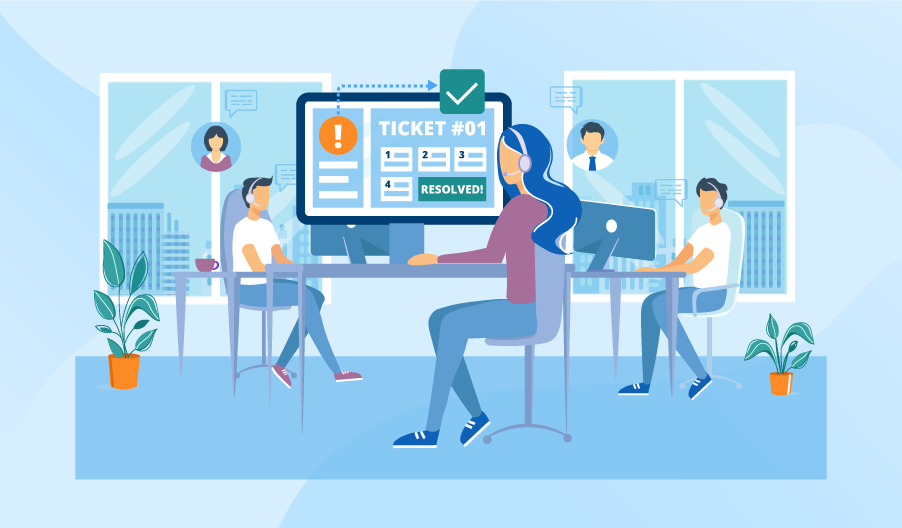
Key Advantages
- Standardized SLA & Priority Matrices: Classifies support tickets based on financial impact and operational urgency (P0 to P3) to prevent mission-critical issues from stalling.
- Elimination of L1 to L2 Escalation Bottlenecks: Establishes automated routing workflows so technical inquiries route directly to specialized engineering tiers without manual ping-pong delays.
- End-to-End Ticket Lifecycle Visibility: Tracks resolution statuses transparently across Open, In Progress, Waiting on Customer, and Resolved stages.
- Telemetry & Customer Context Integration: Links support tickets directly to CRM profiles and historical purchase data to accelerate root-cause investigations.
In mid-market and enterprise customer support operations, the fundamental bottleneck is rarely inquiry volume alone, but rather an organization’s inability to manage the end-to-end issue lifecycle systematically.
When customer complaints are handled inside unstructured chat threads without defined data schemas, leadership loses operational visibility over critical technical incidents occurring in production.
The business consequences are severe: inflated operational overhead, repeated Service Level Agreement (SLA) breaches, and eroded customer trust caused by unresolved support inquiries.
Anatomy of a Modern Customer Support Ticket Lifecycle
A customer service ticket is far more than a raw text note; it is a structured data entity containing granular attributes that govern resolution workflows. An enterprise-grade ticket schema includes the following core components:
- Customer Context Data: User identity profile, subscription tier, transaction history, and customer lifetime value (LTV) synchronized automatically from central databases.
- Categorization & Severity Attributes: Explicit tags indicating issue type (such as billing errors, system bugs, or logistics delays) and business urgency ratings.
- Audit Trail & Timestamp Telemetry: Precise time-stamped logs recording initial ticket generation, First Response Time (FRT), and final resolution timestamps.
To enforce operational discipline across support tiers, tickets advance through defined lifecycle stages:
- Open / New: A new support ticket is generated automatically by the platform upon receiving an inbound inquiry.
- Assigned / In Progress: The ticket is routed to a specialized representative or engineering team and is currently under active investigation.
- Pending / Waiting on Customer: Active resolution pauses temporarily while awaiting necessary logs, screenshots, or verifications from the user.
- Resolved / Closed: The solution has been delivered and verified by the customer, triggering automated CSAT survey dispatches.
Structuring SLA Priority Matrices and Escalation Frameworks
A common failure mode in customer operations is treating every inquiry with identical priority using First-In, First-Out (FIFO) queuing. This approach creates severe operational risk, as minor FAQ inquiries delay critical blockers that threaten commercial revenue. Management must implement an objective priority matrix based on Severity Levels:
| Priority Level | Criteria & Operational Impact | Target First Response | Target Resolution Time |
|---|---|---|---|
| P0 – Critical | Core system downtime, widespread transaction outages, or data security vulnerabilities. | < 15 Minutes | < 2 Hours |
| P1 – High | Primary product features degraded for a segment of users with no immediate workaround. | < 30 Minutes | < 6 Hours |
| P2 – Medium | Minor glitches on secondary features where a viable temporary workaround exists. | < 2 Hours | < 24 Hours |
| P3 – Low | General informational requests (FAQs), account profile adjustments, or feature requests. | < 4 Hours | < 48 Hours |
Deploying the Cekat.ai ticketing management system allows organizations to detect high-risk keywords automatically and classify incoming inquiries into P0 or P1 queues without manual triage overhead.
3 Operational Bottlenecks and Their Technical Solutions
In high-velocity support environments, issue resolution workflows frequently stall across three primary operational friction points:
1. Cross-Departmental Ticket Ping-Pong (L1 to L2 Escalations)
The Bottleneck: Tier-1 frontline agents lack sufficient technical context, leading them to pass unvetted tickets to Tier-2 engineering teams, causing circular reassignment delays.
The Solution: Enforce strict *Required Form Fields* during escalation workflows. L1 representatives must attach system error logs, relevant screenshots, and completed troubleshooting steps before a ticket can transfer to Tier-2 engineers.
2. Lack of Tier-0 Self-Service Automation
The Bottleneck: Skilled human agents spend hours managing repetitive P3 inquiries, such as tracking order shipments or explaining standard terms of service.
The Solution: Position an intelligent WhatsApp AI chatbot at the front line to deflect up to 80% of routine P3 inquiries autonomously, allowing human staff to focus strictly on P0 and P1 issues.
3. Absence of Real-Time SLA Breach Alerts
The Bottleneck: Tickets sit unmonitored in active queues because representatives lose track of approaching SLA resolution deadlines.
The Solution: Configure automated escalation triggers. If a P1 ticket remains unacknowledged after 20 minutes, the platform dispatches automated alerts directly to support supervisors and operations managers.
Key Metrics to Measure Support Operational Health
To evaluate support infrastructure performance objectively, leadership must look beyond simple Customer Satisfaction (CSAT) scores. Track a balanced set of quantitative telemetry metrics:
- Mean Time to Resolve (MTTR): The average time elapsed from initial ticket creation to complete operational resolution.
- First Contact Resolution Rate (FCR): The percentage of inbound inquiries resolved completely during the initial interaction without requiring escalations.
- Ticket Deflection Rate: The percentage of total inquiry volume resolved autonomously by AI and self-service knowledge portals without generating human agent tickets.
- Backlog Volume Trends: The daily ratio comparing newly created tickets against successfully resolved tickets to monitor operational queue health.
Frequently Asked Questions (FAQ)
1. What is the fundamental difference between standard live chat and a ticketing system?
2. How long does it take to integrate a support ticketing system with the official WhatsApp API?
3. Is a ticketing system suitable for B2B enterprises and growing mid-market businesses?
4. How does the system detect and notify teams of SLA breaches?
Strategic Conclusion
Building a resilient post-purchase support architecture is not about demanding agents work faster, but about constructing disciplined workflow systems. Implementing a modern ticketing system augmented with conversational AI automation guarantees every customer inquiry is tracked transparently, accurately, and measurably against enterprise SLA commitments.
Ready to modernize your issue resolution workflows and eliminate SLA breach risks? Schedule a Technical Consultation & System Demo with Cekat.ai Today!
Leave a Reply