Executive Summary & Value Proposition
- Anti-Downtime Architecture: Prevents delivery failures, request timeouts, and rate limit bans during sudden traffic bursts.
- Priority-Based Queue Management: Separates critical message traffic (OTPs & payment receipts) from bulk promotional broadcasts.
- Adaptive Concurrency & Retries: Dynamically adjusts worker threads using exponential backoff patterns to maintain API stability.
- Revenue & SLA Protection: Guarantees that all customer transactions, alerts, and conversations powered by an AI Agent deliver reliably 24/7.
As digital enterprises grow, the WhatsApp Business API becomes the core communication backbone—handling transaction notifications, customer support, and AI-driven workflows. However, many engineering teams mistakenly assume that WhatsApp API integration is purely plug-and-play. At low volumes, this approach works; at high traffic levels, the assumption collapses.
Scaling the WhatsApp API isn’t just about adding more servers. The real engineering challenge lies in queue management, concurrency control, load handling, and system resilience against sudden messaging spikes. This article covers the technical and architectural strategies required to keep your WhatsApp API reliable and cost-effective at enterprise scale.
Why Is Scaling the WhatsApp API a Major Challenge?
Before implementing solutions, it’s essential to test common assumptions made at the system design level:
- “The WhatsApp API automatically auto-scales capacity.”
Not entirely true. While Meta’s cloud infrastructure is massive, rate limits, concurrency caps, and throughput limits must be managed independently from your application side. - “Bottlenecks only occur during extreme traffic.”
In reality, outages frequently happen at moderate traffic levels when systems lack modular queuing—such as during marketing pushes, flash sales, or bulk OTP dispatches. - “Scaling simply means adding more worker nodes.”
Without proper queue architecture and concurrency bounds, adding worker nodes accelerates failure rates (causing thread overload, message drops, and retry storms).
Conclusion: scaling the WhatsApp API is a system architecture problem, not just a hardware capacity issue.
The 3 Engineering Pillars for High-Traffic WhatsApp API Scaling
| Architecture Pillar | Primary Function | Impact Without Optimization |
|---|---|---|
| 1. Queue Management | Buffers traffic bursts and enforces message priority dispatching. | Server request timeouts, dropped payloads, and unordered messages. |
| 2. Concurrency Control | Manages parallel processing threads dynamically against Meta rate limits. | Temporary API rate limit bans (HTTP 429) and spike error rates. |
| 3. Load Handling & Circuit Breaker | Isolates downstream faults to sustain steady throughput. | Complete server crashes, lost payload logs, and live-chat outages. |
The Role of Queue Management in WhatsApp API Scaling
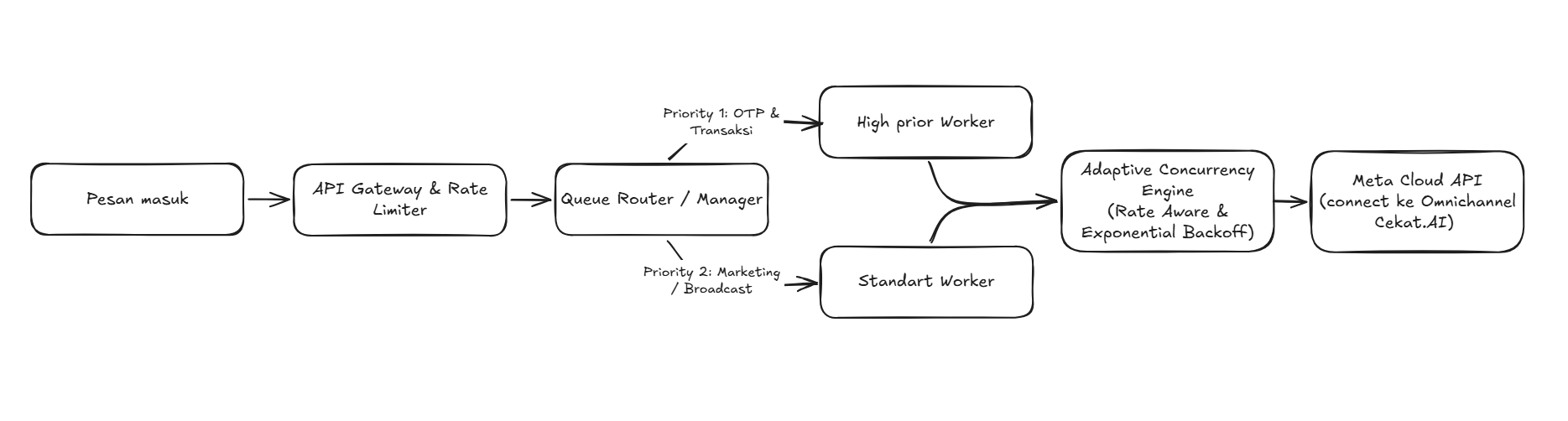
A message queue acts as a buffer between inbound request spikes and downstream execution limits. Without proper queuing, request timeouts and processing failures multiply rapidly during peak hours.
Best practices for effective queue engineering include:
- Queue Segmentation (Priority Queuing):
- OTPs & Critical Alerts → High-Priority Queue (processed instantly in < 2 seconds).
- Marketing & Promotional Broadcasts → Low-Priority Queue (processed gradually).
- Idempotency Enforcement: Applying unique idempotency keys to every message payload to prevent duplicate deliveries during retries.
- Backpressure Handling: When Meta API response latency slows down, the queue absorbs the pressure without crashing your primary backend.
High-Traffic WhatsApp API Architecture Diagram
Concurrency: Balancing Speed with System Stability
Concurrency refers to the number of message dispatch threads running in parallel. If set too low, your queue backs up. If set too high, you exceed Meta’s API thresholds, triggering account bans.
Recommended concurrency handling strategies include:
- Dynamic Concurrency: Real-time worker thread scaling based on live latency and error feedback loops.
- Rate-Aware Worker Pools: Workers temporarily pause dispatches automatically when approaching API rate limit ceilings.
- Adaptive Retry Strategy: Employing an exponential backoff algorithm (increasing delays between retries) to avoid retry storms.
The Business Cost of Poor Architecture Scaling
Infrastructure scaling failures directly impact business revenue and customer retention:
- Delayed OTPs: Users fail to authenticate, causing checkout abandonments and customer churn.
- Failed Transaction Alerts: Erodes customer trust in your service reliability.
- Stalled Marketing Campaigns: Promotional budgets are wasted as limited-time offers miss their window.
- CS Queue Overloads: Support agents in your CRM platform become overwhelmed with technical complaints.
Scale Your WhatsApp API Infrastructure with Cekat.ai
Cekat.ai provides enterprise-ready WhatsApp API infrastructure designed for scale. Featuring smart queue management, adaptive concurrency algorithms, workflow automation, and seamless AI agent integrations, Cekat.ai ensures your messaging platform remains rock-solid during peak traffic surges.
Scale your WhatsApp Business API reliably with Cekat.ai.
Frequently Asked Questions (FAQ)
1. Why does a WhatsApp API system need Queue Management?
Queue Management acts as a buffer during traffic spikes. Without a queue, your primary server can crash or time out by attempting to process more parallel requests than the API or database can handle.
2. What is Exponential Backoff in WhatsApp message dispatches?
Exponential Backoff is a retry strategy where the system increases the wait time exponentially between consecutive failed message attempts, preventing server overload (retry storms) on API endpoints.
3. How does Cekat.ai handle high-volume bulk messaging (burst traffic)?
Cekat.ai uses Queue Segmentation and dynamic concurrency limits. Time-sensitive transactional messages (like OTPs) receive high-priority routing, while marketing broadcasts process smoothly in the background without degrading system stability.
4. What are the throughput limits for the WhatsApp Business API?
Throughput limits depend on your Meta WhatsApp Business API account tier (ranging from 80 messages/second to enterprise tiers). Cekat.ai manages infrastructure throughput automatically to stay within safe Meta rate limits.
Leave a Reply