Category: Finance

  • 5 Operational Signs Your Business Needs an Integrated CRM Program

    5 Operational Signs Your Business Needs an Integrated CRM Program

    Key Advantages

    • Early detection of critical operational inefficiencies across sales and support functions.
    • Financial evaluation framework for revenue leakage caused by delayed lead response times.
    • Performance comparison matrix: manual spreadsheets vs unified commercial platforms.
    • Centralized customer database strategies to measurably improve conversion rates.

    Growth in transaction volume and inbound inquiries often becomes a bottleneck when internal operational infrastructure fails to scale. In manual operating environments, commercial teams frequently spend over 60% of their workday on repetitive administrative tasks, while prospective buyers abandon deals due to delayed follow-up responses.

    This operational friction necessitates adopting a unified crm program to serve as the centralized command center for customer interactions. Identifying operational breakdown indicators early allows leadership to protect profit margins before experiencing severe revenue leakage.

    1. Declining Response Speed and Inbound Message Backlogs

    When an enterprise receives hundreds of multi-channel inquiries daily, initial response latency often stretches from minutes into hours. This operational lag degrades closing probability because modern buyers demand immediate informational clarity. In-depth context regarding communication speed can be explored in our breakdown on fast response meaning.

    Without automated message ingestion systems, frontline representatives struggle to separate high-priority opportunities from routine queries. Consequently, high-intent prospects remain unattended during critical decision windows.

    2. Prospect Leakage from Fragmented Records

    Relying on decentralized spreadsheets introduces data silos. When customer notes remain scattered across individual representative hardware, commercial leadership loses visibility over active deal progression.

    This risk peaks during employee transitions. Without an immutable central data repository, historical interaction context, custom pricing structures, and buyer preferences depart alongside departing personnel, disrupting account continuity.

    3. Internal Friction from Overlapping Representative Outreach

    In the absence of systematic lead distribution rules, multiple sales representatives frequently contact the same prospect concurrently, or conversely, high-value quotation requests go completely unassigned. Such miscoordination damages corporate credibility in competitive markets.

    Modern crm tools prevent these anomalies through rule-based round-robin routing and territory assignments, ensuring every prospect has a transparently designated account owner on the centralized dashboard.

    Operational Metric Manual Frameworks (Spreadsheets/Basic Chat) Unified CRM Program Ecosystem
    First Response Time Slow, prone to compounding multi-hour backlogs Instant via automated chat workflows and bots
    Lead Allocation Manual, high risk of internal rep collision Automated based on capacity and skill parameters
    Deal History Tracking Siloed on personal employee devices Archived on a centralized real-time timeline
    Pipeline Reporting Accuracy Subject to human error and reporting lag Automated, based on verified live transaction data

    4. Inability to Accurately Score and Prioritize Inbound Opportunities

    Not every inbound business inquiry carries equivalent conversion potential. Treating every prospect with identical priority wastes valuable commercial labor on unqualified leads.

    Organizations require automated qualification frameworks to segment opportunities systematically. Methodologies for commercial qualification are detailed in our guide on lead scoring guide, enabling sales teams to focus their direct efforts on opportunities with the highest commercial readiness.

    5. Distorted Revenue Forecasting and Delayed Management Reporting

    Assembling monthly commercial performance reviews manually requires days of data aggregation across disparate files. This reporting lag forces executive leadership into reactive decision-making based on outdated operational figures.

    Unified platforms generate instant commercial telemetry, detailing conversion rates per representative, average deal velocity, and projected pipeline revenue. With real-time visibility, leadership can pinpoint conversion bottlenecks and implement strategic corrections immediately.

    Scale Commercial Operations and Drive Efficiency with Cekat.ai

    When an organization exhibits these operational warning signs, delaying infrastructure upgrades directly increases customer acquisition costs. Cekat.ai provides an intelligent CRM platform that bridges customer databases with AI-powered conversational automation.

    With Cekat.ai, commercial teams manage thousands of concurrent inquiries instantly, automate lead routing, and maintain complete pipeline visibility within a single interface. Eliminate administrative drag and accelerate commercial growth by exploring our Cekat.ai pricing plans today.

    Frequently Asked Questions

    When should an organization transition to an integrated CRM program?

    A transition is required when inquiry volumes overwhelm manual capacity, internal lead duplication occurs, or manual performance reporting delays strategic decision-making.

    Are CRM systems suitable only for large enterprises?

    No, growing businesses and mid-market organizations gain significant advantages by utilizing CRM systems to scale output without increasing headcount costs.

    How does a CRM program secure customer records during employee turnover?

    All conversation threads, transaction histories, and commercial notes reside securely on centralized enterprise servers, allowing instant account reassignment without context loss.

  • Customer Lifetime Value: Formula, Metrics & CLV Growth Guide

    Customer Lifetime Value: Formula, Metrics & CLV Growth Guide

    Key Advantages

    • Acquisition Cost Efficiency: Maximizing revenue from existing customer relationships is proven to be 5x more cost-effective than continuous top-of-funnel acquisition.
    • Predictable Revenue Forecasting: Provides clear long-term recurring revenue visibility to establish sustainable, data-backed marketing budgets.
    • CRM-Driven Automated Retention: Connects historical transaction data with automated engagement schedules to trigger repeat purchase cycles reliably.
    • Elevated Lifetime Profitability: Deploys consultative upselling and cross-selling workflows across 24/7 conversational messaging channels.

    Many expanding commercial organizations direct the majority of their growth capital toward capturing new prospects while neglecting post-purchase lifecycle management. As Customer Acquisition Cost (CAC) rises across paid digital channels, relying exclusively on one-time transactions systematically erodes operating profit margins.

    The foundational metric for sustainable business profitability is Customer Lifetime Value (CLV or LTV). Mastering how to calculate and optimize customer lifetime value enables enterprises to preserve buyer loyalty, accelerate repurchase velocity, and generate predictable cash flow. This operational focus aligns directly with structured customer retention strategies.

    What Is Customer Lifetime Value (CLV)?

    Customer Lifetime Value (CLV) is the total monetary revenue or net profit a business expects to earn from a single customer throughout the entire duration of their commercial relationship. Unlike single-transaction metrics, CLV aggregates all purchases across the full customer lifecycle.

    In financial performance analysis, CLV serves as the primary benchmark for evaluating acquisition sustainability. When your CLV substantially outweighs CAC (maintaining a benchmark ratio of at least 3:1), your enterprise operates on a scalable, profitable foundation.

    Key Metrics and Customer Lifetime Value Calculation Formula

    Calculating CLV accurately requires four essential sales variables:

    • Average Purchase Value (APV): Total revenue divided by total transaction volume within a given timeframe.
    • Average Purchase Frequency (APF): Total transaction volume divided by total unique customer count.
    • Customer Value (CV): The average revenue generated by a customer in a period (APV multiplied by APF).
    • Average Customer Lifespan (ACL): The average duration in years or months that a customer maintains an active relationship with your brand.

    1. Standard Customer Lifetime Value Formula

    Customer Lifetime Value (CLV) = Customer Value × Average Customer Lifespan

    Expanded formula structure:

    CLV = (Average Purchase Value × Average Purchase Frequency) × Average Customer Lifespan

    2. Step-by-Step Calculation Scenario

    Consider an e-commerce retail brand with the following operational data:

    • Average Purchase Value (APV): $50 per transaction
    • Average Purchase Frequency (APF): 4 orders per year
    • Average Customer Lifespan (ACL): 3 years

    Applying the formula:

    Customer Value = $50 × 4 = $200 per year
    CLV = $200 × 3 years = $600

    In this scenario, each acquired customer delivers an average lifetime gross value of $600 across their 3-year active relationship.

    Strategic Importance of CLV in Enterprise Scalability

    Strategic Advantage Operational Business Impact
    Acquisition Budget Optimization Establishes a defined ceiling for acquisition spend (CAC) to prevent unprofitable ad scaling.
    Retention Focus Aligns support and marketing teams around customer satisfaction and long-term account health.
    Cohort Segmentation Identifies high-value buyer segments (VIP accounts) for specialized consultative service tiers.
    Revenue Telemetry Enables leadership to forecast recurring revenue streams and lifetime margins with greater precision.

    Proven Frameworks to Increase Customer Lifetime Value

    Expanding CLV requires systematically increasing average order value, accelerating transaction frequency, or extending account lifespan.

    1. Automated Replenishment and Reorder Messaging

    Deliver timely replenishment reminders as consumable products approach typical exhaustion cycles. Deploying automated follow-up workflows ensures existing buyers receive contextual reorder prompts across messaging channels without manual sales intervention.

    2. Personalized Consultative Upselling

    Leverage historical transaction properties inside your CRM application to recommend complementary accessories or upgraded service tiers. Apply proven frameworks from our guide to effective upselling strategies to expand average basket sizes naturally.

    3. In-Chat Loyalty Programs and VIP Incentives

    Incentivize ongoing engagement with digital loyalty rewards, personalized milestone discounts, and exclusive product releases. Integrating loyalty workflows directly inside chat interfaces allows customers to review point balances and apply vouchers seamlessly.

    4. 24/7 Responsive Customer Support

    Service friction is the leading driver of account churn. Deploying a conversational WhatsApp AI chatbot powered by the official WhatsApp Business API resolves order inquiries and technical issues instantly around the clock.

    Scaling CLV with Autonomous AI Agents and CRM Telemetry

    Managing lifetime customer journeys manually across large databases leads to delayed follow-ups and missed expansion signals. Integrating Agentic AI technology with centralized CRM automation software eliminates this operational bottleneck.

    Intelligent systems evaluate customer health indicators, identify early churn signals, and trigger automated win-back workflows via customer segmentation software before accounts lapse. Combine these automated touchpoints with our comprehensive playbook on how to increase customer retention to maximize customer longevity.

    Frequently Asked Questions (FAQ)

    1. What is the fundamental difference between Customer Lifetime Value (CLV) and Customer Acquisition Cost (CAC)?

    CLV measures the total revenue or gross profit generated by a customer throughout their entire relationship with your business, whereas CAC represents the total sales and marketing expenditure required to acquire a single new customer. A healthy commercial benchmark is a CLV to CAC ratio of 3:1 or higher.

    2. What is the fastest method to increase Customer Lifetime Value?

    The fastest approach is accelerating repeat purchase frequency through automated replenishment messaging on WhatsApp, executing consultative in-cart upselling, and providing instant 24/7 customer service resolution.

    3. What factors cause Customer Lifetime Value to decline?

    CLV decreases primarily due to slow support response times, inconsistent product quality, lack of proactive post-purchase engagement, and high customer churn resulting from unaddressed complaints.

    Scale Customer Lifetime Value with Cekat.ai

    Retaining loyal customers and expanding account value over time forms the foundation of sustainable commercial growth. With structured conversational engagement and rapid support response times, existing accounts become reliable sources of high-margin recurring revenue.

    The enterprise platform at Cekat.ai delivers conversational commerce infrastructure combining the official WhatsApp Business API, 24/7 AI Agents, and automated CRM pipelines designed to maximize customer retention. Explore flexible plan options on our pricing and plans page or consult with our growth solutions team today.

  • Effective Upselling Strategy: Practical Guide to Boost AOV

    Effective Upselling Strategy: Practical Guide to Boost AOV

    Key Advantages

    • Average Order Value (AOV) Expansion: Elevates transaction revenue per buyer without incurring incremental customer acquisition costs.
    • Enhanced Retention & Customer Lifetime Value: Connects clients with advanced tiers tailored to their long-term operational scale.
    • Frictionless Upgrade Journeys: Minimizes decision complexity through seamless one-click checkout flows and fallback downsell options.
    • CRM-Powered Intent Targeting: Leverages behavioral data and pipeline deal stages to trigger upgrades at the optimal commercial moment.

    Imagine this scenario: you have decided to purchase a basic software subscription. As you reach the checkout screen, an upgraded edition appears with transparent pricing and a single-click upgrade option. The offer does not feel intrusive; instead, it feels directly relevant to your operational needs.

    When prospective buyers demonstrate clear purchasing intent, an effective upselling strategy resolves hesitation through contextual relevance. An upgrade must expand upon the core benefits sought—such as advanced feature sets, expanded capacity, or extended licensing terms—rather than simply inflating the invoice total.

    The process must remain frictionless, appear at the opportune moment, and remain value-driven. When added utility is clear, upgrading feels logical, driving measurable increases in Average Order Value (AOV) and Customer Lifetime Value (CLV).

    Core Architectural Concepts: Upsell, Cross-Sell, and Downsell

    Core concepts of upselling cross selling and downselling

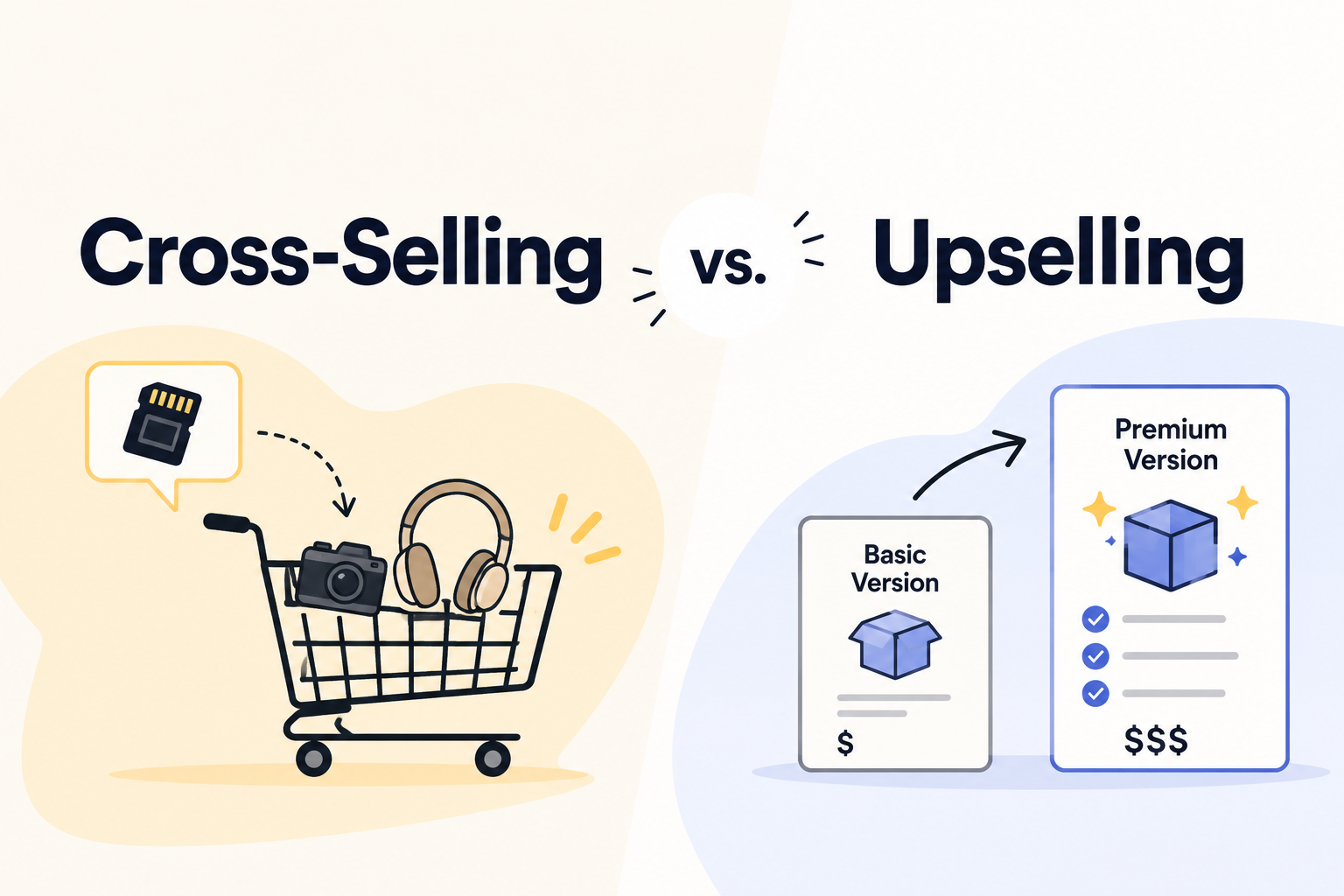
    “An upselling strategy presents a higher-value version of the product already selected, whereas cross-selling introduces complementary items.”

    • Upselling (Focus: Depth / Tier Upgrade): Encouraging customers to upgrade to an advanced edition of the same solution. Example: Transitioning from a Basic to a Pro plan to unlock multi-user collaboration.
    • Cross-Selling (Focus: Breadth / Add-Ons): Recommending supplementary products that enhance the primary purchase. Example: Adding protective cases and screen protectors when buying a smartphone.
    • Downselling (Focus: Safety Net / Plan B): Providing a lighter, budget-friendly alternative when a high-tier upsell is declined. Example: Offering flexible payment installments or modular feature add-ons when a premium tier exceeds the buyer’s budget.

    4 Pillars of High-Converting Upselling Strategies

    Four pillars of a successful upselling strategy

    1. High Relevance: The upgrade directly addresses verified customer pain points and behavioral signals.
    2. Value-Centric Copywriting: Emphasizes tangible business outcomes (faster workflows, reduced overhead) rather than technical jargon.
    3. Precision Timing: Deployed when buyers are most receptive, such as during checkout or post-purchase milestone check-ins.
    4. Frictionless UX: Streamlines decision-making with simple acceptance flows and polite dismissal options.

    Why Upselling Is Vital for Scalable Business Growth

    Acquiring net-new customers costs 5 to 6 times more than retaining and expanding existing accounts. Executing an upselling strategy engages an audience that already trusts your brand, reinforcing broader customer retention strategies:

    • Elevates Average Order Value (AOV): Grows commercial revenue per transaction without requiring additional ad spend.
    • Maximizes Customer Lifetime Value (CLV): Customers matched with the right tier experience higher satisfaction and lower churn rates.

    The 7-Step Upselling Execution Workflow

    1. Map Baseline Selections: Identify the entry-level product and the primary problem the customer intends to resolve.
    2. Analyze Behavioral Data: Review past purchasing patterns inside a dedicated CRM application to uncover latent expansion needs.
    3. Select Logical Upgrades: Determine the optimal upgrade structure (tier upgrades, volume increments, or priority support) organized inside your pipeline management system.
    4. Articulate Concrete Value: Highlight specific operational advantages clearly and concisely.
    5. Minimize Checkout Friction: Implement low-friction workflows like one-step acceptance and automated payment workflows.
    6. Prepare Fallback Downsells: Establish lighter alternative packages if the premium upsell is declined.
    7. Track KPIs & Iterate: Monitor upsell conversion rates, AOV, and customer satisfaction metrics using WhatsApp conversion tracking.

    If you want to deploy structured, data-driven upselling funnels, the growth team at Cekat.ai is ready to help architect your operational workflows.

    Customer Journey Upselling Checklist

    • Segment Audience Cohorts: Group upgrade offers based on historical buying habits and lifecycle stages.
    • Build a Value Ladder: Structure progressive upgrade tiers from foundational packages to enterprise editions.
    • Craft Benefit-Driven Hooks: Answer the customer’s question “What specific outcome do I gain?” in a single sentence.
    • Deploy Intelligent Automation: Use automated follow-up software to engage accounts ready for expansion using proven WhatsApp sales follow-up strategies.
    • Benchmark Commercial KPIs: Monitor upsell conversion percentage, AOV, CLV, and customer feedback scores (CSAT/NPS).

    7 Fatal Pitfalls That Sabotage Upselling Conversion

    Common pitfalls in upselling execution

    • Overly Aggressive Sales Pressure: Disrupting the customer journey rather than offering consultative assistance.
    • Conflating Upsells with Cross-Sells: Recommending unrelated accessories instead of upgrading the primary solution.
    • Focusing on Price Over Utility: Forgetting that customers invest in business outcomes rather than larger invoices.
    • Restricting Upsells to Checkout: Ignoring post-purchase adoption milestones when customers outgrow entry-level tiers.
    • Assuming Everyone Chooses Top Tiers: Failing to provide a downsell safety net for budget-conscious buyers.
    • Listing Raw Features Without Context: Forcing customers to deduce the practical value of technical specs on their own.
    • Triggering Upsell Fatigue: Bombarding buyers with repetitive, unsegmented upgrade prompts.

    Frequently Asked Questions (FAQ)

    1. When is the most effective moment to present an upsell offer?

    The most effective timing is at checkout when buyer intent is peaked, or during the post-purchase adoption phase when user consumption approaches the limits of their basic plan.

    2. What should a sales team do if an upsell offer is declined?

    Immediately introduce a downsell alternative—such as a modular add-on or a flexible billing structure—allowing the customer to complete the core purchase comfortably.

    3. What is the recommended price differential for an upsell?

    A standard best-practice upgrade increment ranges between 10% and 25% above the baseline product price to maintain high conversion without triggering budget hesitation.

    Drive Scalable Revenue with Consultative Value

    An effective upselling strategy functions like customer success guidance rather than a high-pressure sales pitch. By aligning relevance, tangible value, timing, and frictionless execution, you expand commercial revenue while strengthening long-term buyer trust.

    Ready to structure measurable upselling workflows for your organization? Explore flexible subscription tiers on our pricing and plans page or consult directly with the team at Cekat.ai.

  • What Is Upselling: Definition, Benefits, and Strategies

    What Is Upselling: Definition, Benefits, and Strategies

    Key Advantages

    • Average Order Value (AOV) Expansion: Accelerates revenue per checkout by presenting higher-tier, premium product versions to active buyers.
    • Enhanced Customer Lifetime Value (LTV): Connects buyers with comprehensive, durable solutions that improve satisfaction, usage, and long-term retention.
    • Value-Driven Consultative Selling: Shifts the customer perception from paying extra costs to gaining tangible, problem-solving benefits.
    • CRM Data & Workflow Synchronization: Uses behavioral interaction records and pipeline deal stages to trigger upgrade offers at the optimal commercial moment.

    Imagine shopping for a work laptop. After evaluating several models, the sales representative presents a higher-tier specification—featuring expanded memory and upgraded processing speed—for a proportional price increment. The recommendation does not feel pushy; instead, it helps you make a well-informed decision that better matches your long-term requirements.

    Consultative upselling strategy in sales

    This scenario illustrates the core principle of what upselling is: a sales methodology where a business encourages buyers to purchase a premium, advanced, or upgraded version of the product or service they are evaluating. Unlike arbitrary price increases, upselling centers on delivering elevated value—such as enhanced feature sets, greater operational capacity, or extended warranty coverage. It functions as a vital component within comprehensive WhatsApp marketing strategies.

    Mechanically, upselling operates on the principle of the “relevant upgrade.” The buyer first demonstrates purchase intent for a specific option. Next, the business introduces an upgraded version within the same category while clearly articulating its concrete benefits. The defining factors are contextual relevance and perceived value.

    Core Distinctions: Upselling vs. Cross-Selling

    Differences between upselling and cross selling

    To keep promotional offers aligned with customer expectations, it is essential to distinguish upselling from cross-selling:

    • Upselling focuses on higher-tier upgrades: Encourages the customer to select an upgraded version of the same product (e.g., choosing a laptop with 16GB RAM instead of 8GB RAM).
    • Cross-selling introduces complementary items: Offers secondary products or add-ons that accompany the primary purchase (e.g., adding a laptop sleeve or wireless mouse after purchasing a laptop).

    To verify whether your upgrade paths are architected effectively across sales stages, map your opportunities inside structured pipeline management tools with Cekat.ai.

    Why Upselling Drives Commercial Growth

    • Expands Average Order Value (AOV): Upselling elevates transaction volume by offering high-intent buyers an option of superior value.
    • Delivers Stronger Gross Margins: Premium tiers generally yield higher profitability compared to entry-level product versions.
    • Deepens Customer Loyalty: A well-timed upgrade resolves user pain points more effectively over the long term, supporting broader customer retention strategies.
    • Enhances Brand Equity: Connecting buyers with durable, capable solutions prevents the frustration associated with outgrowing entry-level products.
    • Maximizes Customer Lifetime Value (LTV): Value-driven upselling provides customers with ongoing reasons to maintain their subscription or purchasing relationship.

    How to Implement Frictionless, Non-Intrusive Upselling

    To prevent upgrade recommendations from feeling aggressive or pushy, businesses must follow a disciplined operational flow:

    The 5-Stage Upselling Workflow

    1. Identify Core Pain Points: Review buyer preferences and past purchasing trends using customer data management software.
    2. Present Relevant Upgrades: Showcase premium variations within the same category inside an in-app WhatsApp product catalog.
    3. Highlight the Value Proposition: Articulate concrete business outcomes rather than merely listing technical specifications.
    4. Ensure Frictionless Checkout: Make accepting the upgrade seamless via automated payment workflows.
    5. Prepare Downsell Alternatives: If the premium upgrade is declined, provide a lighter alternative to preserve the core transaction.

    Checklist for Ethical Upselling

    • Verify Relevance: Ensure the upgrade directly solves the buyer’s primary challenge using customer segmentation.
    • Maintain Price Transparency: Present price differences clearly (ideally keeping the upgrade increment within 25% of the original purchase).
    • Check Customer Sentiment: Never pitch an upgrade while an active support ticket is being resolved in complaint management.
    • Avoid Artificial Urgency: Steer clear of high-pressure sales tactics or overpromising product capabilities.

    Common Mistakes That Sabotage Upselling Conversion

    • Conflating Upselling with Cross-Selling: Mixing product upgrades with unrelated add-ons creates decision fatigue for buyers.
    • Defaulting Exclusively to the Most Expensive Tier: Pushing top-tier items without considering the customer’s budget damages commercial trust.
    • Restricting Upselling to Checkout Moments: Confining upgrades solely to the cart stage, ignoring post-purchase opportunities via WhatsApp sales follow-ups.
    • Assuming Value Is Self-Evident: Expecting buyers to understand premium advantages without clearly explaining concrete benefits.
    • Ignoring Customer Frustration: Pitching upgrades to accounts currently experiencing technical blockers or service dissatisfaction.

    Strategic Evolution: Reactive vs. Proactive Upselling

    Comparison between reactive and proactive upselling strategies

    To scale sales velocity, evaluate how your organization executes conversational upgrades:

    Approach Key Characteristics Business Impact
    Reactive (Passive) Displays higher prices without explaining added value; waits passively at checkout. Perceived as an unnecessary surcharge, lowers conversion rates, and erodes trust.
    Value-Driven (Proactive) Solves explicit buyer challenges; anticipates needs using behavioral data in a CRM application. Buyers feel supported, Average Order Value (AOV) expands, and long-term LTV increases.

    Measure upselling impact quantitatively by monitoring Average Order Value (AOV), Upsell Conversion Rate, and Customer Lifetime Value (LTV) using WhatsApp conversion tracking.

    To deploy structured, data-backed upgrade workflows across all communication channels, connect your sales operations through an integrated WhatsApp marketing platform with Cekat.ai.

    Frequently Asked Questions (FAQ)

    1. What is the difference between upselling and cross-selling?

    Upselling encourages a customer to purchase a higher-end, advanced, or premium version of the product they are currently considering. Cross-selling recommends complementary or related products that add value to the primary purchase.

    2. When is the best time to present an upsell offer?

    The ideal timing is when a buyer demonstrates clear purchase intent, during final checkout review, or during post-purchase follow-up cycles as the customer’s operational requirements expand.

    3. How can sales teams execute upselling without appearing aggressive?

    Focus on value and outcomes rather than price. Clearly articulate how the upgrade resolves specific pain points, ensure the recommendation is relevant, and keep the price differential within a reasonable range (typically under 25% of the base order).

    Conclusion: Value-Driven Selling Drives Sustainable Revenue

    Understanding what upselling is leads to a vital commercial conclusion: high-performing sales strategies remain value-driven rather than transaction-driven. The goal is to introduce relevant, premium upgrades, communicate their advantages transparently, and engage buyers at the right operational moment while protecting customer trust.

    The team at Cekat.ai is ready to help you architect an intelligent upselling and conversational sales strategy tailored to your growth goals. Explore our flexible subscription tiers on our pricing and plans page.

  • Customer Retention Strategy, Metrics & AI Guide

    Customer Retention Strategy, Metrics & AI Guide

    Key Advantages

    • Long-Term Revenue Predictability: Sustains compounding business growth by driving repeatable purchases without relying entirely on rising acquisition ad spend.
    • Maximized Customer Lifetime Value (CLV): Enhances customer monetization through structured onboarding playbooks, consultative support, and data-driven cross-selling.
    • Operational Scale via AI & CRM: Automates routine triage and contextual follow-up workflows using conversational chatbots and centralized CRM data.
    • Quantitative Metric Governance: Tracks vital retention indicators (CRR, Churn Rate, CLV, NDR, and NPS) to intervene in customer churn risks proactively.

    Consider this familiar scenario: your marketing budget increases to capture new traffic, but customer acquisition remains sluggish. Simultaneously, past buyers who once ordered regularly begin drifting away. When this happens, it is rarely because your product suddenly became inferior—it is because customer retention was never engineered as an organized, repeatable system.

    Retention is a continuous operational discipline. It begins the moment a customer makes their first purchase, not when an issue or complaint arises. Modern buyer journeys are multifaceted, raising customer expectations across every interaction. When product quality, onboarding, and post-purchase care fail to align, customers perceive a decline in value and easily defect to competitors.

    Customer retention strategy for sustainable business growth

    This article expands upon our practical guide to how to increase customer retention. First, we define customer retention and its core scope. Next, you will explore how to build a retention strategy step by step—from enhancing Customer Experience (CX) and customer support to deploying conversational AI and CRM architecture. Finally, we examine essential metrics like CRR, CCR, CLV, NDR, and NPS, along with common pitfalls that keep churn high.

    If you want to accelerate your decision-making, the team at Cekat.ai can help map out high-impact retention priorities for your business.

    What Is a Customer Retention Strategy?

    A customer retention strategy is not a discounting gimmick—it is an operational system designed to make buyers choose your brand repeatedly. Fundamentally, it represents a cohesive set of initiatives engineered to prevent customer defection, minimize churn, and secure recurring commercial transactions. If predictable revenue is your goal, retention must be integrated into core business planning rather than treated as a reactive measure when churn spikes. Explore the foundational principles in our breakdown of what is customer retention.

    Mechanically, retention succeeds when an organization consistently meets and exceeds customer expectations. This relationship does not begin after delivery; it starts at the initial point of sale. A superior product requires frictionless onboarding, intuitive user experiences, and responsive post-purchase support that resolves friction swiftly. Without this continuity, customers quickly feel undervalued and explore alternative market solutions.

    Retention cannot be isolated within a single department. It requires cross-functional coordination between customer service, marketing, customer success, and product development. Today, modern conversational technology reinforces this ecosystem—deploying WhatsApp AI chatbots for rapid inquiry resolution and centralizing buyer data inside a dedicated CRM application to keep ongoing communications contextually relevant.

    Why Customer Retention Drives Long-Term Profitability

    Impact of customer retention on business profitability

    The Direct Financial Impact

    When retention metrics improve, the positive impact reflects immediately on gross margins. Retaining buyers establishes a predictable revenue foundation because satisfied clients demonstrate higher lifetime purchasing frequency. Furthermore, an established customer base unlocks organic expansion opportunities through upselling and tracking active deals in pipeline management, reducing total reliance on top-of-funnel acquisition.

    This dynamic also cushions marketing expenditures through authentic word-of-mouth advocacy. Delighted customers naturally refer peers, ensuring new customer acquisition does not constantly reset from ground zero.

    Why the ROI Compounds Rapidly

    Retention is a quantifiable financial discipline. Industry research confirms that a modest 5% increase in customer retention can boost corporate profitability significantly, as retained accounts spend considerably more than first-time buyers. Organizations can anchor their growth goals against clear benchmarks, such as maintaining an 85% Customer Retention Rate (CRR) while tracking Churn, CLV, NDR, and NPS.

    As these metrics strengthen, commercial health accelerates because customer attrition drops while the aggregate revenue per account expands.

    5 Actionable Steps to Build an Effective Retention Strategy

    Steps to build a high converting customer retention strategy

    1. Anchor Everything on Product Excellence

    Imagine a buyer completing a purchase, only to discover within a week that the product fails to deliver on its core value proposition. At that stage, no promotional discount will rescue the relationship. Because retention relies on sustained perceived value, product functionality must genuinely resolve customer pain points.

    When product performance is dependable, buyers have no incentive to search for alternatives. This provides the solid ground required to optimize the next critical phase: the post-purchase customer journey.

    2. Deliver Flawless Day-One Onboarding

    The retention cycle commences immediately upon transaction confirmation. Structured onboarding guides customers through initial setup rapidly, ensuring they realize primary product benefits without delay. The faster a user experiences time-to-value, the lower the probability of buyer remorse or churn.

    In practice, provide straightforward tutorials, proactively assist users through common friction points, and deploy automated follow-up workflows to check in on initial progress. Effective onboarding is not merely instructional—it secures perceived product value from day one.

    3. Unify Omnichannel Customer Experience (CX)

    Modern buyers transition across touchpoints fluidly. They might discover an ad, inquire via instant messaging, consult documentation, and contact support when facing technical blockers. A robust retention framework maintains consistent service quality across every interaction via an integrated omnichannel application.

    Deploy structured communication to re-engage existing clients, deliver tailored offers using customer segmentation, and streamline reordering. Personalize outreach thoughtfully to ensure every touchpoint feels consultative rather than generic spam.

    4. Elevate Customer Support Speed and Quality

    Sluggish support response times rapidly erode buyer confidence. When issues arise, customer care teams must intervene promptly with definitive solutions. High-retention support is not just about polite phrasing; it focuses on resolving the underlying technical or operational bottlenecks causing customer frustration.

    Offer intuitive self-service resources through a searchable knowledge base. For complex inquiries, ensure seamless escalation paths using an integrated ticketing management system and a collaborative WhatsApp multi-agent workspace so clients receive expert human guidance.

    5. Track Vital Telemetry and Iterate Continuously

    Without quantifiable telemetry, retention management becomes pure guesswork. Measure beginning and ending customer counts to determine your Customer Retention Rate (CRR), while monitoring Customer Churn Rate (CCR) to evaluate defection patterns. Simultaneously, track Customer Lifetime Value (CLV) to quantify account worth and Net Dollar Retention (NDR) to measure recurring revenue expansion.

    Finally, utilize Net Promoter Score (NPS) as an early indicator of customer advocacy. Target an 85% CRR benchmark for operational calibration. Continuously refine onboarding, support SLA benchmarks, loyalty incentives, and personalization workflows based on empirical data.

    Daily Operational Workflow: From Data to Proactive Intervention

    “Data without execution is merely documentation. Retention demands daily operational action.”

    1. Define tracking intervals and monitor CRR and CCR pacing to identify upward or downward retention trends over 30, 90, or 365 days.
    2. Isolate at-risk accounts by reviewing behavioral signals, such as declining platform logins or unresolved service tickets logged in complaint management.
    3. Audit feature drop-off points. When users stall on specific product workflows, it often indicates unaddressed UX friction.
    4. Review support response velocity and recurring inquiry topics to eliminate operational latency, applying best practices on how to cut CS response times.
    5. Execute measured, consultative interventions—reaching out with supplementary guidance, human account reviews, or tailored solutions.

    This operational cadence must remain continuous, generating compounding insights that permanently suppress account churn.

    Deploying AI in Chatbots and Natural Language Processing (NLP)

    AI accelerates response velocity; it does not eliminate the need for human empathy. In this layer, conversational AI equipped with NLP comprehends user intent and delivers immediate solutions. The retention benefit is undeniable: minor customer questions are resolved instantly, eliminating service backlogs. Learn how to implement this architecture in our guide on scaling customer support with chat management.

    For example, when a client asks for operating hours or shipping status, AI bots resolve the query in seconds. When cases require complex technical troubleshooting, the system routes the conversation smoothly to human agents. The operational rule remains: automate standard inquiries, humanize high-stakes consultations.

    Deploying AI in CRM and Behavioral Personalization

    Inside commercial databases, an automated CRM system processes engagement data to optimize touchpoint timing. Utilizing centralized records in customer data management, growth teams determine precisely when to dispatch educational guides, when to present expansion upgrades, and when to deliver specialized care to prevent account stagnation.

    Ultimately, AI empowers teams to scale support capacity while reserving human expertise for relationship-critical moments.

    Common Misconceptions That Sabotage Customer Retention

    Equating Retention with Repetitive Discounting

    Many organizations assume retention is achieved solely through continuous promotional coupons. In reality, discounts merely mask underlying product or service shortcomings. When promotions stop, price-sensitive buyers leave immediately because loyalty was never established on real product value.

    Focus on strengthening onboarding, product reliability, and consultative service. Loyalty anchored in tangible utility creates resilient customer relationships that withstand competitor pricing pressure.

    Treating Closed Deals as the End of the Journey

    Sales teams often disengage once an initial contract closes. However, the retention lifecycle begins at that exact moment—extending through user adoption, feature mastery, and ongoing problem resolution. Understanding the full customer journey from awareness to repeat purchase is vital to prevent post-purchase drop-offs.

    Neglecting post-purchase engagement leaves customers feeling abandoned. Align customer support and customer success teams to ensure clients feel consistently valued throughout their lifecycle.

    Prioritizing Top-of-Funnel Acquisition Exclusively

    While customer acquisition delivers rapid early-stage growth, operating with high churn creates a financial treadmill where companies spend heavily just to replace departing revenue.

    Strengthening retention dramatically enhances long-term profitability. Retained accounts expand over time through repeat orders and upselling, freeing the business from total dependency on volatile paid traffic.

    Ignoring Negative Customer Feedback

    Viewing customer complaints as operational nuisances destroys commercial trust. The majority of dissatisfied buyers never file a complaint—they quietly migrate to competitors when issues go unaddressed.

    Establish structured feedback loops across reviews, surveys, and support conversations, committing to visible operational improvements. When customers witness active issue resolution, brand loyalty rebounds significantly.

    Long-Term Governance: Scaling Your Retention Engine

    Periodic audit and performance evaluation of customer retention metrics

    Conduct monthly and quarterly audits to verify whether Customer Retention Rate (CRR) and Churn Rate are pacing according to target benchmarks. Establish CRR and CCR as your baseline health indicators to confirm whether retention health is strengthening or deteriorating.

    Correlate these metrics with Customer Lifetime Value (CLV) and Net Dollar Retention (NDR). Your strategic focus must center not merely on how many accounts remain, but on the compounding economic value generated across those relationships. Target an 85% CRR benchmark to calibrate program effectiveness.

    Resilient Retention Is Engineered, Not Left to Chance

    “Retention is not a one-off event; it is an organizational habit of continuous refinement.”

    Sustainable customer retention begins at the initial transaction. From there, organizations must align product quality, customer experience, support SLA standards, and customer success workflows. Power this consistency through modern technology—combining AI agents and CRM data to keep interactions relevant over time.

    Managed methodically, retention operates as a predictable system. Monitor CRR, track CLV, evaluate NDR, and interpret NPS sentiment to iterate based on verified user behavior. This disciplined approach systematically suppresses churn while maximizing customer lifetime value.

    Frequently Asked Questions (FAQ)

    1. What is the fundamental difference between customer acquisition and customer retention?

    Customer acquisition focuses on attracting and converting new discovery leads into first-time buyers, whereas customer retention centers on satisfying, nurturing, and retaining existing accounts to maximize repeat purchases and long-term loyalty.

    2. Why is customer retention more cost-effective than customer acquisition?

    Retaining existing buyers requires significantly lower marketing expenditure than acquiring net-new leads through paid channels. Furthermore, loyal customers generate higher average order values, display greater receptivity to upselling, and provide organic referral growth.

    3. What are the most critical metrics to measure customer retention success?

    Core quantitative metrics include Customer Retention Rate (CRR), Customer Churn Rate (CCR), Customer Lifetime Value (CLV), Net Dollar Retention (NDR), and Net Promoter Score (NPS) as a benchmark of customer advocacy.

    Ready to Engineer a Predictable Customer Retention System?

    The growth team at Cekat.ai is ready to help you architect an end-to-end retention and automation engine—from metric benchmarking to scalable workflow execution. Explore our flexible subscription tiers on our pricing and plans page.

  • Eid Mubarak WhatsApp Broadcast Templates: Guide & Tips

    Eid Mubarak WhatsApp Broadcast Templates: Guide & Tips

    Eid Mubarak broadcast greetings and seasonal messaging

    As Eid approaches, it often feels like everyone suddenly has an endless list of contacts to greet. You want to offer sincere holiday greetings and ask for forgiveness, but time is exceptionally tight. In the rush, you find yourself toggling between chats, anxious about using the wrong tone or accidentally omitting important relationships while struggling to compose the right words.

    In moments like these, a structured Eid broadcast template acts as a lifesaver. Using a template does not make your greetings any less sincere; rather, it structures your communication workflow so your genuine intentions arrive in a thoughtful, polished manner. Having clear templates in place ensures you never have to draft messages from scratch during busy holiday celebrations.

    If you want to ensure your high-volume holiday communication remains structured, personalized, and relevant, you can consult with the team at Cekat.ai.

    Related resource: New Year WhatsApp Broadcast Templates

    What Is an Eid Broadcast Template?

    In simple terms, an Eid broadcast template is a pre-structured message format designed to be distributed across digital messaging channels to multiple recipients simultaneously during Eid al-Fitr or Eid al-Adha.

    You select the appropriate format, adjust minor details according to your relationship tier or audience segment, and dispatch the greetings without drafting sentences individually. The objective is keeping holiday communication efficient, organized, clear, and courteous.

    Why Structured Holiday Templates Matter for Personal and Business Contexts

    While the fundamental goal is conveying warm Eid greetings, deploying an Eid broadcast template serves distinct functional purposes across personal and commercial relationships:

    Personal: Time Efficiency Without Losing Warmth

    • Saves Time: Streamlines outreach to extended family, close friends, and acquaintances without typing identical paragraphs repeatedly.
    • Prevents Missed Contacts: Ensures everyone on your holiday greeting list receives a thoughtful message, even when your personal schedule is packed.

    Business: Preserving Brand Goodwill and Reputation

    • Brand Consistency: Guarantees that corporate holiday messages remain professional, courteous, and aligned with your brand voice.
    • Prevents Spam Perceptions: Avoids aggressive sales pitches during holy celebrations, protecting long-term client trust and goodwill.

    How WhatsApp Eid Broadcasts Work

    Dispatching holiday greetings using an Eid broadcast template operates through a straightforward five-stage process:

    1. Select Your Message Format: Determine the optimal medium (plain text, branded image, GIF, or short video) matching recipient preferences.
    2. Calibrate Tone and Context: Adjust language formality—using casual, warm phrasing for close friends and family, or formal, polished wording for corporate partners.
    3. Incorporate Dynamic Personalization: Insert merge tags such as the recipient’s first name or honorific title to keep messages natural.
    4. Segment Contact Lists: Group contacts thoughtfully so content matches your exact relationship with each audience cohort.
    5. Deliver as Individual 1-on-1 Chats: Official broadcast tools deliver messages into private individual chat threads, making each recipient feel uniquely addressed.

    Best Practices for Creating and Sending Eid Greetings

    To ensure your Eid broadcast templates are received warmly, follow this operational checklist:

    • Align Audience with Tone of Voice: Distinguish formal corporate vocabulary for professional clients from relaxed, heartfelt tones for close companions.
    • Prepare 2–3 Template Variations: Draft multiple copy versions mapped to different relationship tiers to avoid generic phrasing.
    • Apply Meaningful Personalization: Insert preferred nicknames or family titles to add authentic warmth.
    • Optimize Dispatch Timing: Schedule delivery thoughtfully (such as the eve of Eid or the morning of the celebration) so greetings land at peak festive moments.

    Standard Greeting Structure:

    • Opening: Warm Eid al-Fitr greeting / traditional holiday salutation.
    • Core Body: Sincere apologies, forgiveness requests, and heartfelt prayers/blessings for the year ahead.
    • Closing: Warm regards along with the sender’s or family’s name.

    Common Mistakes to Avoid in Holiday Broadcasts

    Common mistakes during holiday mass messaging campaigns

    • Using a Single Generic Template for Everyone: Blasting identical wording to corporate executives and close childhood friends makes greetings feel impersonal and awkward.
    • Misjudging Tone Formality: Sending overly informal slang to supervisors, enterprise clients, or respected elders undermines professional courtesy.
    • Relying Entirely on Broadcasts for Close Relationships: Treating mass broadcasts as a complete substitute for genuine 1-on-1 follow-ups with your closest circle.
    • Over-Broadcasting: Forwarding identical greeting copies repeatedly across multiple group chats and private DMs, leading to recipient fatigue.

    Expert Strategies for Memorable Holiday Outreach

    Strategic Approach Positive Impact Risk If Ignored
    Contact Segmentation Messages feel highly relevant, contextual, and sincere. Without segmentation, messages sound flat, generic, and robotic.
    Meaningful Personalization Recipients feel genuinely respected and personally acknowledged. Swapping names without adjusting message context feels like rigid automation.
    Precision Timing Greetings are read when recipients are relaxed and receptive. Sending too early or late causes messages to lose their emotional moment.

    Send Sincere Eid Greetings Effortlessly

    Delivering authentic Eid Mubarak messages seamlessly

    Preparing multiple Eid broadcast template variations ahead of time eliminates the stress of last-minute composing. When tailored messages are organized for distinct contact tiers, you can focus on enjoying the holidays rather than scrambling to manage messaging inboxes.

    With thoughtful preparation, your greetings do more than just deliver—they arrive with authentic warmth, clarity, and personal relevance for every recipient.

    If you want to ensure your organizational messaging workflows remain personal, compliant, and impactful, the team at Cekat.ai is ready to help structure the ideal communication strategy. Contact us for a free consultation.

  • New Year WhatsApp Broadcast Templates: Examples & Guide

    New Year WhatsApp Broadcast Templates: Examples & Guide

    Customer inboxes frequently turn into chaotic “promotional showrooms” as the New Year approaches, and what frustrates marketers most is watching their business messages get buried in the noise. You might have great intentions, but the anxiety remains: what if your message is flagged as spam, especially if your copy looks identical to dozens of other competing brands? The outcome is predictable: recipients ignore the chat, and customer relationships turn cold.

    This is where structured New Year broadcast templates become invaluable. A well-crafted template serves as a guiding framework that keeps your communication warm, highly relevant, and purposefully driven. You avoid writing copy from scratch for every campaign while ensuring you never send generic, thoughtless greetings. When the New Year moment arrives, your messages are deployment-ready with a clean, high-converting structure.

    To ensure your high-volume messaging workflows operate smoothly, securely, and effectively from day one, you can consult with the conversational marketing team at Cekat.ai.

    What Is a New Year Broadcast Template and Why Does It Matter?

    A New Year broadcast template is a pre-structured messaging framework designed for mass distribution across messaging apps during seasonal holiday transitions. This framework standardizes greetings, customer appreciation notes, seasonal promotional offers, and clear calls-to-action (CTAs).

    Deploying a New Year broadcast template delivers core strategic advantages for growing businesses:

    • Operational Efficiency: Eliminates manual drafting from scratch, allowing support and sales agents to focus on handling incoming customer replies.
    • Brand Consistency: Protects your brand’s voice and tone across campaigns, ensuring critical details, redemption codes, and promotional URLs are never omitted.
    • Elevated Engagement: Combining warm appreciation with contextually relevant offers drives significantly higher response and conversion rates compared to rigid, aggressive sales pitches.

    Related resource: Eid Mubarak Broadcast Message Templates

    How WhatsApp Broadcast Templates Function in Practice

    To ensure your New Year broadcast templates deliver maximum commercial impact while mitigating account restriction risks, follow this structured execution roadmap on WhatsApp:

    1. Define Clear Campaign Objectives: Decide whether your primary goal is brand goodwill, a limited-time flash sale, exclusive rewards for VIP customers, or pre-holiday service booking reminders. Your objective dictates copy length, tone, and CTA urgency.
    2. Segment Your Target Audience: Group contacts based on purchase history or recent interaction recency. Loyal repeat buyers should receive exclusive appreciation perks, while newer prospects can be nurtured with welcome incentives.
    3. Incorporate Dynamic Personalization Variables: Use system parameters such as [Customer Name] or [Last Purchased Product] so the message feels like a 1-on-1 personal conversation rather than a generic blast.
    4. Audit Quality, Schedule Delivery, and Monitor Telemetry: Verify that no dynamic variable tags are broken, keep copy concise, schedule dispatch times thoughtfully, and monitor delivery telemetry in real time.

    How to Structure High-Performance Holiday Broadcast Templates

    Crafting impactful New Year broadcast templates requires balancing empathy with performance marketing principles:

    • Single Objective and Clear Angles: Maintain one primary focal point per message. Avoid mixing holiday greetings, product cross-sells, and survey requests in a single text to prevent decision fatigue.
    • Humanized, Conversational Openers: Leverage recipient name parameters and open with genuine, warm greetings. Avoid stiff corporate phrasing that sounds like an automated robot.
    • Seasonal Relevance and Contextual Value: Connect your offer to the seasonal transition. For example, align health, lifestyle, or education products with New Year resolutions (“Start Fresh This Year”).

    Proven Template Variations for Diverse Business Objectives

    Strategic template frameworks for holiday messaging

    Explore these practical New Year broadcast template frameworks tailored to distinct buyer psychologies and commercial goals:

    • Flash Sale for Immediate Conversions: Emphasizes explicit time deadlines (e.g., “Valid today until 11:59 PM”) and inventory scarcity to trigger rapid purchasing action.
    • Year-End Warehouse Clearance: Positions offers around “making room for exciting new collections,” delivering transparent discount tiers or bundled seasonal clearance pricing.
    • VIP Exclusive Rewards & Warm Wishes: Focuses on genuine gratitude and customer loyalty appreciation, accompanied by high-value exclusive vouchers reserved for VIP cohorts.
    • “New Year, New Me” Resolution Momentum: Ideal for wellness, skincare, lifestyle, and education brands by framing product bundles as tools that help buyers accomplish their upcoming personal goals.

    Related resource: Industry-Specific WhatsApp Message Templates: F&B, Real Estate, Clinics, & Retail

    Common Pitfalls That Make Broadcasts Feel Like Spam

    Avoid these frequent campaign mistakes when deploying New Year broadcast templates:

    • Excessive Dispatch Frequency: Bombarding customer inboxes multiple times per week causes fatigue, triggers high spam report ratios, and leads to account blocks.
    • Generic Blasts Without Segmentation: Delivering identical promotional copy to your entire contact list without evaluating behavioral relevance.
    • Promotions Lacking a Clear CTA: Highlighting attractive discounts without providing explicit, frictionless instructions on how to redeem them.
    • Rushed, Last-Minute Execution: Preparing campaigns in a hurry often leads to embarrassing errors, such as unpopulated [Name] variable tags in customer inboxes.

    Pre-Send Checklist and Essential Performance Metrics

    Before launching your New Year broadcast template campaign, audit your preparation against this operational checklist:

    Pre-Dispatch Verification Checklist

    • Personalization variables (such as [Customer Name]) map correctly to your contact database.
    • CTA URLs and deep links are active, UTM-tagged, and redirect to the appropriate landing pages.
    • Dispatch timelines are scheduled thoughtfully according to peak recipient engagement windows.

    Essential Performance Metrics to Track

    • Delivery Rate: Confirms messages successfully reach recipient inboxes through official API infrastructure.
    • Click-Through Rate (CTR): Measures offer attractiveness and CTA clarity across audience segments.
    • Conversion Rate: Tracks the percentage of broadcast recipients who complete checkout transactions.
    • Opt-Out / Block Rate: The primary health indicator evaluating whether message frequency and copy are alienating your audience.

    Make New Year Messaging Feel Personal, Not Industrial

    Personalized holiday messaging and engagement tracking

    The most effective holiday communications are those that feel genuinely personal and effortless to act upon. That is the essence of a high-performing New Year broadcast template. A warm message still requires sharp contextual relevance, dynamic personalization, and an intuitive CTA so recipients know exactly how to proceed without feeling pressured.

    Balance authentic greetings with meaningful value, execute campaigns on structured schedules, and let operational telemetry guide continuous refinements for future holiday milestones.

    If you want to structure high-converting, compliant broadcast workflows for your enterprise, the team at Cekat.ai is ready to help you deploy the ideal messaging strategy.

  • How Payment Gateways Work: Complete Step-by-Step Guide

    How Payment Gateways Work: Complete Step-by-Step Guide

    Imagine checking out on an online store. You select your products, click payment, and clear instructions appear—such as a dynamic QRIS code or a dedicated Virtual Account number. Within seconds of completing the transfer, the status updates to “Success,” and your order is instantly marked ready for fulfillment without ever needing to upload a bank transfer slip. That seamless, automated checkout experience happens because a dedicated system bridges the payment flow from initial customer action to merchant confirmation.

    Behind the scenes, a payment gateway functions as a digital communication bridge. The system ingests transactional payloads, generates valid payment instructions for the buyer, and routes the authorization requests. Once the transaction clears, the confirmed settlement status returns directly to the merchant’s backend system.

    To eliminate guesswork from your commercial checkout workflows, you can consult with the engineering and growth team at Cekat.ai.

    Understanding Core Terminology in the Payment Ecosystem

    To design an effective checkout architecture, it is essential to distinguish between these three fundamental components:

    • Payment Gateway: The front-facing data communication bridge that transmits payment instructions and returns definitive transaction statuses (success, pending, or failed) to the merchant’s application.
    • Payment Processor: The backend financial infrastructure connected directly to banking networks and card schemes to verify fund availability and execute fund routing.
    • Merchant Account: A specialized holding account where transactional funds accumulate before being disbursed into your primary corporate bank account.

    Without a dedicated payment gateway, businesses are forced to manually cross-reference bank statement mutations against buyer payment slips. This manual approach is not only time-consuming, but also creates severe reconciliation errors as transaction volumes scale.

    Step-by-Step: How a Payment Gateway Works

    Understanding how a payment gateway works is best seen through the step-by-step data journey from the moment a buyer clicks pay until order confirmation:

    1. Transaction Payload Ingestion: When a customer initiates checkout, your store system dispatches transaction parameters (order value, unique order ID, and chosen payment instrument) to the payment gateway API.
    2. Payment Instruction Generation: The payment gateway processes this payload and renders specific payment instructions—such as a dynamic QRIS code, a dedicated Virtual Account number, a hosted payment link, or an encrypted credit card tokenization form.
    3. Processing and Automated Status Callbacks: Once the buyer completes payment on their banking or wallet app, the gateway receives real-time verification from the processing network. It then dispatches automated status updates back to the merchant system via dashboard notifications and secure webhooks (callbacks), automatically marking the order as paid.

    Deployment Models Across Business Scales

    • Direct QRIS Channels for Small Enterprises: Ideal for micro and small businesses requiring rapid payment acceptance without complex technical software development.
    • Native Website and App API Integration: Best suited for expanding mid-market companies and enterprise organizations requiring complete workflow automation, structured accounting reconciliation, and full brand control over checkout interfaces.

    Cost Architecture Note: When evaluating payment service providers, audit all fee components—including Merchant Discount Rates (MDR), flat per-transaction fees, and settlement disbursement charges. “Free” marketing claims typically apply only to account registration, not transaction processing.

    Common Misconceptions to Watch Out For

    Payment gateway misconceptions and monitoring best practices

    • QRIS Is Not a Payment Gateway: QRIS is a standardized QR payment method specification; a payment gateway is the underlying data processing engine that reconciles the transaction.
    • Neglecting Webhook and System Monitoring: Payment integrations require automated health monitoring to ensure webhook notifications execute reliably without leaving pending orders hanging in limbo.
    • Falling for the Lowest Rate Trap: Selecting a vendor purely for minimal transaction fees often leads to degraded checkout uptime and elevated payment failure rates.

    Related resource: Payment Gateway vs. Payment Link: Key Differences Explained

    Pre-Launch Checklist and Production Monitoring

    Before launching digital payment gateways to live production customers, ensure you have validated the following technical criteria:

    • Payment instructions render accurately matching the buyer’s selected method.
    • Transaction status codes (success, pending, failed) synchronize accurately with your internal database.
    • Order records update to paid status automatically without requiring manual staff intervention.
    • Reporting ledgers inside the provider dashboard match internal financial transaction logs.

    Understanding the complete architecture of a payment gateway empowers you to build a resilient, secure, and frictionless checkout workflow. With unified payment rails in place, operational overhead drops substantially while customer satisfaction rises.

    If you want to ensure your payment status integrations and conversational checkout workflows operate seamlessly from checkout to fulfillment, the team at Cekat.ai is ready to help structure the ideal technical strategy.

  • Payment Gateway vs Payment Link: Key Differences & Guide

    Payment Gateway vs Payment Link: Key Differences & Guide

    If you have ever heard the terms payment gateway and payment link used interchangeably and felt confused about which one to choose, you are not alone. Many business owners simply want transactions to process rapidly and funds to settle smoothly. However, these two mechanisms deliver distinctly different checkout workflows and buyer experiences.

    This guide will help you determine when to deploy an integrated payment gateway for native website or mobile app checkouts, and when a dynamic payment link is more suitable for instant chat invoicing and direct billing.

    If you want to structure your enterprise payment workflows smoothly from day one, you can consult with the team at Cekat.ai.

    Definitions: Payment Gateway vs. Payment Link

    • Payment Gateway (Integrated Checkout Infrastructure): The technical system connecting your online storefront (website or custom app) directly with financial processing networks. A gateway operates natively within your checkout pages to encrypt transactional data, execute real-time banking authorizations, and return definitive order status updates instantaneously.
    • Payment Link (Instant Hosted Invoicing URL): A unique, shareable URL generated for a specific transaction amount. This link redirects buyers to a secure, hosted payment page managed by the payment service provider. Merchants simply distribute this link via WhatsApp, email, or social media messaging so customers can choose their preferred payment method and complete the purchase.

    In simple terms, a payment gateway acts as an automated, integrated checkout terminal within your digital store, whereas a payment link functions as a dedicated digital invoice sent directly to individual buyers.

    Customer Journey & Operational Workflows Compared

    Understanding the distinction between a payment gateway and a payment link is easiest when examining the end-to-end customer purchase journey:

    1. Payment Gateway Flow for Website Checkouts: The buyer browses product catalogs, adds items to their digital shopping cart, and enters the integrated website checkout page. Transaction details encrypt and route to the payment processor. Once authorized by the issuing bank, order statuses synchronize and update within the merchant’s store backend in real time.
    2. Payment Link Flow for Direct Chat Billing: The merchant generates a transaction link configured with a specific invoice amount and shares it with the customer inside a messaging thread. The customer clicks the link, lands on a secure external payment interface, and selects their preferred payment instrument. Upon settlement, automated webhook notifications confirm the payment to both buyer and seller.

    Decision Framework: Choosing the Right Solution for Your Business

    Analyzing your commercial workflows will help you determine which payment option maximizes operational efficiency:

    Decision framework comparing payment gateway and payment link use cases

    • Choose a Payment Gateway If: You operate an e-commerce platform or custom application with high daily transaction volumes and standardized product catalogs. A gateway automates order processing, simplifies refund management, and maintains structured accounting reconciliation at scale.
    • Choose a Payment Link If: You manage a service-based business (such as creative design or consulting), sell bespoke/custom-order goods, close sales inside messaging apps, or require down payment (deposit) invoicing without the overhead of building a complex web storefront.
    • The Hybrid Approach: Many scaling mid-market enterprises combine both tools. The payment gateway powers the primary website checkout flow, while sales representatives leverage payment links to bill custom quotations or negotiate deals outside standard storefronts.

    Common Misconceptions to Avoid

    • Assuming Both Tools Are Identical: Forcing manual links onto high-volume e-commerce catalogs complicates automated inventory reconciliation, while building custom gateway integrations for simple 1-on-1 client consulting is unnecessary overkill.
    • Assuming Payment Links Are Less Secure: Both mechanisms utilize identical enterprise-grade PCI-DSS data encryption protocols. The difference lies in where the user interface renders, not in the underlying security standards.
    • Overlooking Operational Features for Lower Fees: Selecting a payment vendor purely for marginal basis-point fee savings often means sacrificing automated webhooks, robust reporting dashboards, and responsive customer support.

    Deciding between a payment gateway and a payment link ultimately depends on your customer engagement touchpoints and internal operational workflows. If you need automated, centralized transactions directly inside your website, a payment gateway is the proper choice. However, if you require flexible, rapid invoicing without technical deployment friction, a payment link delivers immediate value.

    If you need assistance designing an automated conversational checkout flow and financial reconciliation system for your business, the team at Cekat.ai is ready to help structure the ideal strategy.

  • Payment Gateway for SMEs: Complete Integration Guide

    Payment Gateway for SMEs: Complete Integration Guide

    Have you ever experienced a customer clicking pay, transferring the money, but the transaction status remains unconfirmed? Or perhaps you constantly have to cross-check bank transfer receipts because administrative staff are overwhelmed and verifications lag behind. When this recurs daily, transactions feel like double the effort: sales happen, but recording and manual verification become a constant operational burden.

    Manual confirmation bottlenecks frequently stifle growing small and medium-sized enterprises (SMEs). This is where integrating a dedicated payment gateway for SMEs becomes a foundational solution—automating transaction inflows, centralizing reconciliation, and eliminating manual bookkeeping friction entirely.

    What Is a Payment Gateway and How Does It Differ from an E-Wallet?

    Technically, a payment gateway is the intermediary infrastructure connecting a merchant’s digital storefront or point-of-sale system with diverse financial networks, including banks, credit card processors, and digital financial institutions. It functions as an automated terminal that verifies, encrypts, and authorizes transactions in real time.

    Many business owners confuse payment gateways, e-wallets, and manual bank transfers:

    • Payment Gateway: A centralized transaction processing platform. It does not hold stored balances like a bank; rather, it routes transactional data securely across multiple payment channels.
    • E-Wallet: Digital wallet applications (such as GoPay, OVO, ShopeePay, or DANA) that serve as payment instruments or funding sources used by customers at checkout.
    • Manual Bank Transfer: Direct account-to-account funds transfers where the merchant must manually review payment slips and bank statement mutations one by one.

    Within this ecosystem, several core technical terms are essential to understand:

    • Merchant: The business or seller receiving the commercial payment.
    • Buyer: The end customer executing the purchase and transaction.
    • Acquiring Bank: The partner financial institution processing transactions on behalf of the merchant.
    • Issuing Bank: The financial institution that issued the card or account held by the buyer.
    • Authorization: The real-time verification process validating fund availability and payment authenticity.
    • Settlement: The transfer of approved funds into the merchant’s designated commercial bank account.
    • Dashboard & Reconciliation: The administrative portal used to monitor payment statuses and reconcile sales reports against financial ledgers.

    Related resource: AI for SMEs: Accelerating Growth with Automation

    Why a Payment Gateway Is Critical for SME Growth

    Transitioning from manual transfer checks to automated payment systems drives measurable operational advantages:

    1. Enhances Customer Trust: A seamless checkout experience with instant automated confirmations gives buyers immediate transaction security.
    2. Eliminates Costly Human Error: Prevents shipping orders before funds clear or confusing similar transfer amounts during peak sales periods.
    3. Saves Operational Hours: Administrative teams stop spending hours every day manually verifying bank statements.
    4. Scales with Transaction Volume: As daily order volumes surge, automated gateways process hundreds or thousands of concurrent transactions without expanding bookkeeping headcount.

    How a Payment Gateway Operates from Checkout to Settlement

    Payment gateway transaction workflow from checkout to settlement

    Behind the scenes, transaction processing executes across structured, high-speed stages:

    1. Payment Method Selection: The customer selects their preferred payment method on the checkout page or via a payment link.
    2. Data Encryption: The system encrypts sensitive cardholder and transaction data to prevent interception or fraud.
    3. Authorization Request: The payment gateway routes the authorization request to the acquiring bank or relevant payment rail.
    4. Transaction Response: The issuing institution verifies account balances and returns a definitive status code: approved, declined, or pending.
    5. Instant Status Notification: The system delivers real-time webhooks updating the merchant dashboard and buyer confirmation screen instantaneously.
    6. Settlement Disbursement: Approved transactional funds aggregate and transfer to the merchant’s linked bank account according to scheduled payout cycles.
    7. Auditing and Reconciliation: Clean ledger records populate the reporting dashboard to simplify accounting and manage customer refunds smoothly.

    How SMEs Can Deploy a Payment Gateway Across Sales Channels

    You can deploy payment gateway solutions tailored to your specific commercial channels:

    • Website and E-Commerce Integration: If you run a custom online store or CMS, integrate the gateway using native plugins or REST APIs to enable in-app checkout flows.
    • Payment Links for Conversational Commerce: If you primarily sell via WhatsApp, Instagram, or social channels, generate secure payment links from your dashboard and share them directly inside customer chat threads.
    • Dynamic QRIS for Physical Stores and Pop-Ups: For on-premise retail transactions, display dynamic or static QRIS codes connected to your gateway so register payment statuses update automatically.

    Related resource: Best Omnichannel CRM for SMEs

    Framework for Selecting the Right Payment Gateway Provider

    Checklist for evaluating payment gateway software

    Avoid rushing vendor selection. Audit candidate payment gateways against these essential criteria:

    • Transparent Transaction Fees: Compare per-transaction Merchant Discount Rates (MDR) and ensure no hidden recurring maintenance charges erode profit margins.
    • Comprehensive Payment Method Support: Ensure the provider supports local preferred channels, including QRIS, major bank Virtual Accounts, leading e-wallets, and PayLater services.
    • Developer-Friendly Integration: Choose platforms offering well-documented APIs, software development kits (SDKs), and turnkey plugins for rapid deployment.
    • Responsive Technical Customer Support: Verify that local support engineers are readily accessible to resolve technical anomalies or payout inquiries quickly.
    • Regulatory Licensing & Security Compliance: Confirm the provider is officially licensed by central banking authorities (e.g., Bank Indonesia) and holds PCI-DSS Level 1 data security certification.
    • Clear Settlement Payout Cycles: Understand disbursement turnaround times (e.g., T+1, T+2) to maintain predictable business working capital.

    Common Mistakes to Avoid When Adopting a Payment Gateway

    Avoid these frequent pitfalls when implementing a digital payment system:

    • Focusing Solely on the Lowest MDR: Choosing a platform strictly for rock-bottom fees while ignoring system uptime reliability and support responsiveness can lead to severe revenue loss during technical outages.
    • Delaying Implementation Due to Perceived Small Scale: Postponing automated payments until order volumes become overwhelming causes operational chaos down the road.
    • Neglecting Dashboard Access Governance: Enforce strict role-based access permissions internally to secure administrative settings and withdrawal privileges.
    • Treating Pending Statuses as Immediate Failures: A pending status indicates the customer has initiated the transaction and has an active window to complete payment; uncoordinated cancellations risk alienating buyers.

    Operational Next Steps After Gateway Deployment

    Optimizing payment operations and reconciliation

    Once your payment gateway is live, maximize its operational value through these ongoing best practices:

    1. Maintain Routine Financial Reconciliation: Periodically cross-reference dashboard transaction logs with backend order records and bank deposit statements.
    2. Analyze High-Converting Payment Methods: Identify which payment channels buyers utilize most and feature those prominently at the top of your checkout menu.
    3. Leverage Transaction Insights for Marketing: Use peak purchase time data and average order values (AOV) from reporting dashboards to structure high-impact promotional campaigns.
    4. Establish Standard Operating Procedures (SOP) for Refunds: Create clear operational workflows for processing order cancellations and refunds to ensure transparent tracking and buyer satisfaction.

    Building a Scalable Financial Foundation with Payment Gateways

    Adopting a dedicated payment gateway for SMEs is no longer merely an optional upgrade; it is an essential foundation for operating an efficient, trustworthy, and scalable enterprise. By eliminating manual payment verifications, your team can redirect focus toward refining product quality and scaling customer acquisition strategies.

    Digitalizing business payments does not have to be complex. Choose a payment solution that fits your current commercial workflows, standardize your bookkeeping, and let automated systems support your business expansion.

    If you want to structure conversational checkout and automated payment workflows for your business, the team at Cekat.ai is ready to help you implement the ideal strategy.