Category: Finance

  • Best Omnichannel Applications for Indonesian Businesses 2026: The Complete Guide

    Best Omnichannel Applications for Indonesian Businesses 2026: The Complete Guide

    An omnichannel application is a platform that integrates all business communication channels such as WhatsApp, Instagram, email, live chat, and marketplace messaging into one centralized inbox, so teams can respond to customers from any channel without switching apps.

    Modern customers don’t interact with a business through just one channel. They discover a product on Instagram, ask questions via WhatsApp, read a promotional email, then reach out through live chat before finally making a purchase. Research shows that 73% of customers use more than one channel before making a purchase decision.

    Without a system connecting all these channels, businesses face the same problems: customer conversations scattered across many apps, disconnected communication history, slow responses, and missed sales opportunities.

    This guide covers in full what an omnichannel application is, why Indonesian businesses need one in 2026, the must-have features, a comparison of the best platforms, and a guide to choosing the right solution for your business’s scale and needs.

    What is an Omnichannel Application? Definition and Basic Concept

    Omnichannel is a business communication approach that integrates all customer interaction channels into one unified system, with the goal of creating a consistent and seamless customer experience across every touchpoint.

    The key difference from a conventional communication approach is preserved customer context. When a customer starts a conversation on Instagram and then continues it on WhatsApp, the customer service team can see the entire interaction history in a single view without asking the customer to repeat information.

    Channels Typically Integrated in an Omnichannel Platform

    • WhatsApp Business API: The most dominant business communication channel in Indonesia

    • Instagram Direct Message: Conversations from Instagram flow directly into the centralized inbox

    • Facebook Messenger: Integration of messages from a business’s Facebook page

    • Website live chat: A chat widget connected to the same system

    • Email: All incoming email is managed together with conversations from other channels

    • Telegram: An alternative channel increasingly used by businesses

    • Marketplace messaging: Messages from Tokopedia, Shopee, and other marketplaces

    • SMS: For notifications and text-based communication

    In modern implementations, omnichannel platforms also integrate directly with CRM systems so every conversation is automatically logged into a complete customer profile accessible to all team members.

    Why Indonesian Businesses Need an Omnichannel Application in 2026

    Indonesian digital consumer behavior keeps changing. High smartphone penetration, WhatsApp’s dominance as the primary communication channel, and rapid e-commerce growth are creating an increasingly complex, multi-platform customer journey.

    Problems Faced by Businesses Without an Omnichannel System

    • Conversations scattered across many apps: Teams have to monitor and respond on WhatsApp, Instagram, email, and live chat separately, wasting time and increasing the risk of missing important messages.

    • Disconnected customer history: When a customer switches channels, conversation context is lost and the customer has to repeat the same information from scratch.

    • Slow and inconsistent responses: Without a centralized system, response speed and quality depend entirely on who happens to be monitoring which channel.

    • Missed sales opportunities: Messages that go unmonitored or are responded to late directly lead to lost conversion opportunities.

    • Difficulty monitoring team performance: Without a centralized dashboard, managers lack visibility into conversation volume, response time, and overall service quality.

    What Changes With an Omnichannel Platform

    • All conversations from all channels flow into one centralized dashboard

    • Complete customer interaction history accessible at any time

    • Faster responses with automatic routing to the right agent

    • AI Agent automatically responds to routine questions 24/7

    • Managers have full real-time visibility into team performance

    • Every conversation automatically syncs to the customer CRM

    In 2026, AI integration in omnichannel platforms brings a new dimension: the system doesn’t just collect conversations, it actively responds, analyzes sentiment, prioritizes conversations, and triggers automatic actions based on context.

    Omnichannel vs Multichannel: A Distinction Worth Understanding

    Many businesses assume multichannel and omnichannel are interchangeable terms. In reality, they have fundamental differences that directly impact customer experience quality and operational efficiency:

    Aspect

    Multichannel

    Omnichannel

    Definition

    Present on many communication channels separately

    All channels integrated into one unified system

    Customer history

    Not connected across channels, data scattered

    Stored in one complete customer profile

    Customer experience

    Fragmented, needs to repeat information on each channel

    Consistent and seamless across every touchpoint

    Team efficiency

    Low, team switches between apps to respond

    High, all communication managed from one dashboard

    Conversation context

    Lost when the customer switches channels

    Fully preserved throughout the customer journey

    CRM integration

    Usually separate or requires manual integration

    Automatically integrated with the customer profile and history

    Automation

    Limited to each channel independently

    Centralized, a trigger on one channel can drive action on another

    Analytics

    Separate per channel, hard to consolidate

    Centralized, giving a full picture of the customer journey

    Scale readiness

    Complexity increases as channels are added

    Scales centrally without added complexity

    In short: multichannel is about being present on many channels. Omnichannel is about connecting all those channels so customers get a seamless experience and businesses gain significant operational efficiency.

    Must-Have Features of a Good Omnichannel Application

    Not all omnichannel platforms offer equal capability. Here’s a feature guide ranked by priority to help businesses evaluate and choose the platform that best fits their needs:

    Feature

    Function in Business Operations

    Priority

    Unified inbox

    All conversations from all channels flow into one centralized dashboard

    Must-have

    WhatsApp Business API integration

    Manages business WhatsApp messages centrally with all official features

    Must-have

    Instagram and Facebook integration

    Handles social media DMs directly from the omnichannel platform

    Must-have

    Website live chat integration

    Conversations from the website flow into the same inbox as other channels

    Must-have

    Integrated customer CRM

    Customer profiles and history automatically stored and accessible to the team

    Must-have

    AI Agent / smart chatbot

    24/7 automatic responses that understand context and can take action

    Highly recommended

    Automation workflow

    Automatic triggers based on cross-channel customer behavior

    Highly recommended

    Smart conversation routing

    Automatic distribution of conversations to the right agent or department

    Highly recommended

    Real-time analytics dashboard

    Monitoring team performance, response time, and customer satisfaction

    Highly recommended

    E-commerce integration

    Syncing order, shipping, and customer data with the sales platform

    As needed

    Team performance reports

    Evaluating agent productivity and service quality based on data

    As needed

    AI Features That Set Modern Platforms Apart

    • Context-aware AI Agent: Not just a rule-based chatbot, but a system that naturally understands conversation and can take real business action.

    • AI-powered smart routing: The system determines the best agent to handle each conversation based on expertise, workload, and the customer’s issue context.

    • Real-time sentiment analysis: Detects customer emotion and satisfaction level from conversations to enable proactive intervention before issues escalate.

    • Customer needs prediction: Anticipates what customers need based on interaction history and behavior patterns to deliver more personal service.

    • Cross-channel automation: A trigger from one channel can drive automatic action on another channel or system, creating a truly integrated workflow.

    Cekat.ai integrates all these features into one platform with a native AI Agent approach, not an add-on feature. This means every conversation can trigger real action in the CRM and other business systems.

    Best Omnichannel Applications in Indonesia 2026: Full Comparison

    Here is a comparison of the omnichannel platforms most relevant for businesses in Indonesia based on AI capability, channel coverage, CRM integration, and fit with local market needs:

    Platform

    AI Features

    Supported Channels

    Integrated CRM

    Main Advantage

    Best For

    Cekat.ai

    Automatic AI Agent, Indonesian language NLP, smart routing

    WhatsApp, Instagram, Facebook, live chat, email, Telegram

    Yes, natively integrated

    AI Agent + CRM + omnichannel in one platform, WhatsApp-first, no-code

    Startups to enterprise, Indonesian businesses of all scales

    SleekFlow

    Basic automation, flow builder

    WhatsApp, Instagram, Facebook Messenger, LINE

    Limited, external integration

    Simple interface, strong for WhatsApp

    Small to mid-sized businesses, chat-focused

    Qiscus

    Rule-based chatbot, bot builder

    WhatsApp, live chat, social media, email

    External integration

    Local Indonesian infrastructure, enterprise-grade

    Large companies, large-scale customer support needs

    Freshdesk

    Freddy AI, sentiment analysis

    Email, chat, phone, social media

    Yes, Freshworks CRM

    Complete customer support suite, strong helpdesk

    Mid-to-large companies with structured support teams

    Zendesk

    AI Agent, answer bot

    Email, chat, social media, phone, self-service

    Yes, Zendesk CRM

    The most complete customer service ecosystem, very scalable

    Global enterprise, complex customer support needs

    Cekat.ai: The AI Omnichannel Platform for Indonesian Businesses

    Cekat.ai is an omnichannel CRM platform designed specifically for the needs of Indonesian businesses, combining multi-channel communication, an AI Agent, and CRM into one integrated system.

    Cekat.ai’s Core Capabilities

    • Unified omnichannel inbox: WhatsApp, Instagram, Facebook Messenger, live chat, email, and Telegram in one centralized inbox accessible to the whole team.

    • Integrated native AI Agent: An AI Agent that naturally understands Indonesian, can take business action, and operates 24/7 across all channels simultaneously.

    • Integrated customer CRM: A complete customer profile with a history of all cross-channel interactions, automatically updated with every new conversation.

    • Sales and customer service automation: Automated workflows for prospect follow-up, customer onboarding, ticket management, and other repetitive business processes.

    • Official WhatsApp Business API: Direct integration with the WhatsApp Business API for managing enterprise-scale business communication through WhatsApp.

    • Comprehensive analytics dashboard: Full real-time visibility into conversation volume, response time, team performance, and customer satisfaction.

    Why Cekat.ai Fits the Indonesian Market

    • WhatsApp-first: Optimized for the most dominant business communication channel in Indonesia

    • Indonesian language: NLP that understands Indonesian context, idioms, and nuance

    • All-in-one: Omnichannel, AI Agent, CRM, and sales automation in one platform

    • No-code: Non-technical teams can configure and manage it without a developer

    • Scalable: Suitable for startups, mid-sized businesses, and enterprise alike

    • Fast implementation: Start operating within days using ready-made templates

    How to Implement an Omnichannel Application in Your Business

    Successful omnichannel implementation requires a structured approach. Here are the recommended steps:

    1. Audit your existing communication channels: Identify all channels customers currently use to interact with your business. Note the conversation volume on each channel and the most common pain points.

    2. Determine channel integration priority: Start with the highest-volume channel. For businesses in Indonesia, WhatsApp is almost always the top priority, followed by Instagram and website live chat.

    3. Choose the right platform: Evaluate based on relevant criteria: AI capability, CRM integration, WhatsApp support, ease of use for the team, and scalability to match business growth.

    4. Prepare data and system configuration: Migrate or integrate existing customer data into the new platform. Configure conversation routing, response templates, and basic automated workflows.

    5. Train the AI Agent with business content: Give the AI Agent knowledge about your products, services, FAQs, and business procedures. The more comprehensive the training, the more accurate and useful the resulting responses.

    6. Onboard and train the team: Make sure the entire customer service, sales, and operations team understands how to use the new platform. Focus on daily usage and how to collaborate with AI.

    7. Monitor, evaluate, and optimize: Track key metrics: average response time, conversation resolution rate, volume handled by AI vs humans, and customer satisfaction scores. Use this data to continually optimize configuration.

    Guide to Choosing an Omnichannel Application by Business Size

    Every business has different needs. Here’s a practical guide to choosing the omnichannel platform that best fits:

    Small Businesses and SMEs

    • Prioritize ease of use and fast implementation

    • Make sure it supports WhatsApp Business API as the primary channel

    • Look for a platform with flexible pricing plans that fit your scale

    • Basic AI Agent and automation greatly help small teams handling many conversations

    • Recommendation: Cekat.ai with no-code implementation and ready-made templates

    Mid-Sized Businesses

    • Need more advanced conversation routing features to distribute team workload

    • Strong CRM integration to manage a growing customer database

    • Deeper analytics to evaluate team and service performance

    • Ability to integrate with other business tools already in use

    • An AI Agent that can handle high conversation volume during peak hours

    Enterprise Companies

    • Data security and regulatory compliance are top considerations

    • Clear SLAs for uptime and technical support

    • Deep customization capability for specific workflows and integrations

    • Multi-team and multi-department support in one unified platform

    • Scalability to handle thousands of simultaneous conversations without degradation

    FAQ: Frequently Asked Questions About Omnichannel Applications

    What is an omnichannel application?

    An omnichannel application is a platform that integrates all business communication channels, such as WhatsApp, Instagram, email, and live chat, into one centralized inbox so teams can respond to customers across channels without switching apps.

    What’s the difference between omnichannel and multichannel?

    Multichannel means a business is present on many channels, but each operates separately. Omnichannel connects all those channels into one integrated system so customer history is preserved and their experience stays consistent across every touchpoint.

    What are the main benefits of omnichannel for a business?

    The main benefits include: faster customer responses, complete and centralized communication history, significantly improved team efficiency, a consistent customer experience, and the ability to automate service at scale.

    Is omnichannel suitable for small businesses?

    Yes. Even small businesses gain huge benefits from omnichannel because it helps small teams manage many communication channels efficiently. Platforms like Cekat.ai are designed for businesses of all scales.

    What role does AI play in modern omnichannel platforms?

    AI in omnichannel enables smart automatic responses across all channels simultaneously, customer sentiment analysis, smart conversation routing, customer needs prediction, and managing large conversation volumes without adding staff.

    Can omnichannel be used for sales, not just customer service?

    Yes. Modern omnichannel platforms like Cekat.ai integrate CRM and sales automation so sales teams can track prospects, run automatic follow-ups, and manage the sales pipeline directly from the same platform.

    How much does an omnichannel application cost?

    Costs vary based on scale and features. For SMEs, modern platforms start from hundreds of thousands to a few million rupiah per month. Enterprises with complex needs generally use custom pricing. Cekat.ai offers packages tailored to business needs.

    How fast is omnichannel implementation?

    With a modern platform like Cekat.ai, basic implementation can start within a few days using ready-made templates. Full integration with all systems usually takes 1-3 weeks depending on complexity.

    Which channels do the best omnichannel platforms support?

    The best omnichannel platforms support: WhatsApp Business API, Instagram Direct, Facebook Messenger, email, website live chat, Telegram, and marketplace messaging. Cekat.ai supports all the main channels used by businesses in Indonesia.

    How do you choose the right omnichannel platform?

    Consider: the communication channels your customers use (WhatsApp is the priority in Indonesia), CRM integration needs, AI and automation capability, ease of use for non-technical teams, scalability, and Indonesian language support.

    The digital customer journey now involves many communication channels before a transaction happens. Businesses without a system to connect all these channels will keep facing scattered conversations, slow responses, and missed sales opportunities.

    An omnichannel application has become essential communication infrastructure for modern businesses in Indonesia. With a unified inbox, CRM integration, AI Agent, and workflow automation, companies can deliver a consistent, responsive customer experience across every touchpoint while significantly improving team operational efficiency.

    In 2026, omnichannel platform differentiation is no longer just about the number of integrated channels, but how intelligently the system understands context, automates responses, and generates real business action from every customer interaction.

    Platforms like Cekat.ai deliver this approach in an integrated way for businesses in Indonesia, with an AI Agent that understands Indonesian, a WhatsApp-first architecture, and a system that can be implemented without needing a dedicated technical team.

    Improve Customer Service with Omnichannel AI from Cekat.ai

    Cekat.ai delivers a unified inbox that makes it easy for teams to manage all customer conversations from multiple channels, complete with an AI Agent that responds automatically, integrated CRM, and real-time analytics in one platform.

    • Unified inbox: WhatsApp, Instagram, live chat, email, and more

    • Native AI Agent that understands Indonesian

    • Directly integrated CRM and sales automation

    • Fast implementation without a developer

    • See a platform demo: cekat.ai

    Businesses that build a smart omnichannel infrastructure earlier will gain a competitive advantage that becomes increasingly difficult for competitors still managing each communication channel separately to catch up with.

  • Payment Reminder WhatsApp API: Protecting Cash Flow Without Damaging Customer Relationships

    Payment Reminder WhatsApp API: Protecting Cash Flow Without Damaging Customer Relationships

    Executive Summary & Value Proposition

    • Cash Flow Acceleration: Significantly reduces overdue invoice rates through automated, scheduled payment notifications.
    • Polite & Professional Tone: Preserves customer relationships using neutral, solution-oriented messaging templates.
    • Staggered Timing Strategy: Establishes structured messaging cadences across pre-due date (D-3), due date (D-0), and overdue stages (D+3).
    • Financial System Integration: Connects WhatsApp API with your CRM platform and payment automation gateways for instant checkout resolution.

    Late payments represent a classic business challenge. The impact goes beyond cash flow bottlenecks to disrupt operational efficiency and financial planning stability. Conversely, poor collection approaches—overly frequent, aggressive, or ill-timed messages—often damage valuable customer relationships.

    Deploying a WhatsApp API payment reminder strategy offers an effective solution when executed with precision. It moves beyond simple automated broadcasts to deliver measured, polite, and contextual payment communications.

    Why Is the WhatsApp API Ideal for Payment Reminders?

    WhatsApp has become the primary communication interface for business clients. Its open rates significantly surpass traditional email and feel more conversational than standard SMS. However, given its personal nature, minor collection missteps can feel intrusive.

    With official WhatsApp Business API integrations, enterprises can:

    • Dispatch scheduled invoice reminders with absolute consistency.
    • Tailor message copy based on real-time account statuses inside your omnichannel application.
    • Reduce finance team dependency on manual collection follow-ups.
    • Embed instant payment links directly within messaging threads.

    The primary value lies not merely in automation, but in absolute control over dispatch timing, message phrasing, and recipient targeting.

    Timing: The Core Driver of Effective Payment Reminders

    A common misconception assumes that collection notices should be dispatched as frequently as possible to accelerate payments. In practice, overly aggressive reminders increase customer complaints and opt-out rates.

    Collection Phase Dispatch Timing Message Focus & Tone
    Early Reminder Before due date (D-3 or D-1) Informative heads-up allowing clients time to process accounts.
    Due Date Reminder On due date (D-0) Concise notice focused on instant payment action and direct links.
    Overdue Follow-Up Post-due date (D+3, D+7, D+14) Staggered, polite notices firming up payment obligations without hostility.

    Copywriting: Firm, Clear, and Respectful

    In payment collections, copywriting tone carries significant weight. Overly legalistic or accusatory phrasing breeds friction, even when accounts are legitimately past due.

    Recommended copywriting principles include:

    • Maintaining neutral, courteous, and non-intimidating tone throughout.
    • Including complete context (invoice number, amount due, and original due date).
    • Focusing on payment convenience by embedding direct payment links or QR codes.

    “Hello [Client Name], this is a quick reminder that invoice #12345 due today can be settled easily using the following link: [Payment Link]. Thank you for your partnership.”

    Case Study: Frictionless B2B Account Collections

    A regional B2B distributor faced an ongoing issue: nearly 35% of monthly invoices slipped into overdue status. Collection outreach relied on manual phone calls and emails, consuming labor hours and causing friction with long-standing accounts.

    The enterprise implemented an automated workflow using workflow automation from Cekat.ai:

    • Informative pre-due date reminders dispatched D-2 before due date.
    • Actionable due date reminders containing direct payment gateway links.
    • Courteous past-due notices dispatched at D+3 with easy support options.

    Within three months of deployment:

    • Overdue invoice percentages plummeted by 60%.
    • Finance hours dedicated to manual collections declined sharply.
    • Customer satisfaction improved due to clear, transparent messaging.

    Ensuring Compliance and Account Trust

    Effective payment reminders must align with legal communication standards. Ensure dispatches respect defined AI working hours and business operating schedules, while offering explicit opt-out controls to preserve customer trust.

    Cekat.ai empowers businesses to manage scheduled invoice and overdue payment reminders via the WhatsApp API seamlessly. Accelerate your cash flow while protecting client relationships with Cekat.ai.


    Frequently Asked Questions (FAQ)

    1. Which WhatsApp API template category covers payment reminders?

    Payment reminders utilize Meta’s Utility template category, which covers transactional messages like billing notices, payment confirmations, and account updates.

    2. How can direct payment links be embedded in WhatsApp templates?

    You can embed dynamic Call-to-Action (CTA) buttons inside WhatsApp templates that link customers directly to hosted payment gateways or QR payment portals.

    3. Can invoice reminder dispatches be fully automated?

    Yes. Through Cekat.ai workflow automation, reminder dispatches trigger automatically based on due-date parameters synced from your financial or CRM backend.

    4. What happens if a customer replies to a payment reminder asking for extension?

    Inbound replies open a standard 24-hour service conversation window, which can be handled automatically by an AI Agent or routed directly to finance support agents.


  • WhatsApp API Chatbot: Effective or Not?

    WhatsApp API Chatbot: Effective or Not?

    Key Advantages

    • 24/7 Operational Availability: Automates routine inquiries, structured status lookups, and transactional updates instantly around the clock.
    • Context-Preserving Smart Fallbacks: Automatically transfers complex or high-severity conversations to human agents with full conversation summaries.
    • NLP-Driven Language Comprehension: Understands conversational speech and regional slang flexibly compared to rigid keyword-based decision trees.
    • Real-Time Data Integration: Connects messaging threads directly to CRM, ERP, and order management systems to resolve customer requests without manual verification.

    Deploying a WhatsApp API Chatbot has become a leading strategy for modern enterprise communication. However, beneath the promise of frictionless scalability and operational savings, many businesses experience implementation breakdowns. Automated bots frequently leave buyers frustrated when they fail to deliver contextually accurate resolutions.

    This guide objectively evaluates the operational efficacy of WhatsApp API chatbots, examines common deployment pitfalls, and explains how smart fallback architecture and conversational AI integration determine customer satisfaction. Explore related customer support workflows in our guide to scaling customer support chat management and SLAs.

    Why Businesses Adopt WhatsApp API Chatbots

    WhatsApp represents the dominant messaging channel across key international markets. Leveraging the official WhatsApp Business API infrastructure enables organizations to automate customer engagement at high velocity—spanning technical support, transaction tracking, and inbound sales triage.

    In theory, WhatsApp API chatbots offer clear operational benefits:

    • Instant response times 24 hours a day, 7 days a week.
    • Substantial reduction in routine Tier-1 support volume for human agents.
    • Standardized answer quality aligned with compliance guidelines.
    • Native connectivity with internal CRM pipelines and transaction databases.

    However, the fundamental question for operations leaders is not merely whether a bot can be deployed, but whether it effectively resolves customer inquiries in real-world scenarios.

    Evaluating Efficacy: When Do Chatbots Succeed vs. Fail?

    A frequent mistake is assuming that automated chatbots can manage every customer interaction uniformly. In practice, chatbot efficacy depends entirely on the complexity of the user intent.

    Chatbots succeed exceptionally well when handling:

    • Repetitive inquiries with structured data outputs (such as FAQs and operational hours).
    • Real-time status verifications (order tracking, appointment confirmations, balance checks).
    • Linear workflows with defined decision parameters.

    Conversely, conventional bots break down when confronted with:

    • Ambiguous, multi-part inquiries requiring contextual reasoning.
    • Emotionally charged customer complaints demanding empathy.
    • Complex policy exceptions requiring subjective commercial discretion.
    • Free-form conversational branching without predefined keyword triggers.

    In these scenarios, the failure stems not from the underlying technology, but from unrealistic operational expectations and rigid conversational design.

    Common Failure Points in WhatsApp Chatbot Implementations

    1. Rigid, Linear Menu Structures

    Many chatbots are configured with restrictive numbered menus. Users are forced to navigate rigid system trees rather than expressing their needs naturally. When a customer types an unlisted phrase, the bot enters a dead end, forcing the user to restart.

    2. Superficial Keyword-Based Intent Recognition

    Relying solely on basic keyword matching creates significant operational friction:

    • Keywords are misinterpreted because conversational context is ignored.
    • Natural colloquial phrasing and regional idioms are not recognized.
    • Minor typographical errors trigger immediate fallback failures.

    Without Natural Language Processing (NLP), a bot functions merely as an auto-responder rather than an intelligent conversational agent.

    3. Absence of a Structured Human Escalation Path

    The most damaging deployment error is trapping users in automated loops without an escalation route. Repeated generic responses erode brand credibility. A mature customer service architecture routes complex cases smoothly to a centralized WhatsApp multi-agent workspace.

    4. Disconnected Backend Data Architecture

    Chatbots operating in isolation from live operational data provide generic responses. When a customer asks about a specific delivery update, the disconnected bot cannot query the database, forcing the user to wait for manual human assistance.

    Smart Fallback: An Indicator of System Maturity

    A widespread misconception is viewing escalation fallback as a technical failure. In reality, an advanced conversational system is defined by its ability to recognize its operational boundaries and transfer the interaction gracefully to a human expert.

    An effective smart fallback framework incorporates:

    • Confidence Score Thresholds: Rerouting threads to human agents when semantic confidence falls below verified accuracy levels.
    • Sentiment Analysis Triggers: Identifying negative emotional cues to prioritize tickets inside complaint management systems.
    • Loop Prevention Rules: Triggering an automatic handover after two consecutive unresolvable prompts.
    • Context-Enriched Handover: Delivering an automated summary of the conversation to the human agent, preventing the customer from having to repeat details. Learn how to implement this in our guide to cutting customer service response times.

    Rule-Based Chatbots vs. AI-Powered Conversational Agents

    Architectural Dimension Rule-Based Legacy Chatbot AI-Powered Conversational Agent
    Linguistic Flexibility Low; strictly dependent on exact keyword matching High; comprehends semantic intent, slang, and typos
    Script Dependency Rigid; breaks down when queries deviate from flowcharts Adaptive; formulates answers grounded in a centralized knowledge base
    System Integration Limited to static text responses Deep bi-directional sync with CRM applications in real time
    Intent Scalability Constrained by manual rule programming Scales across complex commercial scenarios
    Escalation Handling Prone to infinite loops or dropped threads Smooth context handovers to human teams with conversation summaries

    Measuring True Chatbot Effectiveness

    Evaluating chatbot performance based purely on message throughput is misleading. Meaningful operational metrics measure actual problem resolution:

    • First-Contact Resolution Rate: The percentage of customer inquiries fully resolved by automation without human escalation.
    • Mean Time to Resolution (MTTR): The average time elapsed from initial message delivery to complete issue resolution.
    • Customer Satisfaction Score (CSAT): Customer sentiment ratings collected immediately following automated interactions.
    • Workflow Drop-Off Rate: The exact touchpoints where users abandon chat sessions due to confusing navigation.

    Frequently Asked Questions (FAQ)

    1. What is the main difference between a rule-based WhatsApp chatbot and an AI chatbot?

    Rule-based chatbots rely on fixed keywords or numbered menu options. In contrast, AI chatbots utilize Natural Language Processing (NLP) to comprehend user intent, adapt to conversational variations, and answer questions based on verified dynamic datasets.

    2. Why is a smart fallback mechanism essential for customer service chatbots?

    Smart fallback prevents customers from getting trapped in frustrating conversational dead ends. It automatically transfers complex or ambiguous inquiries to a live agent along with the complete chat context.

    3. How do AI chatbots connect with internal business software?

    AI chatbots connect via official WhatsApp Business API webhooks and REST APIs, synchronizing data bi-directionally with CRM databases, order management platforms, and ticketing systems.

    Build Scalable Conversational AI with Cekat.ai

    An effective WhatsApp AI Chatbot is not an isolated auto-responder—it is an intelligent conversational asset that understands its operational scope and escalates smoothly when human empathy is required. Structuring your messaging workflows effectively directly accelerates long-term customer retention.

    The platform at Cekat.ai delivers enterprise-grade AI Agents with adaptive multilingual NLP, automated CRM synchronization, and smart human escalation. Explore our transparent subscription tiers on our pricing and plans page or consult directly with our growth solutions team today.

  • Integrating AI into WhatsApp API Without Breaking the UX

    Integrating AI into WhatsApp API Without Breaking the UX

    AI integration into WhatsApp API is often promoted as an instant solution for improving customer service efficiency, sales automation, and business operations. But that assumption isn’t always true. AI can indeed speed up responses and reduce team workload, but without the right design, AI integration risks damaging the user experience (UX), eroding customer trust, and even triggering compliance risks.

    This article takes a critical, comprehensive look at how WhatsApp API AI integration should be done — not just “installing AI,” but building a system that is safe, controlled, and relevant to users.

    Why Integrating AI into WhatsApp API Isn’t as Simple as It Sounds

    Many businesses start from the following assumption:

    “If AI can answer faster, the UX automatically improves.”

    This assumption is problematic. Speed without accuracy, context, and control actually creates new friction.

    Within the WhatsApp Business Platform ecosystem, WhatsApp isn’t just a chat channel — it’s a personal communication space. Users arrive with the expectation of a relevant, safe, and trustworthy answer. When AI fails to understand intent or gives a response that “sounds smart but is wrong,” the impact is far greater than on other channels like email or web chat.

    Key Risk: Hallucination in Generative AI

    What Is Hallucination in the Context of WhatsApp API?

    Hallucination occurs when generative AI produces an answer that sounds convincing but is:

    • Not based on internal data

    • Not aligned with business policy

    • Inaccurate or even misleading

    In the context of WhatsApp API, this risk is heightened because:

    • Interactions are real-time

    • Answers are often treated as “official” by the user

    • There isn’t the same room for lengthy clarification as in email

    Examples of Real-World Hallucination Impact

    • AI invents a refund policy that doesn’t exist

    • AI promises a promo that never actually applied

    • AI answers sensitive questions (pricing, legal, SLA) without validation

    The problem isn’t just incorrect information — it’s the loss of trust, which is very costly in customer experience.

    WhatsApp UX: Why Is It More Fragile Than Other Channels?

    Unlike a website live chat or ticketing system, WhatsApp has unique characteristics:

    • Asynchronous but personal: messages are read like a private chat

    • Low tolerance for error: a single wrong answer feels “intrusive”

    • Context-sensitive: users rarely want to repeat a long question

    Poor AI integration will:

    • Break the conversational flow

    • Force users to repeat their questions

    • Create a “robotic” and unempathetic impression

    This is exactly where many AI implementations fail: AI is forced to fully replace humans, instead of supporting the communication flow.

    Key Principles for Safe, UX-Friendly AI Integration in WhatsApp API

    1. AI Is Not the Primary Source of Truth

    AI should:

    • Pull answers from a curated knowledge base

    • Be restricted to a specific domain

    • Not “improvise” beyond its scope

    This approach matters for AI safety, especially on a high-risk channel like WhatsApp.

    2. Intent Detection Matters More Than Long Answers

    Good WhatsApp UX isn’t about the smartest answer — it’s about:

    • Detecting intent quickly

    • Routing to the right path (FAQ, form, human CS)

    • Keeping the conversational flow concise

    AI that’s too “generative” often ends up prolonging the conversation without actually resolving the issue.

    3. Use Clear Fallback & Escalation

    Every AI on WhatsApp API must have limits:

    • If confidence is low → clarify

    • If intent is complex → escalate to a human agent

    • If the topic is sensitive → redirect to a safe flow

    Without a fallback mechanism, AI will keep “trying to answer” even when it should stop.

    4. Transparency Beats an Illusion of Intelligence

    Healthy UX doesn’t deceive the user. Best practices include:

    • Letting users know when they’re talking to AI

    • Using neutral, non-exaggerated language

    • Avoiding an AI persona that’s overly “human-like”

    Honesty builds long-term trust.

    AI Safety as a Foundation, Not an Add-On Feature

    Many businesses treat AI safety as a final layer. This is wrong. Within WhatsApp API:

    • Safety must be built in from the flow design stage

    • Prompts, knowledge sources, and rules must be audited

    • AI output must be monitorable and evaluable

    This matters especially because WhatsApp sits under the Meta ecosystem, which has strict standards around spam, misleading content, and user protection.

    Good AI on WhatsApp Is AI That Knows When to Stay Quiet

    Integrating AI into WhatsApp API isn’t about how “smart” the model used is, but rather:

    • How well AI understands its own limits

    • How safely it interacts with users

    • How smoothly it preserves UX without forcing automation

    AI that always answers isn’t necessarily helpful.
    On the other hand, AI that knows when to stop, clarify, or hand off to a human creates a more professional and trustworthy experience.

    Build a Safe, Scale-Ready WhatsApp AI Integration with Cekat.AI

    If your business wants to leverage AI + WhatsApp API without the risk of hallucination, broken UX, or policy violations, Cekat.AI offers a controlled, intent-based AI approach designed specifically for business communication.

    With an AI architecture that prioritizes safety, smart fallback, and user experience, Cekat.AI helps you integrate AI into WhatsApp API strategically — not speculatively.
    It’s time to build automation that truly helps both your business and your customers.

  • AI Agent for Operational Efficiency: Save Up to 40% in Costs and 20 Hours a Week

    AI Agent for Operational Efficiency: Save Up to 40% in Costs and 20 Hours a Week

    Many businesses feel like they’re already working hard, but the results still fall short. The team is busy every day, customer messages keep coming in, reports need to be made, and follow-ups often get missed. The problem isn’t a lack of effort — it’s a way of working that’s still manual.

    This is where an AI Agent starts to matter. Not as some complicated piece of technology, but as a system that helps a business work lighter, faster, and more efficiently.

    What Is an AI Agent in the Context of Business Operations?

    An AI Agent improves business operational efficiency by automating repetitive tasks such as customer service responses, follow-up, reporting, and scheduling, so human teams can focus on higher-value strategic work.

    Put simply, an AI Agent is a system that takes over routine work that usually eats up time. It doesn’t replace humans entirely — it removes the workload that isn’t necessary.

    Common Problems in Operations Without AI

    Before looking at the benefits, it’s important to understand the root problems that often occur in many businesses:

    • The customer service team is overwhelmed answering the same questions every day

    • Follow-up with prospective customers is inconsistent

    • Customer data is scattered and hard to track

    • Reports are made manually and often late

    • Time is spent on technical work, not strategy

    These problems seem trivial, but if left unaddressed, the impact is significant. Costs balloon, sales opportunities are lost, and the team burns out quickly.

    How an AI Agent Changes the Way a Business Works

    Instead of adding more headcount, a more efficient approach is to reduce the work that doesn’t need to be done by humans in the first place.

    1. Taking Over Repetitive Work

    An AI Agent can answer customer questions automatically, whenever needed. No more delayed responses just because working hours are limited.

    Beyond that, the system can also:

    • Send follow-ups automatically

    • Segment customers based on behavior

    • Store every interaction without manual input

    The result is simple but significant: the team’s time frees up again.

    2. Genuinely Cutting Operational Costs

    Many businesses don’t realize that the biggest costs aren’t just salaries, but also:

    • Wasted time

    • Manual mistakes

    • Missed opportunities

    With an AI Agent, savings happen across several fronts at once. Based on 2026 usage trends, businesses that adopt AI for operations report cost efficiency gains of between 30 and 40 percent, particularly in customer service and administrative functions.

    3. Fast Responses That Impact Sales

    Speed is often the difference between closing a deal and losing a customer.

    Recent data shows that most customers expect a response within minutes. If not, they’ll move on to a competitor.

    An AI Agent ensures every message is answered instantly and consistently. This isn’t just about service — it’s also about improving conversion.

    4. Data Is No Longer Just Stored — It’s Put to Use

    One of AI’s advantages is its ability to read data directly.

    You can find out:

    • Your busiest hours for customers

    • The products asked about most often

    • Purchase behavior patterns

    This information helps you make faster, more accurate decisions.

    Real Comparison: Before and After Using an AI Agent

    Activity

    Without an AI Agent

    With an AI Agent

    Time Saved

    Answering CS questions

    4 hours per day

    30 minutes per day

    3.5 hours

    Following up leads

    2 hours per day

    15 minutes per day

    1.75 hours

    Entering customer data

    1.5 hours per day

    10 minutes per day

    1.3 hours

    Daily reports

    1 hour per day

    automatic

    1 hour

    Scheduling

    1 hour per day

    10 minutes per day

    50 minutes

    Add it all up, and the time saved reaches more than 8 hours a day — equivalent to a full day’s work.

    AI Agent ROI: A Sensible Savings Calculation

    Let’s use a simple example that happens often.

    A business receives 100 customer inquiries every day.

    Without AI:

    • Each inquiry takes about 3 minutes

    • Total working time reaches 5 hours per day

    With AI:

    • About 90 percent of inquiries are answered automatically

    • The team only handles special cases

    Working time drops drastically to around 30 minutes per day.

    Converted into cost terms:

    • One customer service staff member costs around 5 million rupiah per month on average

    • This efficiency gain is equivalent to reducing the need for one to two staff members

    Over the course of a year, savings can reach tens to hundreds of millions of rupiah.

    And that’s not even counting the sales increase from faster responses.

    A Simple Case Study

    One online fashion business in Indonesia saw the following changes after using an AI Agent:

    • Customer service team reduced from 6 to 3 people

    • Response time dropped from 15 minutes to under 1 minute

    • Customer ratings improved significantly within 3 months

    • The internal team could focus more on marketing and content

    This change wasn’t an instant result — it came from a more efficient way of working.

    Features That Genuinely Make a Difference

    An effective AI Agent typically has the following capabilities:

    • Automated chat across multiple platforms in one system

    • Customer follow-up without needing manual reminders

    • Neatly organized, structured customer data storage

    • Performance reports accessible anytime

    What matters most isn’t the number of features, but whether those features genuinely reduce your workload.

    FAQ About AI Agents

    Is an AI Agent hard to use?
    No. Most solutions are designed to be easy to use, even for non-technical teams.

    Is it suitable for small businesses?
    Yes. Small businesses actually gain the most benefit because of their limited team size.

    How long until results are visible?
    Usually within a few weeks, especially in terms of time efficiency and response speed.

    Can AI replace all work?
    No. AI only replaces routine tasks, not strategic decisions.

    How do you measure success?
    Look at the time saved, costs reduced, and increase in conversion.

    Is this investment worth it?
    If calculated from the savings and productivity gains, ROI is usually achieved within a short time.

    Operational efficiency isn’t about working harder — it’s about working in a smarter way.

    An AI Agent helps you eliminate unnecessary work, speed up business processes, and cut costs without sacrificing service quality.

    If your team has always felt busy but the results weren’t optimal, maybe what needs to change isn’t the people, but the way of working.

    Start Optimizing Your Operations Today

    If you want to see how an AI Agent can be applied in your business, you can start by understanding the basic concept at Cekat.ai

    Cekat.ai is here to help businesses like yours work more efficiently without adding to your team’s burden. With a flexible approach, you can tailor your use of AI to your specific needs.

    A small step today can become a major change in how your business runs going forward.

  • AI Agent for Educational Institutions: Enrollment, Class Reminders, and Student Engagement

    AI Agent for Educational Institutions: Enrollment, Class Reminders, and Student Engagement

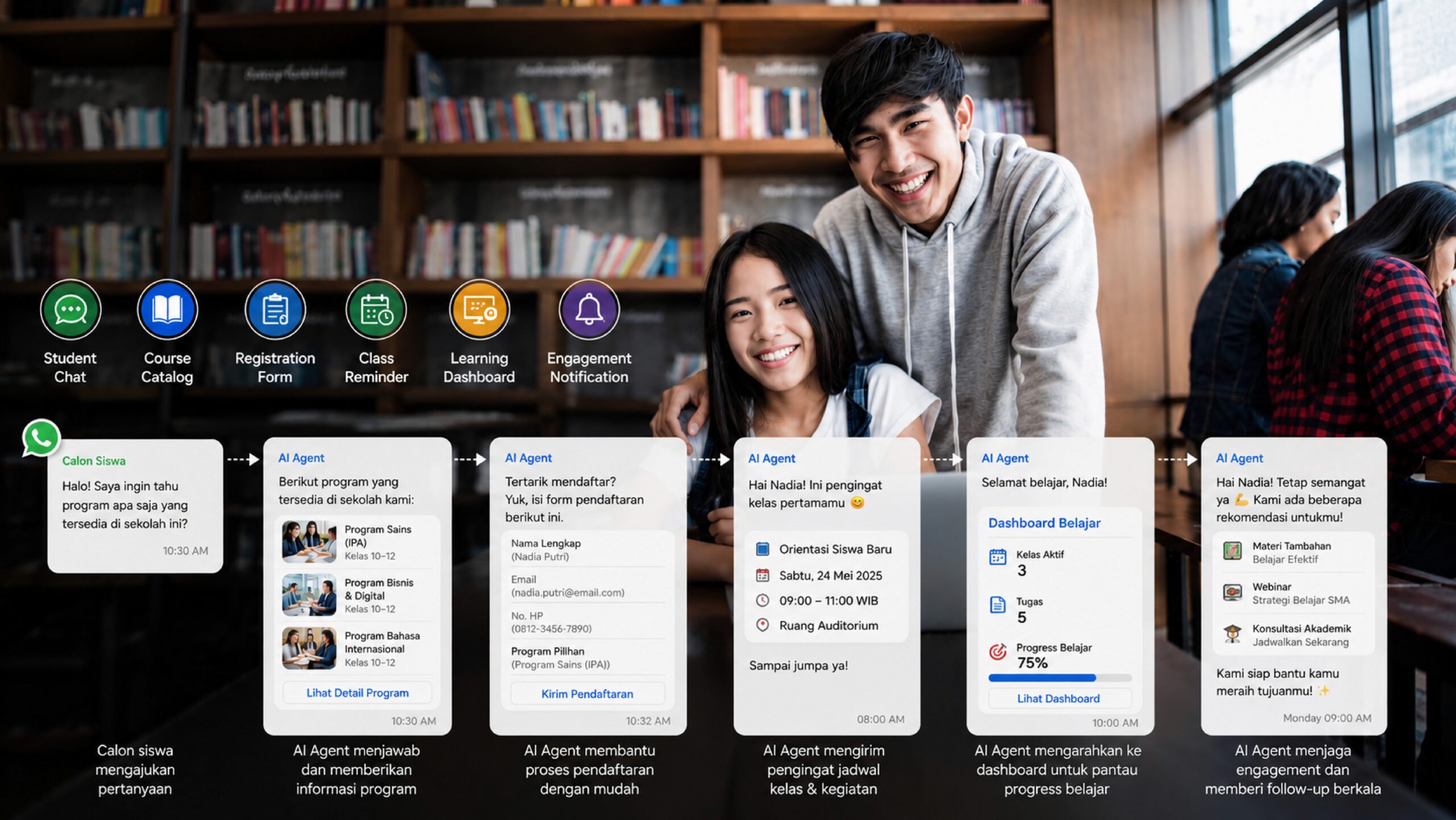
    In the education industry, decisions from prospective students and parents don’t always happen in a single conversation. They usually ask first about cost, schedule, location, learning method, facilities, programs, tutors, and the results they can expect to achieve. For educational institutions such as courses, tutoring centers, schools, and private tutoring services, this early moment is crucial because every question can become an enrollment opportunity. But when the response is late, follow-up is inconsistent, or prospective student data gets scattered across multiple admins and channels, conversion opportunities can disappear before they’re even properly processed.

    This is why an AI agent for educational institutions, courses, and tutoring centers is becoming increasingly relevant for modern education businesses. Not just as a chatbot answering simple questions, an AI agent can become a working system that helps educational institutions manage prospective students from the inquiry stage, enrollment, class reminders, engagement during the program, all the way to upselling advanced programs. At Cekat.AI, we see that the main challenge for educational institutions isn’t just getting more leads, but making sure every prospective student gets a fast response, clear information, and proper follow-up until they finally enroll and show up to class.

    Today’s Educational Institution Challenge Isn’t Just Promotion — It’s Conversion

    Many educational institutions are already actively promoting through Instagram, TikTok, WhatsApp, the website, referrals, and digital ads. Marketing activity can generate plenty of incoming questions, but that doesn’t mean all of them turn into enrollments. The problem usually shows up after a prospective student makes contact. There are chats left unanswered, questions answered differently by different admins, prospective students who were interested but never followed up, or students who already enrolled but forgot their class schedule.

    In the course and tutoring business, response speed has a huge influence on prospective students’ interest. When someone asks about an English program, a university entrance exam class, a digital marketing course, math tutoring, or private classes for their child, they’re usually comparing several options at once. If the educational institution can’t answer quickly and convincingly, prospective students can switch to a competitor that’s more ready to respond.

    This is where AI for courses and tutoring centers becomes a solution that not only helps operations, but also strengthens the student acquisition process. An AI agent can keep the conversation going, provide program information consistently, record the prospective student’s needs, and help the admissions or admin team focus on the most promising prospects.

    AI Agent as the First Gateway to Student Enrollment

    The enrollment process usually starts with a simple question. Prospective students or parents want to know about available classes, schedule, cost, learning method, location, payment system, promos, trial classes, and whether the program fits their needs. If all these questions are still answered manually, admins can get overwhelmed, especially during busy periods like the new school year, exam season, new batch openings, or promo campaigns.

    With an AI agent-powered student enrollment chatbot, educational institutions can provide automatic responses that still feel natural and relevant. An AI agent can answer questions based on prepared program information, guide prospective students to the right class option, and help collect important data such as name, age, education level, learning goals, schedule preferences, location, and specific needs.

    For an English course, an AI agent can help ask about the prospective student’s proficiency level, learning goals, and desired schedule. For a tutoring center, an AI agent can identify whether the student needs preparation for university entrance exams, school exams, olympiads, or regular tutoring support. For private tutoring, an AI agent can record the subject, home location, online or offline preference, and tutor requirements. With this process, the admissions team no longer starts the conversation from zero because initial data has already been gathered automatically.

    More Consistent, Measurable Follow-Up for Prospective Students

    One of the biggest leak points in educational institutions is follow-up with prospective students. Many prospective students are actually already interested, but haven’t made a decision yet because they’re still discussing it with their parents, comparing costs, waiting for a suitable schedule, or wanting to confirm program quality. If follow-up depends only on an admin’s memory, big opportunities can slip through.

    An AI agent helps educational institutions build more consistent follow-up without feeling pushy. After a prospective student asks about a program, the AI agent can send a follow-up message based on the conversation’s context. For example, a prospective student who asked about cost can get a follow-up explaining the program’s value, payment options, or promo information. A prospective student interested in a trial class can be reminded to pick a schedule. A prospective student who hasn’t completed the enrollment form can be guided back with a more personal message.

    For Cekat.AI, follow-up isn’t just about sending automated messages — it’s about building a communication flow that helps prospective students make a decision. Every stage of the conversation needs a clear purpose, from addressing doubts and reinforcing the program’s value, to guiding toward enrollment and making sure the prospective student actually shows up to the first class.

    Automated Class Reminders to Improve Show-Up Rate

    In the education business, enrollment isn’t the end of the process. The next challenge is making sure students actually show up to class. Many educational institutions run into situations where students have already signed up for a trial class, placement test, program consultation, or first class, but don’t show up because they forgot, had a schedule conflict, or didn’t get a clear enough reminder.

    Automated class reminders can help improve show-up rate because students get timely reminders through the channel they use most, such as WhatsApp. An AI agent can send reminders before class starts, re-confirm the schedule, send the online class link, location, tutor’s name, materials to prepare, and additional instructions. For recurring classes, reminders can also be sent periodically to keep students disciplined about following the schedule.

    For tutoring centers and courses with many batches, a manual reminder system can be exhausting. Admins have to remember many schedules, classes, students, and time changes. With an AI agent, this process can be made tidier because reminders are connected to student data and class schedules. The result: educational institutions can reduce the risk of miscommunication, maintain the student experience, and help the operations team work more efficiently.

    Student Engagement Doesn’t Stop Once Class Starts

    Many educational institutions focus too much on enrollment but forget that student engagement after class starts matters just as much. Students who feel looked after tend to be more active in class, more open to giving feedback, and more willing to take advanced programs. On the other hand, students who feel unsupported can lose motivation faster, skip classes, or drop out of the program.

    AI-powered student engagement can help educational institutions maintain communication once a student is enrolled in a program. An AI agent can send assignment reminders, supporting materials, class information summaries, evaluation schedules, or relevant motivational messages. For parents, an AI agent can also help send specific updates such as payment reminders, meeting schedules, or program progress information.

    In the context of courses and tutoring centers, good engagement doesn’t just make students feel connected — it also creates retention opportunities. When a student finishes one program, an AI agent can help offer a suitable follow-up program. For example, a student who completes a basic class can be directed to intermediate. A student who finishes a university entrance exam program can be offered additional intensive classes. A student taking math tutoring can be recommended an exam preparation program. With this approach, an AI agent doesn’t just support service — it also supports the educational institution’s revenue growth.

    Upselling Advanced Programs with Better Timing

    Upselling in the education business needs to be done sensitively. Prospective students and parents don’t want to feel like they’re just being sold additional programs. They want to receive recommendations that make sense based on their needs, progress, and learning goals. That’s why timing and context matter so much.

    An AI agent can help educational institutions read the right moment to offer an advanced program. After a student completes a certain class, the AI agent can send a relevant recommendation based on their previous program. After a student attends a trial class, the AI agent can offer a regular package. After a parent gives positive feedback, the AI agent can guide them toward an advanced program or additional classes.

    With Cekat.AI, educational institutions can build a more structured upsell flow. Not the same mass promotional message for everyone, but communication that’s more tailored to each student’s status and needs. This helps educational institutions increase repeat enrollment opportunities without sacrificing the quality of their relationship with students and parents.

    Easier Feedback Collection That Gets Followed Up Faster

    Feedback is one of the most important assets for an educational institution. From feedback, course, tutoring center, and school operators can understand teacher quality, material effectiveness, student satisfaction, learning obstacles, and areas that need improvement. However, feedback collection is often inconsistent because it’s done manually, too late, or sent only once without follow-up.

    An AI agent can help collect feedback automatically after class, after a trial, after a program ends, or after a consultation session. Students and parents can be asked to give a quick rating, comment, or input about their learning experience. This data can then be used by the academic team, customer success, and management to make better decisions.

    For educational institutions looking to grow, feedback isn’t just an evaluation tool — it’s also a source of insight for improving service quality and strengthening positioning. If many students feel helped by a particular teaching method, that insight can become marketing communication material. If a recurring obstacle keeps showing up, the team can fix the process before the issue affects student retention.

    From Manual Chat to a More Scalable Admissions System

    When an educational institution is still small, replying to chats manually might feel manageable. But as the number of inquiries grows, programs multiply, class batches get more complex, and communication channels become more varied, a manual system starts becoming a bottleneck. Admins can get overwhelmed, response quality drops, and prospective student data becomes hard to track.

    An AI agent for educational institutions, courses, and tutoring centers helps turn the admissions process from simply replying to chats into a more scalable system. Every prospective student can enter a clearer flow, starting from the initial question, data collection, program recommendation, follow-up, enrollment, class reminders, all the way to engagement once class is underway.

    Cekat.AI helps educational institutions build a tidier communication system with an AI agent, omnichannel inbox, CRM, and automation. This means conversations from various channels can be managed more centrally, prospective student data can be recorded better, and follow-up can run automatically based on need. The team no longer has to spend all its time replying to repetitive messages, but can instead focus on the prospective students most ready to enroll and the students who need more attention.

    AI for Courses, Tutoring Centers, Private Tutoring, and Schools

    Every educational institution has different needs, but the pattern of challenges is often similar. Courses need a system that can answer program questions, manage batch schedules, and maintain student retention. Tutoring centers need strong follow-up for prospective students and parents, especially ahead of exam season or the opening of intensive classes. Private tutoring needs to match student needs with tutor schedule and availability. Schools need tidy communication between prospective parents, the admissions admin, and the academic team.

    An AI agent can be adapted to each institution’s flow. For courses, an AI agent can help explain program levels, schedules, and placement tests. For tutoring centers, an AI agent can help prospective students choose a program based on grade level and exam target. For private tutoring, an AI agent can gather learning needs and schedule preferences. For schools, an AI agent can answer questions about enrollment, cost, curriculum, facilities, open house schedule, and the admissions process.

    With the right approach, an AI agent doesn’t fully replace the human role, but strengthens the team’s capacity. Admins can still handle conversations that require empathy, negotiation, or special decisions, while the AI agent handles repetitive questions, reminders, follow-up, and initial data collection.

    Improving Enrollment Conversion with a Faster, Clearer Experience

    Enrollment conversion isn’t only influenced by program quality, but also by the communication experience from the very start. Prospective students and parents want to feel served quickly, guided clearly, and reassured that the institution is professional. If the enrollment process feels slow, confusing, or unresponsive, trust can drop before the prospective student even tries the program.

    With an AI agent, educational institutions can create a faster, more consistent experience. Questions get answered more promptly, program options get explained more clearly, prospective student data gets recorded more completely, and follow-up runs more in a structured way. This helps increase conversion opportunities because prospective students aren’t left hanging in the middle of the process.

    For Cekat.AI, automation in educational institutions should be seen as part of a growth strategy. An AI agent helps educational institutions reduce repetitive work, speed up responses, improve show-up rate, strengthen student engagement, and open up opportunities to upsell advanced programs. When the communication process becomes tidier, educational institutions can capture more opportunities from the inquiries already coming in.

    It’s Time to Automate Your Educational Institution

    Educational institutions that want to grow can’t rely only on promotion and program quality. They also need a communication system capable of handling prospective students quickly, maintaining relationships with existing students, and making sure every enrollment opportunity isn’t lost to a manual process.

    An AI agent for educational institutions, courses, and tutoring centers is the solution to these needs. With a student enrollment chatbot, automated class reminders, prospective student follow-up, AI-powered student engagement, advanced program upsell, and feedback collection, educational institutions can build an experience that’s more responsive, measurable, and scalable.

    Cekat.AI helps courses, tutoring centers, schools, and other education businesses automate their communication process from the first inquiry all the way through engagement once class is underway. If your educational institution wants to improve enrollment conversion, fix show-up rate, and build more consistent student relationships, now is the time to make admissions and student engagement work more automatically.

    Automate your educational institution with Cekat.AI and start managing enrollment, class reminders, follow-up, and student engagement in one smarter, faster system ready to support the growth of your education business.

  • 5 Most Effective WhatsApp Automations for Business in 2025

    5 Most Effective WhatsApp Automations for Business in 2025

    Transforming Business Communication with WhatsApp Automation

    In today’s fast-paced business world, communication with customers has to be real-time, efficient, and personal. WhatsApp, with more than two billion active users globally, has become the main channel for brands to reach their audience. However, as the daily volume of messages grows, many companies struggle to maintain fast responses without increasing operational costs.

    This is where WhatsApp Automation comes in. By automating conversations through a smart system like Cekat.ai, businesses can save time, increase customer satisfaction, and speed up the conversion process without losing the personal touch.

    This article discusses the 5 most effective WhatsApp automation use cases for business in 2025, complete with implementation examples and their direct impact on efficiency.

    What Is WhatsApp Automation?

    WhatsApp Automation is the use of technology — particularly AI-based chatbots and CRM system integration — to automatically manage customer communication on WhatsApp.
    Its functions include:

    • Instantly answering common questions (FAQs).

    • Sending automatic order notifications or confirmations.

    • Running customer follow-ups without manual intervention.

    • Running surveys and personalized broadcast campaigns.

    With a platform like Cekat.ai, businesses can build a smart chatbot that recognizes conversation context, understands customer intent, and responds in natural, human-like language.

    1. Automatic Order Confirmation

    Use Case:

    Every time a customer makes a purchase through a website, marketplace, or social media, the system automatically sends an order confirmation message via WhatsApp.

    Example Template:

    Hi [Customer Name], thank you for shopping at [Store Name]. Your order #[Order Number] is being processed and will be shipped to [Shipping Address]. We will send you automatic shipping status updates.

    Business Impact:

    • Saves customer service staff time by up to 70%.

    • Reduces the number of order status questions.

    • Increases customer trust through proactive communication.

    Cekat.ai Case Study:
    A fashion retail client used Cekat.ai to automate order confirmations and shipping updates. As a result, response time dropped by 80% and customer satisfaction rose significantly.

    2. Automatic Payment Follow-Up

    Use Case:

    Many customers stop at the checkout stage or forget to complete payment. Follow-up automation on WhatsApp can help recover pending transactions.

    Example Template:

    Hi [Name], we noticed you haven’t completed payment for order #[Order Number]. Click the following link to continue your payment: [Payment Link].

    Business Impact:

    • Increases conversion rate by up to 25%.

    • Reduces losses from incomplete transactions.

    • Provides a gentle yet effective shopping experience.

    With Cekat.ai, follow-ups can be scheduled based on time (e.g. 3 hours after cart abandonment) or based on user behavior in the CRM system.

    3. Shipping Notifications and Package Status

    Use Case:

    Once an order has shipped, customers often want to know where their package is. An automated WhatsApp system can send real-time notifications integrated with the logistics system.

    Example Template:

    Your order #[Order Number] has shipped and is on its way. Track your shipment here: [Tracking Link]. Thank you for shopping at [Store Name]!

    Business Impact:

    • Reduces the operations team’s workload from manual update requests by up to 40%.

    • Increases transparency and customer trust.

    • Increases repeat order rate thanks to a smoother customer experience.

    4. Automatic Surveys and Feedback

    Use Case:

    After a purchase, businesses can automatically send a feedback request message to improve service quality.

    Example Template:

    Hi [Name], we hope you’re happy with order #[Order Number]. Please take a moment to give us your rating here: [Survey Link].

    Business Impact:

    • Generates rich customer data for service quality analysis.

    • Helps detect issues faster before they become public complaints.

    • Increases post-transaction engagement by up to 35%.

    Real example:
    An F&B brand using the Cekat.ai Survey Bot managed to collect 3x more customer feedback within 2 weeks compared to their previous manual method.

    5. 24/7 Customer Service Chatbot

    Use Case:

    With high volumes of customer questions, an AI chatbot on WhatsApp can provide nonstop 24-hour service, from answering product questions to checking order status.

    Example Template:

    Hi! I’m the Virtual Assistant for [Brand Name]. Choose the service you need:

    • Check order status

    • Product info & promos

    • Contact a human team member

    Business Impact:

    • Keeps response fast outside of working hours.

    • Reduces CS agent workload by up to 60%.

    • Increases customer loyalty because the brand is always “present” whenever needed.

    How Do You Build a WhatsApp Automation Chatbot?

    To build an effective WhatsApp Automation system, there are three main components:

    1. Official WhatsApp API Platform
      Use an official provider like Cekat.ai that integrates directly with Meta’s WhatsApp Business API.
      This guarantees data security and system stability.

    2. Chatbot Builder with AI Natural Language Processing (NLP)
      The chatbot must be able to recognize customer intent, not just reply based on keywords.
      Cekat.ai uses adaptive AI that keeps learning from conversations to improve response accuracy.

    3. CRM Integration and Analytics Dashboard
      All conversations and interactions must be logged so businesses can analyze performance, measure conversion, and improve personalization.

    Benefits of WhatsApp Automation for Business

    Aspect

    Immediate Impact

    Long-term Impact

    Operational Efficiency

    Saves time and customer service cost

    Increases profit margin

    Customer Satisfaction

    Fast response and high transparency

    Increased customer loyalty

    Sales

    Automatic follow-up drives conversion

    Higher repeat order rate

    Scalability

    System can serve thousands of chats per day

    Business ready to grow without adding staff

    WhatsApp Automation, a Strategic Investment for 2025

    In 2025, automation is no longer optional — it’s a necessity.
    WhatsApp Automation helps businesses not only respond to customers faster, but also build stronger, more efficient relationships.

    With a platform like Cekat.ai, every business — from e-commerce to professional services — can activate a smart conversation system that boosts productivity, accelerates sales, and strengthens customer loyalty.

    If your business wants to move toward a more effective digital transformation, start with WhatsApp automation today.

  • Implementing AI Agents for Clinics & Hospitals: An Indonesia Case Study

    Implementing AI Agents for Clinics & Hospitals: An Indonesia Case Study

    The Challenge of Digitalization in Healthcare

    Healthcare is one of the most vital sectors in Indonesia, but it is also among the most operationally complex. Clinics and hospitals have to manage thousands of patient records, answer repetitive questions every day, arrange doctors’ schedules, handle payments, and carry out medical follow-ups. For years, much of this has been done manually or relied on a call center with a limited number of staff.

    This situation creates various problems such as long queues, slow responses to patient questions, a high rate of patients missing their scheduled check-ups (no-shows), and delayed bill payments. In the digital era, these challenges can no longer be solved simply by adding more staff. What’s needed is smart technology that can work automatically, responsively, and still remain personal.

    This is where the AI Agent comes in as a solution. With the ability to understand natural language, integrate with hospital information systems (HIS), and reach patients through popular communication channels such as WhatsApp, SMS, and email, an AI Agent can help clinics and hospitals face modern challenges while improving the quality of healthcare services.

    What Is an AI Agent in the Context of Healthcare?

    An AI Agent is different from a conventional chatbot. While a chatbot generally only provides limited script-based answers, an AI Agent works in a smarter and more dynamic way:

    • Understanding conversational context using Natural Language Processing (NLP) technology.

    • Executing actions automatically, such as creating an appointment, sending a reminder, or generating a payment link.

    • Integrating with the hospital’s internal systems, so every patient interaction can be directly linked to medical history, doctor schedules, and billing.

    • Providing 24/7 service without interruption, so patients feel supported whenever they need information.

    With these capabilities, an AI Agent isn’t just a communication tool, but an integral part of a digital transformation strategy in the healthcare sector.

    Local Case Study: AI Agent Implementation in Indonesian Clinics & Hospitals

    1. Making Patient Registration More Efficient

    Before AI Agents, patients usually had to wait a long time at the counter or call a call center just to register. This wasted patients’ time while also burdening administrative staff.

    With an AI Agent:

    • Patients simply send a message via WhatsApp or the official app.

    • The system asks for basic identity information such as name, ID number, and initial complaint.

    • The AI Agent automatically matches the patient with an available doctor’s schedule and provides a registration confirmation.

    Benefits:

    • Reduces counter wait times by up to 50%.

    • Reduces the burden on administrative staff who previously had to handle repetitive questions.

    • Provides a more convenient and efficient registration experience for patients.

    2. Appointment Reminders & Patient Billing

    One classic problem in the healthcare sector is the high rate of patient no-shows and delayed payments. This not only harms patients but also affects the hospital’s operational efficiency.

    An AI Agent helps by:

    • Sending automatic reminders one day before or a few hours before a scheduled consultation.

    • Providing an attendance confirmation feature or reschedule option without needing a manual phone call.

    • Sending digital payment notifications complete with links to online payment methods.

    Benefits:

    • Patient attendance rates increase by up to 30% thanks to consistent reminders.

    • The billing process is faster, reducing payment delays.

    • Patients feel supported because reminders are personal and timely.

    3. Post-Treatment Patient Follow-Up

    Medical care ideally shouldn’t stop once a patient leaves the consultation room. Clinics and hospitals that prioritize service quality typically carry out follow-ups. However, if done manually, this takes a great deal of effort and time.

    With an AI Agent, follow-up can run automatically:

    • Patients receive a personal message about their post-treatment health condition.

    • Health education related to medication, diet, or post-surgery activity is delivered in a digital format.

    • Patients can reply immediately if they experience symptoms or side effects, which is then forwarded to the medical team.

    Benefits:

    • Increases patient satisfaction because they feel cared for.

    • Minimizes the risk of complications because patients receive additional education.

    • Creates a positive image for the clinic/hospital because service doesn’t stop at the consultation.

    Frequently Asked Questions

    1. Can a hospital use a chatbot?

    Yes, it can. However, a regular chatbot is limited to answering simple questions. An AI Agent is far more effective because it can execute real actions such as registration, reminders, and follow-up connected to the hospital’s internal systems.

    2. How does AI help healthcare services?

    AI helps by reducing administrative burden, speeding up communication processes, optimizing schedules, and improving the patient experience through consistent, personal service.

    3. Can AI replace a clinic’s customer service?

    Not entirely. An AI Agent is better suited as a co-pilot for customer service. It handles repetitive questions and administrative tasks, while human staff are still needed for complex cases that require empathy and clinical judgment.

    4. What are some examples of AI use in Indonesian hospitals?

    Real examples include automatic patient registration via WhatsApp, appointment reminders, digital payment notifications, and patient satisfaction surveys sent after treatment.

    Business and Strategic Impact for Clinics & Hospitals

    Implementing an AI Agent delivers a significant impact, both operationally and strategically:

    • Operational Efficiency: Reduces overhead costs and manual staff workload.

    • Improved Patient Retention: Automatic reminders make patients more disciplined about check-ups and more loyal.

    • Revenue Optimization: Automated billing speeds up cash flow and minimizes bad debt.

    • Better Service Quality: Patients feel cared for throughout their entire medical journey.

    As a result, an AI Agent isn’t just a technology solution, it’s also a strategic investment that can strengthen the competitiveness of clinics and hospitals in Indonesia.

    Healthcare digitalization in Indonesia is no longer just an option, it’s a necessity. AI Agents for clinics & hospitals have proven capable of improving registration efficiency, reducing no-show rates, speeding up the payment process, and strengthening patient follow-up. Local case studies show that this technology isn’t just a trend, it’s a real solution that delivers business and service impact.

    Is your clinic or hospital ready to step into the era of modern healthcare?
    With Cekat.ai, you can deploy an integrated, secure AI Agent specifically designed to support healthcare operational needs in Indonesia. Contact our team today to get an AI-based solution tailored to your healthcare institution’s challenges and needs.

  • Order Management via WhatsApp API: Accurate Order Tracking & Automation

    Order Management via WhatsApp API: Accurate Order Tracking & Automation

    Executive Summary & Value Proposition

    • Real-Time Data Synchronization: Connects your Order Management System (OMS) directly with the WhatsApp API as the single source of order truth.
    • Automated Post-Purchase Alerts: Dispatches payment confirmations, shipping tracking numbers, and delivery status updates proactively.
    • CS Operational Efficiency: Eliminates repetitive “where is my order” (WISMO) support tickets so agents focus on high-value cases.
    • Transparent Customer Self-Service: Delivers a consistent, reliable, and convenient order-tracking experience directly inside messaging threads.

    Order Management via WhatsApp API represents the integration between an Order Management System (OMS) and WhatsApp as a primary customer engagement channel. This integration enables businesses to send automated, real-time status updates, shipping dispatches, and post-purchase notifications.

    The core objective is not simply messaging customers, but ensuring that information received by buyers matches real-time operational status within your warehouse and backend platforms.

    Why Connect Your Order Management System to WhatsApp?

    Once a checkout transaction completes, customer focus shifts from pricing to fulfillment certainty:

    • Has my order been processed?
    • When will it be shipped?
    • How can I track my shipment package?

    When businesses fail to answer these inquiries proactively, customer service ticket queues swell and brand trust declines. By leveraging the WhatsApp Business API, companies send time-sensitive updates automatically through order automation without waiting for manual customer inquiries.

    The OMS as the Single Source of Truth

    In this architecture, the OMS acts as the central source of order truth. The WhatsApp API does not replace your OMS; rather, it delivers notifications sourced directly from backend database events.

    An optimized integration guarantees that:

    • Notifications trigger only when order statuses actually change within the OMS.
    • Customer data stays synchronized with records stored in your CRM platform.
    • No discrepancies exist between customer support, warehouse staff, and buyers.

    Order Management Workflow via WhatsApp API

    Workflow Stage System Action (OMS & Backend) WhatsApp API Action (Cekat.ai)
    1. Order Created Order logged & payment verified in OMS. Dispatches order confirmation & item summary template.
    2. Order Processing Status shifts to packing/fulfillment in warehouse. Triggers internal inventory workflow automation.
    3. Shipped & Dispatched Courier tracking number generated. Sends tracking number & direct tracking link payload.
    4. Delivered Courier confirms successful package arrival. Dispatches delivery confirmation & feedback request.

    Effective and Non-Intrusive Order Tracking

    Effective order tracking does not require messaging customers for every minor update. Over-messaging risks being perceived as spam. Recommended tracking practices include:

    • Sending notifications exclusively at milestone touchpoints (order confirmed, shipped, delivered).
    • Using clear, concise, and professional template language.
    • Including the order ID, recipient name, and tracking code clearly.
    • Providing clear guidance if customers wish to converse further via your omnichannel application.

    Case Study: Mid-Scale E-Commerce Business

    A regional e-commerce merchant handles approximately 300 orders daily. Prior to automation, support teams were overwhelmed with manual order status inquiries, causing delayed response times during seasonal sales spikes.

    After integrating their OMS with the WhatsApp API via Cekat.ai:

    • Order confirmations and shipment notifications dispatched automatically.
    • Customers accessed self-service tracking directly inside WhatsApp.
    • Routine “where is my order” support ticket volumes dropped by over 60%.
    • Support personnel redirected focus toward complex customer inquiries.

    Business Impact and Operational ROI

    Implementing structured order management empowers retail & e-commerce businesses to:

    • Lower operational overhead associated with repetitive messaging.
    • Increase post-purchase customer satisfaction and trust.
    • Maintain absolute communication consistency across fulfillment pipelines.
    • Scale daily order fulfillment without inflating support team headcount.

    Cekat.ai helps enterprises integrate OMS backend systems with the WhatsApp API securely and reliably. From custom message template architecture to automated update logic, Cekat.ai ensures every order notification builds customer confidence and operational efficiency.


    Frequently Asked Questions (FAQ)

    1. Can the WhatsApp API connect with any OMS or e-commerce platform?

    Yes. Cekat.ai provides robust Open API endpoints and webhooks to connect with OMS platforms, ERPs, Shopify, WooCommerce, and custom enterprise backends.

    2. Which message template category is used for shipping and order status alerts?

    Order status alerts utilize Meta’s Utility message category, which is specifically designed for post-purchase transactional updates.

    3. What happens if data updates fail within the OMS platform?

    If OMS status updates stall, automated dispatches pause. Cekat.ai includes pre-dispatch data validation logic to prevent sending inaccurate notifications to buyers.

    4. Can customers reply directly to automated order status notifications?

    Yes. When a customer replies, it opens a standard 24-hour service conversation window, which can be handled automatically by an AI Agent or routed to human agents.


  • Boosting Online Sales with AI-Powered Social Commerce

    Boosting Online Sales with AI-Powered Social Commerce

    Digital business competition is getting fiercer, especially for mid-to-large enterprises trying to sustain online sales growth. Consumers now increasingly interact and shop directly through social platforms like Instagram, WhatsApp, or TikTok. This phenomenon is called social commerce — and it is now being supercharged by artificial intelligence (AI).

    With Social Commerce AI, businesses can turn chats and social interactions into measurable sales. Platforms like Cekat.ai allow brands to automate customer conversations, provide product recommendations, and monitor campaign performance, without sacrificing a personal touch.

    Understanding Social Commerce

    Social commerce is the practice of selling products directly through social media platforms or messaging apps, where customers can complete the entire purchase process without leaving for an external website.

    For mid-to-large enterprises, this isn’t just an additional strategy — it’s a new sales channel that shortens the customer journey from “seeing a product” to “buying a product.”

    Quick Comparison

    Aspect

    Traditional E-Commerce

    Social Commerce

    Main platform

    Online store website

    Social media / chat (Instagram, WhatsApp, TikTok)

    Purchase path

    Must leave the social platform

    Direct purchase within chat/social app

    Customer interaction

    Formal, separate

    Interactive, chat-based

    User data

    Limited

    Richer, as it includes conversations and social behavior

    Social commerce allows brands to sell where their customers already spend their time, instead of waiting for them to visit a website.

    The Role of AI in Optimizing Social Commerce

    a. Automated Chat Commerce

    AI allows businesses to serve customers 24/7 via WhatsApp, Instagram DM, or Facebook Messenger. AI-powered chatbots can:

    • Answer questions about stock, sizing, or shipping.

    • Provide automatic product recommendations.

    • Direct customers to payment or a human agent when needed.

    Companies with high message volumes can significantly improve their response rate and chat-to-purchase conversion.

    b. Personalization and Prediction

    AI analyzes customer interaction history to:

    • Surface relevant products.

    • Send promotions at the times customers are most active.

    • Predict purchasing trends and stock that is about to run out.

    With this personalization, customers feel individually served — boosting loyalty and repeat purchases.

    c. Marketing Automation and Retargeting

    AI can:

    • Identify customers who haven’t completed a purchase.

    • Send personalized reminders or promos via WhatsApp.

    • Measure the effectiveness of social/chat campaigns in real time.

    For mid-to-large enterprises, this reduces conversion leakage and improves campaign ROI.

    d. Analysis and Operational Insights

    AI doesn’t just answer messages — it also learns from conversation patterns to uncover insights:
    the products customers ask about most, peak chat hours, and even the reasons customers don’t end up buying.

    This data becomes the foundation for more accurate marketing and operational decisions.

    Why Social Commerce AI Matters for Mid-to-Large Enterprises

    a. Handling Scale and Complexity

    Mid-to-large enterprises often face thousands of incoming messages every day across various channels. AI helps process them automatically, maintaining service speed without needing to grow a large team.

    b. Operational Efficiency

    Chat automation saves customer service teams 50–70% of their time, allowing staff to focus on high-value cases like upselling and premium service.

    c. Data-Driven Decisions

    Social commerce AI provides full visibility into customer behavior across all social and chat channels. These insights support data-driven decision-making instead of guesswork.

    d. Increased Loyalty

    Fast responses and personal interactions build customer trust. For mid-to-large enterprises, this plays a key role in protecting brand image and increasing customer lifetime value.

    How to Implement Social Commerce AI in Your Business

    Step 1: Audit Your Social and Chat Channels

    • Identify active platforms (Instagram, WhatsApp, Facebook).

    • Measure current chat volume, response time, and conversion rate.

    • Find the gaps: unanswered chats or customers who didn’t complete a purchase.

    Step 2: Set Goals and KPIs

    Example KPIs for 6–12 months:

    • Chat response time < 5 minutes.

    • Chat-to-purchase conversion up 20%.

    • Social customer retention up 15%.

    Step 3: Choose an Integrated AI Solution

    Use a system that can:

    • Connect WhatsApp, Instagram, and marketplaces in a single dashboard.

    • Provide analytics reports and automatic message personalization.

    • Integrate with the company’s CRM and stock data systems.

    Cekat.ai provides omnichannel integration with a focus on chat commerce, customer analytics, and automated abandoned-cart follow-up.

    Step 4: Design an Automated Chat Flow

    A simple example:

    1. Customer sends a message → chatbot greets them & shows options: catalog, promo, or consultation.

    2. Customer selects catalog → AI recommends products based on preferences.

    3. If the customer doesn’t buy → the system automatically sends a reminder or promo within 24 hours.

    Step 5: Monitor and Evaluate

    Use the dashboard to track:

    • The number of chats that end in a transaction.

    • The most frequently asked questions.

    • Peak hours of customer interaction.

    Iteration and optimization are carried out regularly to ensure continuously improving results.

    Case Study: Cekat.ai Helps a Retail Brand Boost Chat Conversion

    According to an official article on the Cekat.ai website, one retail brand in Indonesia faced a major challenge in the form of a high volume of chats on Instagram and WhatsApp that weren’t being handled quickly.

    Challenges

    • Many customers asked about stock but didn’t get real-time responses.

    • High abandoned cart rates on the marketplace due to a lack of follow-up.

    • No system to integrate customer interaction data across channels.

    Cekat.ai’s Solution

    • Implemented chat automation on Instagram DM and WhatsApp Business.

    • Added an automatic follow-up feature for customers who hadn’t completed payment.

    • Used conversation analytics to understand the most commonly asked question types.

    Results

    • Chat response rate improved significantly.

    • Chat-to-purchase conversion increased measurably.

    • Customers felt they received fast and consistent service.

    Lessons for Your Business

    Cekat.ai shows that AI technology isn’t just efficient — it can also be a major driver of sales growth through social and chat channels, even without expanding the team significantly.

    Implementation Challenges and Solutions

    Common Challenges

    1. Data Integration: Chat, stock, and CRM systems must be connected for automation to work optimally.

    2. Chatbot Quality: Generic chatbots often fail to handle complex questions.

    3. Security and Privacy: Customer data must be managed in line with regulations and AI transparency.

    How to Address Them

    • Use a platform with enterprise-grade data security standards and customer privacy controls.

    • Run a pilot project on one channel before expanding to all channels.

    • Make sure customers know they’re interacting with an automated system and can switch to a human agent at any time.

    Success Strategies for Mid-to-Large Enterprises

    1. Start Gradually, Focus on Quick Wins
      Automate common questions (FAQ, stock, promos) first before moving on to advanced personalization.

    2. Integrate with Internal Systems
      Connect chat data with CRM and inventory to keep information real-time at all times.

    3. Use Insights for Decision-Making
      Analyze conversation data to identify popular products and new demand trends.

    4. Preserve the Human Touch
      AI improves efficiency, but human interaction remains crucial for building trust with major customers.

    5. Evaluate and Iterate Regularly
      Regularly update chat flows and messaging based on performance data and customer feedback.

    Data Compliance and Security

    In line with Google AI Overview guidance and EEAT principles (Expertise, Experience, Authoritativeness, Trustworthiness), implementing Social Commerce AI must comply with:

    • Data Security: Customer information is stored encrypted and never shared without consent.

    • Transparency: Customers are informed when interacting with an automated system.

    • Accuracy: AI recommendations and responses must be based on valid, verified data.

    Companies that maintain data integrity and AI transparency will earn greater customer trust and be easier to optimize for Google search results.

    Social Commerce AI has become a major catalyst in the evolution of digital sales. For mid-to-large enterprises, implementing solutions like Cekat.ai can:

    • Turn WhatsApp and Instagram DM into direct sales channels.

    • Reduce the CS team’s workload while speeding up customer response times.

    • Deliver sharper business insights through conversation analysis.

    With the right implementation strategy — starting from a channel audit, gradual automation, all the way to full CRM integration — companies can turn chat into a sustainable new source of sales.

    Social commerce is no longer the future — it’s today’s business reality, and AI is the engine driving it.