Category: Finance

  • AI Lead Nurturing: How to Keep Prospects Warm Automatically

    Not every lead is ready to buy the moment they come in. Some are just gathering information, some are still comparing vendors, some are waiting on budget, and some are already interested but don’t yet have the urgency to decide. The problem is, many businesses focus too much on chasing leads that are ready to close today, letting other prospects simply go cold.

    Yet a lead that hasn’t closed doesn’t mean it isn’t promising. They just need the right approach, relevant information, and consistent follow-up. This is where AI lead nurturing helps businesses keep prospects warm automatically, without forcing the marketing and sales team to send messages manually one by one.

    At Cekat.ai, we see lead nurturing as more than just sending periodic broadcasts. Effective lead nurturing has to understand who the prospect is, what stage they’re at, what they need, and what kind of message is most relevant to move them to the next stage.

    Why Do Leads Often Go Cold Before Closing?

    In the sales process, a lead can be lost not only because they aren’t interested. Often, a lead goes cold because there’s no consistent follow-up. Once the first conversation ends, the sales team gets busy handling new leads, while prospects who still need more education don’t get additional information.

    On the other hand, prospects also aren’t always ready to decide in a single interaction. They might need time to discuss internally, compare solutions, read case studies, understand pricing, or wait for the right moment. If a business isn’t present during that consideration phase, the prospect can forget, lose context, or move to a competitor that follows up more actively.

    AI lead nurturing helps close this gap. With automation, every new lead can flow directly into the appropriate nurturing sequence. They keep getting relevant information, reminders, and content periodically, even when the sales team isn’t actively reaching out to them manually.

    What Is AI Lead Nurturing?

    AI lead nurturing is the process of automatically maintaining relationships with prospects using AI, conversation data, segmentation, and workflow automation. The goal is to make sure every lead gets relevant communication based on their needs, industry, stage, and level of interest.

    Unlike a generic broadcast, AI lead nurturing doesn’t treat every prospect with the same message. A lead from the education industry can get different content from a healthcare lead. A prospect who just asked about pricing can get different education from a prospect who has already requested a demo. A lead who hasn’t replied in seven days can get a different reminder from a lead who has already shown high buying intent.

    With this approach, nurturing becomes more personal, more structured, and easier to scale.

    AI Lead Nurturing Flow: From New Lead to Re-Engagement

    Simply put, the AI lead nurturing flow can start from the moment a new lead comes in. The AI agent then helps read the conversation context, qualify the initial need, provide relevant information, and place the lead into the appropriate segment. After that, the system can run periodic content, follow-up reminders, and re-engagement for leads that start going cold.

    The flow can be illustrated like this:

    New Lead Comes In → AI Qualifies the Need → Segmentation by Industry & Stage → Send Relevant Content → Periodic Follow-Up Reminder → Escalate to Sales When Buying Intent Rises → Re-Engagement for Cold Leads

    In practice, this flow helps the marketing and sales team work more smoothly. Marketing can make sure leads get the right education, while sales can focus more on prospects who have already shown signals of being ready to buy.

    First Step: AI Helps Qualify New Leads

    When a new lead comes in from WhatsApp, the website, an ad, an event, or a digital campaign, the first response matters a great deal. At this stage, AI can help ask initial qualifying questions, such as business needs, team size, industry, current challenges, or the solution they’re looking for.

    This qualification helps businesses understand whether the lead is still at the awareness stage, the consideration stage, or already approaching a decision. For example, a lead who just asks “What can Cekat.ai help with?” is likely still in need of basic education. Meanwhile, a lead who asks “Can this integrate with our CRM?” or “What’s the pricing for 10 agents?” shows higher intent.

    With AI, the qualification process can run faster and more consistently. The lead doesn’t have to wait long for an initial response, while the sales team gets clearer context before taking over the conversation.

    Periodic Content Keeps Prospects Educated

    Once a lead is qualified, nurturing shouldn’t stop at a single conversation. Prospects need periodic content that helps them understand the problem, see the solution, and build trust in the brand.

    Nurturing content can take the form of practical tips, industry insight, case studies, product education, testimonials, limited-time promos, or guides relevant to their pain points. For leads still at an early stage, educational content like tips and insights works best. For leads already considering a solution, case studies and comparison angles can be more effective. For leads approaching a decision, a promo, demo invitation, or consultation reminder can be a more relevant push.

    AI helps make sure the content sent isn’t just periodic for its own sake, but matches the lead’s context. That way, the communication feels more personal and doesn’t read like spam.

    Nurturing Segmentation by Industry and Stage

    One of the keys to successful AI lead nurturing is segmentation. Without segmentation, every lead flows into the same sequence, even though each prospect’s needs can be very different.

    A lead from the F&B industry might be more interested in how to reply to order chats faster, send promos, or maintain repeat orders. A lead from education might need more of a prospective-student follow-up flow, registration reminders, and program information. A lead from healthcare might focus more on appointments, responding to patient questions, and managing service inquiries.

    Beyond industry, stage also matters. A new lead needs an introduction. A lead who has already asked about pricing needs a value explanation. A lead who has already attended a demo needs a more specific follow-up. A lead who isn’t responding needs to enter a re-engagement flow.

    With segmentation by industry and stage, nurturing becomes more relevant. Prospects don’t just receive a message, they receive a message that fits their situation.

    Periodic Reminders for Leads That Haven’t Closed

    In many sales processes, a lead isn’t always lost because they refused. Many leads are simply delayed. They haven’t replied yet, haven’t gotten approval, haven’t had time for a meeting, or are still waiting for the right time.

    AI can help send periodic reminders automatically without the sales team having to remember everything manually. For example, after three days without a response, the system can send a light follow-up message. After seven days, the system can send a relevant case study. After two weeks, the system can send a consultation reminder or an offer to talk again.

    Reminders like this help keep the conversation alive. The sales team doesn’t have to chase every lead manually, but can still show up consistently at the right moments.

    Re-Engagement for Cold Leads

    Cold leads often become a forgotten database. Yet some of them may not have been ready to buy when they first came in, but could become relevant again weeks or months later.

    With AI lead nurturing, cold leads can be reactivated through a re-engagement workflow. A re-engagement message doesn’t have to sell right away. It can start with helpful content, the latest insight, a feature update, an industry case study, or a light question to check whether their needs are still the same.

    For example, a lead who was once interested in customer service automation can be sent content about how to handle repetitive questions without adding headcount. A lead who once asked about CRM can be sent insight on follow-up automation. With this approach, re-engagement feels more contextual and not forced.

    Cekat.ai Helps with More Personal Lead Nurturing

    Cekat.ai helps businesses run automatic lead nurturing from conversations that have already happened. AI agent, CRM, omnichannel chat, marketing automation, and workflow can all be connected within one ecosystem, so every lead can be managed with fuller context.

    When a new lead comes in, AI can help provide an initial response and gather important information. When a lead shows interest, the data can flow into the CRM and be grouped by stage. When a lead hasn’t closed, the system can run automatic nurturing through periodic content, reminders, or re-engagement. When buying intent rises, the conversation can be routed to the sales team to follow up.

    With Cekat.ai, nurturing no longer relies entirely on the team’s manual memory. Businesses can maintain communication with prospects consistently, while still feeling personal because the messages sent follow the lead’s context and needs.

    Lead Nurturing Is Not Just Follow-Up, It’s a Revenue Strategy

    Good lead nurturing helps businesses maximize the opportunity from leads that have already come in. This matters because acquiring a new lead usually costs money. If existing leads aren’t managed well, a business doesn’t just lose prospects, it also wastes the marketing budget that was already spent.

    With AI lead nurturing, marketing and sales can work more in sync. Marketing doesn’t just generate leads, it also helps educate and keep prospects active. Sales doesn’t just chase leads manually, it can focus on prospects who are already more ready to close.

    Ultimately, automatic nurturing helps businesses build a healthier pipeline. Leads don’t go cold quickly, follow-up is more consistent, and the chances of closing can increase because every prospect gets more relevant communication.

    Start nurturing leads automatically with Cekat.ai.

  • Best Omnichannel CRM for Indonesian SMEs 2026: Guide & Platform Comparison

    Best Omnichannel CRM for Indonesian SMEs 2026: Guide & Platform Comparison

    Key Advantages

    • Unified Multi-Channel Communications Inbox: Consolidates WhatsApp, Instagram direct messages, email, and live web chat into a single dashboard.
    • Zero Lead Drop-Off Rate: Automatically records every incoming customer touchpoint to ensure systematic sales follow-ups.
    • Conflict-Free Team Collaboration: Empowers multiple support representatives to handle customer inquiries simultaneously on one business number.
    • Cost-Effective Licensing Architecture: Delivers conversational automations and contact tracking without expensive enterprise software fees.

    In modern commercial environments, customer interactions are distributed across diverse digital touchpoints such as WhatsApp, Instagram, email, e-commerce marketplaces, and website forms. The core challenge facing small and medium-sized enterprises (SMEs) is no longer merely generating inbound inquiries, but managing high conversation volumes neatly and responsively. Successfully unifying these interactions requires understanding essential omnichannel software features.

    Without an integrated communication backbone, growing businesses forfeit valuable commercial opportunities due to buried chat threads, neglected follow-up deadlines, and delayed response times. Selecting the right omnichannel crm for smes provides a structured operational framework. Adopting scalable sme crm software establishes enterprise-grade efficiency on an accessible budget, as highlighted in our guide to choosing a WhatsApp CRM.

    What Is an Omnichannel CRM?

    An omnichannel CRM is an integrated software platform that unifies customer correspondence across multiple digital channels into a single operational workspace, while automatically tracking buyer histories, deal stages, and representative activities.

    Unlike conventional CRM software focused solely on isolated contact tables, an omnichannel solution connects real-time messaging directly with commercial deal pipelines. Utilizing a unified omnichannel application ensures customer service teams maintain strict fast response benchmarks across every communication touchpoint.

    Why Growing SMEs Require an Omnichannel CRM

    Consumer buying habits have transformed permanently. A prospective buyer routinely discovers a product catalog on social media, requests technical details on WhatsApp, and finalizes checkout on a web storefront. Without a unified system, this customer journey becomes fragmented.

    Key operational advantages of deploying an omnichannel CRM include:

    • Accelerated Response Velocity: Incoming messages funnel into a shared inbox, eliminating the need to rotate through multiple browser tabs or mobile devices.
    • Elimination of Lost Opportunities: Every inbound interaction generates an active contact record ready for immediate representative assignment.
    • Higher Transaction Closing Rates: Automated task scheduling guarantees commercial proposals and price quotes arrive when buyer interest peaks.
    • Conflict-Free Agent Delegation: Collision detection features prevent multiple staff members from typing duplicate responses to the same customer.
    • Superior Buyer Experience: Historical conversation records remain accessible, preventing customers from having to re-explain their background.

    Comparative Matrix: Omnichannel CRM Platforms for SMEs

    CRM Platform Unified Shared Inbox AI Messaging Automation Pipeline Lead Tracking SME Budget Suitability
    Cekat.ai Included (WhatsApp, IG, Web Chat) Agentic AI & Visual Workflow Engine Integrated Visual Kanban Boards Highly Accessible for Growing SMEs
    Qontak Included Standard Rule-Based Chatbots Included Mid to High Enterprise Tiers
    SleekFlow Included Basic Trigger Scripts Included High (Foreign Currency Billing)

    7 Essential Omnichannel CRM Features for SMEs

    Commercial leaders must evaluate platforms carefully to avoid overpaying for unnecessary complexities. Prioritize these seven core software capabilities:

    1. Multi-Channel Shared Inbox: Consolidates verified WhatsApp Business, social media messaging, and website live chat inside one screen.
    2. Visual Deal Stage Tracking: Monitors the progression of prospective accounts from initial inquiry to final payment inside commercial CRM applications.
    3. Centralized Account Timeline: Preserves previous order receipts, custom requests, and quotation files in chronological order.
    4. Automated Conversational Auto-Replies: Resolves repetitive inquiries regarding operating hours and product availability automatically 24/7.
    5. Audience Tagging and Segmentation: Categorizes buyer profiles based on purchase value tiers, geographical location, or account status.
    6. Performance Telemetry Dashboards: Audits representative response times, ticket resolution speeds, and customer satisfaction metrics objectively.
    7. Regional Infrastructure Integrations: Connects seamlessly with domestic payment gateways and regional commercial marketplaces.

    Structured Implementation Steps for Growing Businesses

    Adopting an omnichannel CRM does not require complex IT overhauls. Follow these six operational steps:

    1. Audit Primary Digital Endpoints

    Pinpoint where the majority of your customer interactions originate, focusing initially on core verified messaging endpoints before adding secondary channels.

    2. Consolidate Fragmented Contact Lists

    Aggregate buyer records currently scattered across representative smartphones and spreadsheets into a clean central database.

    3. Configure Contextual Quick Responses

    Structure pre-approved messaging templates for standard billing, shipping, and product queries to accelerate frontline reply speeds.

    4. Establish User Role Permissions

    Assign specific inbox queues and account responsibilities to designated support agents to maintain clear operational accountability.

    5. Conduct Inbound Workflow Simulation

    Send test inquiries to verify that automated queue routing rules and assignment alerts trigger accurately prior to customer rollout.

    6. Audit Performance Metrics Periodically

    Examine response velocity and peak conversation hours weekly to refine staffing schedules and improve overall customer satisfaction.

    Scale Your Customer Communications with Cekat.ai

    Managing hundreds of daily buyer touchpoints should never overwhelm your support staff. Implementing modern infrastructure transforms incoming messages into sustainable revenue growth.

    The enterprise platform at Cekat.ai provides verified WhatsApp Business API connectivity, collaborative multi-agent shared inboxes, visual CRM deal tracking, and autonomous AI automation inside an easy-to-use system.

    Explore our platform capabilities on the official Cekat.ai website or book an introductory discovery consultation with our technical team to elevate your business communication today.

    Frequently Asked Questions (FAQ)

    1. What is the difference between a traditional CRM and an Omnichannel CRM?

    A traditional CRM functions primarily as a static database of customer details and transaction histories, whereas an Omnichannel CRM natively unifies active multi-channel messaging inboxes directly into live customer records in real time.

    2. Does an SME require internal IT engineers to deploy an Omnichannel CRM?

    No. Modern cloud-native platforms like Cekat.ai are engineered with intuitive, no-code interfaces, enabling frontline sales and administrative personnel to operate the workspace immediately.

    3. What is the typical monthly subscription cost of an SME Omnichannel CRM?

    Software pricing varies based on user seats and messaging automations. Purpose-built SME platforms provide accessible entry-level subscription tiers that scale sustainably as operational transaction volumes expand.

    4. Can multiple support staff collaborate over a single official WhatsApp number?

    Yes. Deploying verified WhatsApp Business API solutions allows dozens of representatives to log in concurrently from separate computers, collaborating over a single verified business number.

  • WhatsApp Templates by Industry: Ready-to-Use for F&B, Property, Clinics, and Retail

    Many businesses already use WhatsApp to communicate with customers. However, not all of them use WhatsApp strategically. One common mistake is relying on message templates that are too generic to fit any specific industry.

    In reality, F&B customer needs are different from property. The way a clinic sends reminders is naturally different from a retailer trying to drive repeat purchases. Even within the same channel, WhatsApp, industry context heavily determines the message content, the timing of delivery, and the communication goal.

    That’s why ready-to-use WhatsApp templates by industry, for F&B, property, clinics, and retail, are so important. They help marketing, sales, and customer service teams work faster without having to write messages from scratch every time a campaign runs. A good template doesn’t just sound polished, it also helps customers clearly understand the next step to take.

    At Cekat.AI, we see WhatsApp as more than just a messaging medium, it’s part of the customer journey. Every message should serve a business function: confirming, reminding, offering, following up, or encouraging the customer to transact again.

    Why Industry-Specific WhatsApp Templates Are More Effective

    Generic WhatsApp templates usually sound safe, but they lack relevance. Messages like “Thank you for contacting us” or “Please contact our admin for further information” can technically be used in many situations, but they aren’t strong enough to drive action.

    Marketing teams need more specific templates. For F&B, messages need to support reservations, menu promotions, and feedback after a customer visit. For property, messages need to support unit-visit follow-ups, mortgage simulations, and down payment reminders. For clinics, messages need to support appointments, treatment reminders, and lab result notifications, all in professional language. For retail, messages need to drive restock alerts, birthday offers, and loyalty point updates.

    With more specific templates, teams don’t need to make many edits. They simply adjust the customer’s name, date, product, branch, or promo. The result is communication that’s faster, more consistent, and easier to measure.

    WhatsApp Templates for the F&B Industry

    In the F&B industry, WhatsApp is often a key touchpoint before and after a customer visit. Customers can use WhatsApp to make reservations, ask about the menu, receive promotions, or give feedback after their meal. Because the pace of F&B business is fast, message templates need to be concise, friendly, and direct customers straight to the next action.

    For reservation confirmations, the message needs to provide clarity on time, number of guests, location, and instructions in case the customer wants to change the schedule.

    Hi [Name], your reservation at [Restaurant Name] has been confirmed for [Date] at [Time] for [Number of Guests] guests.

    Your table will be ready according to schedule. If there’s any change to the time or number of guests, feel free to reply to this message directly. See you at [Restaurant Name].

    For new menu promotions, the message needs to feel enticing while staying clear. Avoid messages that are too long, since F&B customers typically respond faster to visuals, the menu item name, the benefit, and the promo deadline.

    Hi [Name], there’s a new menu item at [Restaurant Name] you can try starting today.

    [Menu Item] comes with [Flavor/Benefit Highlight], perfect for anyone who loves [Menu Preference]. This week only, enjoy a [Promo Details] promotion for dine-in or takeaway orders.

    Would you like us to help you make a reservation or place an order now through WhatsApp?

    For post-dining feedback, timing is crucial. The message should be sent after the customer finishes their meal, while the experience is still fresh but without feeling intrusive.

    Hi [Name], thank you for visiting [Restaurant Name].

    We want to make sure your experience today was enjoyable. If you don’t mind, feel free to share some quick feedback through this message. Your input helps us maintain the quality of our food and service.

    A good F&B WhatsApp template helps a restaurant not only close today’s transaction, but also maintain the relationship so customers want to come back.

    WhatsApp Templates for the Property Industry

    In the property industry, the customer journey is typically longer. Prospective buyers or tenants don’t make a decision after a single inquiry. They need to view the unit, compare prices, calculate their payment capacity, discuss with family, and confirm documents or payment schemes.

    That’s why property WhatsApp messages need to support the follow-up process without feeling too pushy. The focus is on providing relevant information, maintaining momentum, and helping prospective customers make decisions with more confidence.

    For follow-up after a unit visit, the message needs to remind the customer of the unit they viewed and open the door for further discussion.

    Hi [Name], thank you for visiting [Property Name] and viewing the [Unit Type] unit today.

    As a quick summary, this unit features [Unit Highlight], with an estimated price starting from [Price]. If you’d like to compare it with other unit types or see a payment simulation, we’re happy to send the details over WhatsApp.

    For mortgage simulations, the message needs to be clear and helpful, since payment is often the biggest point of hesitation in a property purchase.

    Hi [Name], here’s the mortgage simulation for the [Unit Type] unit at [Property Name].

    With a unit price of [Price], the estimated down payment starts from [Down Payment Amount], with installments of around [Estimated Installment] per month over a [Loan Term] term. This simulation is only an estimate and can be adjusted based on your application profile.

    If you’d like, our team can help review the installment options that best fit your needs.

    For down payment reminders, the message needs to be firm but professional, so the customer feels supported rather than pressured.

    Hi [Name], this is a reminder that the down payment for the [Unit Type] unit at [Property Name] is due no later than [Date].

    To keep your chosen unit reserved, payment can be made via [Payment Method]. If you run into any issues or need help with the payment process, please reply to this message so our team can assist you.

    Specific property WhatsApp templates help sales teams maintain relationships with high-value leads, especially during the consideration-to-closing phase.

    WhatsApp Templates for the Clinic Industry

    For clinics, WhatsApp plays an important role in maintaining appointment discipline and the patient experience. Messages sent need to be clear, polite, and trust-building. Unlike other industries, clinic communication needs to be handled more carefully because it involves treatment schedules, medical information, and patient privacy.

    For treatment appointment reminders, the message needs to help patients remember their schedule while also providing preparation instructions if needed.

    Hi [Name], this is a reminder of your treatment appointment at [Clinic Name] on [Date] at [Time].

    The scheduled treatment is [Treatment Name] with [Doctor/Therapist Name]. Please arrive [Duration] minutes early for registration. If you need to reschedule, you can reply to this message.

    For post-treatment reminders, clinics can send light instructions so patients still feel supported after their visit.

    Hi [Name], thank you for completing your treatment at [Clinic Name].

    For the best results, please follow the aftercare instructions provided by our team. If you have any questions after your treatment, feel free to reply to this message so our clinic team can assist you.

    For lab result notifications, the message should avoid stating result details directly on WhatsApp. Use WhatsApp only to notify the patient that results are available, then direct them to a secure process.

    Hi [Name], your lab results at [Clinic Name] are now available.

    To protect your privacy and data security, results can be accessed via [Secure Link/Clinic App] or collected directly at the clinic following standard procedure. If you’d like to schedule a follow-up consultation with the doctor, we can help arrange it through this WhatsApp chat.

    A good clinic WhatsApp template helps keep operations organized, reduces the risk of patients forgetting their schedule, and keeps communication professional.

    WhatsApp Templates for the Retail Industry

    In the retail industry, WhatsApp is highly effective for driving repeat purchases. Customers can receive stock notifications, birthday promotions, loyalty point updates, product recommendations, and even personalized offers based on their purchase history.

    However, retail businesses are also prone to sending too many messages that feel like mass broadcasts. That’s why retail WhatsApp templates need to feel relevant and grounded in each customer’s context.

    For restock alerts, the message needs to directly mention the product the customer has been waiting for and provide clear purchase instructions.

    Hi [Name], the [Product Name] you’ve been waiting for is back in stock at [Store Name].

    Stock is currently limited, so feel free to place your order right through this WhatsApp chat or visit our store at [Store Location/Link]. Would you like us to help secure the item for you now?

    For birthday offers, the message needs to feel personal and not like just another regular promotion.

    Happy birthday, [Name]!

    As a token of appreciation from [Brand Name], we’ve prepared a special birthday offer just for you: [Promo Details]. This offer is valid until [Date] and can be used to purchase your favorite products via [Purchase Channel].

    We hope you have a wonderful day.

    For loyalty point updates, the message needs to make customers feel there’s real value they can use, not just receive a number.

    Hi [Name], your loyalty points at [Brand Name] have now reached [Points Balance] points.

    These points can be used for [Points Benefit], including shopping discounts or select rewards, subject to applicable terms. If you’d like to see product recommendations you can redeem or purchase using your points, we’re happy to send you some options.

    Retail WhatsApp templates help brands keep customers engaged, boost repeat purchases, and make loyalty programs feel more alive.

    How to Use WhatsApp Templates More Effectively

    Ready-to-use templates become even more powerful when used within the right workflow. Confirmation messages should be sent immediately after the customer takes an action. Reminder messages need to be sent close enough to the scheduled time. Promo messages are more effective when sent to relevant customer segments. Loyalty and birthday offer messages feel more personal when connected to customer data.

    This is where having the right system matters. If every template is sent manually, the team still risks forgetting follow-ups, misjudging segmentation, or sending messages that don’t fit the context. Templates shouldn’t just be stored as documents, they should be integrated into the business’s communication workflow.

    With Cekat.AI, industry-specific WhatsApp templates can be used within a more structured omnichannel workflow. Teams can manage conversations, organize templates, run automation, handle follow-ups, and track customer communication performance, all in a single platform.

    Cekat.AI Helps Teams Turn Templates Into Workflows

    A good WhatsApp template does more than just speed up message writing. More importantly, it helps businesses maintain consistent communication at every point of the customer journey. From restaurant reservations and property follow-ups to clinic appointments and retail loyalty, every message can be directed toward a clearer business objective.

    Cekat.AI helps businesses turn templates into workflows that run more smoothly. Messages no longer depend entirely on an admin’s memory or manual notes. Every template can be tied to a trigger, a segment, a customer status, and a specific follow-up need.

    For marketing teams across industries, this means faster campaign execution. For business owners, it means customer communication that is more consistent, more measurable, and ready to scale.

    If your business operates in F&B, property, clinics, or retail, use WhatsApp templates that fit your industry context, not generic messages that need heavy editing every time you use them.

    Import these industry templates directly into Cekat.AI.

  • WhatsApp API Fallback System: Reliable Failover & SMS Fallback Architecture

    WhatsApp API Fallback System: Reliable Failover & SMS Fallback Architecture

    Executive Summary & Value Proposition

    • Critical Message Continuity: Guarantees the delivery of OTP codes, transaction alerts, and urgent notices even during WhatsApp API downtime.
    • Automated Failover Mechanism: Instantly reroutes message flows to secondary channels (such as SMS fallback or email) based on real-time event triggers.
    • Revenue & SLA Protection: Prevents checkout drop-offs, protects conversion rates, and reduces customer frustration caused by platform outages.
    • Controlled Decision Engine: Manages retry logic and channel prioritization to avoid unnecessary operational cost spikes.

    A WhatsApp API fallback system is an automated failover mechanism that reroutes message delivery to a backup channel—such as SMS fallback or email—when a WhatsApp message fails to deliver. Its main purpose is to maintain communication continuity, prevent operational disruptions, and protect customer experience during critical scenarios like OTP verification, transactional alerts, and customer support.

    Why a Fallback System Is a Necessity, Not an Option

    Many enterprises assume that the WhatsApp Business API is 100% available at all times. This assumption carries significant risk. In daily operations, delivery failures are not anomalies; they are calculable risks. When a single channel becomes a single point of failure, the impact directly affects revenue, SLA compliance, and brand trust.

    Common causes of WhatsApp API delivery failures include:

    • Downtime or service degradation: Technical outages originating from Meta’s infrastructure or network carrier issues.
    • Rate limits & throughput caps: Sudden traffic spikes during high-volume promotional events.
    • Message template rejections: Templates violating updated policy guidelines or failing automated checks.
    • Expired session windows: 24-hour conversation windows closing without valid template messages ready.

    Without a fallback architecture, a single technical glitch can freeze your entire business communication pipeline.

    Backup Channels Comparison

    Backup Channel Key Advantages Limitations Best Use Cases
    SMS Fallback Near 100% delivery reach, independent of internet access. Higher cost per message, character limits (no rich media). OTP codes, security alerts, & urgent transaction status.
    Email Handles rich formatting & long text, highly cost-effective. Higher latency, not always opened in real-time. Invoices, order summaries, & formal confirmation receipts.
    Push Notifications Low cost, displays directly on the user’s mobile screen. Limited only to users who have installed the mobile app.

    Building an Effective Failover Architecture

    A mature fallback system must be designed as an event-driven workflow rather than a manual process. Key components include:

    1. Delivery Status Monitoring: Reading sent, delivered, failed status updates via webhook events in real-time.
    2. Controlled Retry Logic: Capped retries to prevent duplicate messages or triggering API rate limit bans.
    3. Decision Engine: Logic automation that determines when to retry WhatsApp versus immediately failing over to SMS.
    4. Channel Prioritization: Message categorization ensuring non-critical messages do not trigger expensive backup paths.

    Case Study: Reliability Planning for Enterprise E-Commerce

    Consider a national e-commerce platform relying on the WhatsApp API for login OTPs and payment confirmations. During a flash sale event, a traffic surge causes a portion of WhatsApp OTPs to stall due to platform rate limits.

    Without a fallback system, thousands of users fail to log in, halting transactions. However, with an active fallback system managed via workflow automation, the system detects the WhatsApp delivery failure within seconds and instantly redirects the dispatch to SMS fallback.

    Users receive their OTP codes without delay, checkouts complete successfully, and support ticket queues remain manageable.

    Best Practices for Implementing WhatsApp API Fallback

    • Apply fallback triggers exclusively to time-sensitive, critical messages.
    • Implement strict deduplication guards to prevent customers from receiving duplicate notifications.
    • Ensure user opt-in consent covers secondary communication channels.
    • Log all failover transactions into your CRM platform for auditing and operational performance tracking.

    Build a Resilient Communication System with Cekat.ai

    Cekat.ai helps enterprises design intelligent, automated WhatsApp API fallback architectures—ranging from real-time failure detection and instant failover to SMS or email, to unified analytics within an omnichannel application.

    Protect your critical business communications today with Cekat.ai.


    Frequently Asked Questions (FAQ)

    1. What is a fallback system in WhatsApp Business API?

    A fallback system is an automated workflow that reroutes message delivery from WhatsApp to an alternative channel (like SMS or email) whenever the primary delivery fails due to technical or network disruptions.

    2. Why is SMS the most common fallback option for WhatsApp?

    SMS offers the highest global reach because it does not require an active internet connection and can be received immediately on virtually any mobile device.

    3. Should all WhatsApp messages have an automated fallback?

    No. Fallback workflows should be prioritized only for critical, time-sensitive messages such as OTPs, security alerts, and payment receipts to optimize operational costs.

    4. How does Cekat.ai detect message delivery failures?

    Cekat.ai monitors real-time webhook callback statuses from the WhatsApp API. If a message status returns as “failed” or remains unconfirmed within a set threshold, the platform automatically triggers the failover routine.


  • AI Agent for Specialist Clinics: Dental, Eye, Skin, and ENT

    AI Agent for Specialist Clinics: Dental, Eye, Skin, and ENT

    Specialist clinics have a different operational rhythm from general clinics. Patients don’t just come in for a single consultation and then they’re done. Many specialist services require regular check-ups, post-procedure follow-up, reminders for continued treatment, at-home care education, and even recommendations for repeat product purchases or additional examinations. This is where the needs of dental, eye, skin, and ENT clinics become increasingly complex: it’s not just about how to get new patients, but how to make sure every patient stays connected, monitored, and returns at the right time.

    For specialist doctors and clinic managers, the challenge isn’t just about the number of patients coming in, but how to maintain continuity of care without overloading the front office and admin team. Each specialization has a different patient flow. Dental clinics need to remind patients about scaling every six months. Eye clinics need to manage glasses check-up schedules or post-op LASIK follow-up. Skin clinics need to make sure patients complete their treatment series and restock skincare products on time. ENT clinics need to remind patients about follow-up audiometry or periodic hearing check-ups. If all of this is done manually, the chances of patients forgetting, being late for check-ups, or falling out of the database become much higher.

    Specialist Clinics Don’t Just Need Booking, They Need a Precise Follow-Up System

    Many clinics still see digitalization as merely a way to make it easier for patients to book appointments. In practice, however, booking is just the entry point. The greatest value for specialist clinics actually happens after the patient arrives: whether the patient returns for check-ups, whether the patient completes treatment, whether the patient follows post-procedure instructions, whether the patient makes repeat product purchases, and whether the patient feels cared for throughout the treatment process.

    The problem is, follow-up activity often depends heavily on the admin’s memory or manual records. As patient volume grows, admins have to handle new chats, answer pricing questions, arrange doctors’ schedules, confirm payments, remind patients who have already booked, and follow up with existing patients all at once. Under these conditions, follow-up — which should be a source of retention and recurring revenue — often gets delayed, becomes inconsistent, or is missed altogether.

    For specialist clinics, follow-up isn’t just an extra message. Follow-up is part of the patient experience and part of business operations. Patients who receive timely check-up reminders find it easier to maintain their treatment results. Patients who receive clear post-procedure instructions feel safer. Patients who are reminded to continue their treatment series are more likely to complete the program. That’s why AI for specialist clinics needs to be designed not only to answer chats, but also to help clinics manage patient relationships from before the visit through after the procedure is complete.

    AI Agent for Dental Clinics: From Scaling Reminders to Post-Extraction Follow-Up

    Dental clinics have a visit pattern that’s a great fit for optimization with an AI agent. Many dental services require regular check-ups, especially scaling every six months, orthodontic care, follow-up fillings, braces check-ups, veneers, bleaching, and procedures such as tooth extraction and root canal treatment. Unfortunately, many patients only come in when they have a complaint. Once the procedure is done, the relationship with the clinic often stops because there’s no consistent reminder system in place.

    With an AI agent for dental clinics, Cekat.AI can help clinics set up automatic six-month scaling reminders based on each patient’s visit history. After a patient finishes scaling, the system can store the date of the last visit and send a reminder as the next check-up date approaches. The message doesn’t have to feel stiff or like a mass promotion — it can be made more personal, for example reminding the patient that it’s time to take care of their dental health again so plaque doesn’t build back up.

    For procedures like tooth extraction, post-procedure follow-up becomes very important. Patients usually need guidance after the anesthesia wears off, reminders not to rinse too vigorously, information on when to come back if bleeding occurs, and reassurance that mild pain is normal for a certain period. An AI agent can help send follow-up messages after the procedure, ask about the patient’s condition, provide basic instructions according to the clinic’s guidelines, and direct patients to contact the admin or doctor if there’s a complaint that needs to be handled directly.

    For dental clinics, the benefit of an AI agent isn’t just admin efficiency, but also improved patient recall. Previously inactive returning patients can be re-engaged through periodic reminders. The patient database stops being just an archive and becomes a source of long-term relationships. Clinics can also build a more professional experience because patients feel reminded, guided, and cared for even after they leave the treatment room.

    AI Agent for Eye Clinics: Glasses Check-Ups, Periodic Exams, and Post-Op LASIK

    Eye clinics have a different customer journey from dental clinics. Many patients come in for refraction exams, buying or adjusting glasses, dry eye consultations, cataracts, retina issues, and LASIK procedures. Each service has its own specific follow-up needs. Glasses patients need to be reminded about periodic check-ups because eye prescriptions can change. LASIK patients need more disciplined post-op reminders, since there’s a check-up schedule after the procedure and eye-drop instructions that must be followed correctly.

    This is where an AI agent for eye clinics can help maintain disciplined patient communication. After a patient has an eye exam and receives a glasses prescription, the system can help send a reminder for a follow-up check-up according to the interval set by the clinic. If the patient has already bought glasses, the AI agent can also send a follow-up message to make sure the patient is comfortable with the new lenses, isn’t experiencing dizziness, and has no complaints during daily activities.

    For LASIK patients, follow-up needs become more sensitive because they involve post-procedure recovery. An AI agent can help clinics set up post-op reminders based on a predetermined schedule, such as a next-day check-up, first-week check-up, first-month check-up, or according to the clinic’s protocol. Messages can include check-up schedule reminders, basic eye-drop instructions, and light questions about the patient’s condition. If the patient responds with a specific complaint, the AI agent can help escalate it to the admin or medical team according to the clinic’s settings.

    For eye clinic managers, a system like this helps reduce the risk of patients forgetting their check-ups and reduces the admin burden of sending reminders one by one. For patients, the experience feels safer because the clinic shows up consistently after the procedure. For doctors, structured follow-up helps make sure patients stay on the right treatment track.

    AI Agent for Skin Clinics: Maintaining Treatment Series and Driving Product Retention

    Skin and aesthetic clinics have a very strong need around treatment series and repeat purchases. Many services aren’t completed in a single visit. Acne treatment, brightening, rejuvenation, laser, peeling, hair removal, body treatment, and anti-aging programs usually require several sessions for optimal results. The biggest challenge for skin clinics is keeping patients from stopping halfway through.

    Without a well-organized follow-up system, patients can forget their next treatment schedule, feel like they haven’t seen instant results, switch to another clinic, or fail to restock products that are actually part of the treatment. Admins usually have to remind patients manually via WhatsApp, but when patient numbers are high, follow-up for treatment series often becomes uneven. Some patients get contacted regularly, some get missed, and some only get followed up after being away for too long.

    With an AI agent for skin clinics, Cekat.AI can help clinics set up treatment series reminders based on the package or program the patient has taken. If a patient is going through a series of four to six treatment sessions, the AI agent can send a reminder before the next session is due, ask about the patient’s readiness, and help direct them to the booking process. This communication can be made more personal based on the type of treatment, such as acne care, laser, brightening, or maintenance treatment.

    Besides treatment series, an AI agent can also help follow up on product usage. Many skin clinics have supporting skincare products such as facial wash, toner, serum, sunscreen, night cream, or post-procedure products. Each product has an estimated usage period. An AI agent can help send restock reminders when a product is expected to run out, so patients don’t stop using their skincare routine before it’s supposed to end. This approach not only drives repeat sales, but also helps maintain the patient’s treatment results.

    For skin clinics, an AI agent can act as a retention system that works consistently. Patients aren’t left to disappear after their first treatment. Every interaction can be directed toward maintaining the patient’s commitment to the program, helping them understand their progress, and encouraging repeat visits in a way that feels relevant, not like hard selling.

    AI Agent for ENT Clinics: Audiometry Reminders and Periodic Hearing Check-Ups

    ENT clinics have follow-up needs that are often more educational and based on further examinations. ENT patients may come in with complaints about the ears, nose, throat, hearing problems, recurring infections, allergies, sinus issues, vertigo, or the need for audiometry. For patients with hearing problems, periodic check-ups and follow-up audiometry exams become an important part of monitoring their condition.

    The challenge is that many patients don’t immediately realize the importance of a check-up once their initial complaint improves. They may feel that finishing their medication is enough, when in fact some conditions need re-evaluation. ENT clinics need a system that can help remind patients politely and educationally, especially for follow-up exams like audiometry or check-ups after using a hearing aid.

    With an AI agent for ENT clinics, Cekat.AI can help send audiometry reminders according to the schedule set by the clinic. Messages can be tailored to the patient’s context, for example patients who have previously had a hearing exam, patients recommended for a follow-up check-up, or patients currently using a hearing aid. The AI agent can also help ask whether the patient is still experiencing complaints such as ringing in the ears, a feeling of fullness, hearing problems, or other complaints that need to be consulted again.

    For ENT clinics, an AI agent helps build more proactive communication. Patients aren’t only responded to when they contact the clinic, but are also reminded when there’s an important schedule they shouldn’t miss. This approach can improve patient adherence to periodic check-ups while also helping clinics keep their patient database active.

    Why Specialist Clinics Need an AI Agent That Can Be Customized

    The needs of dental, eye, skin, and ENT clinics point to one important thing: every specialization has different operational logic. A scaling reminder isn’t the same as a post-op LASIK reminder. Tooth-extraction follow-up isn’t the same as acne-treatment follow-up. A skincare restock reminder isn’t the same as an audiometry reminder. That’s why an AI agent for specialist clinics has to be customizable, rather than just using the same chatbot template for every type of clinic.

    Cekat.AI is designed to help businesses manage conversations, customer data, automation workflows, and AI agents within one more structured ecosystem. For specialist clinics, this approach means clinics can build communication flows that match each of their services. Admins can manage patient chats from various channels in a more organized way, patient data can be tagged based on needs or interaction history, and follow-up can run automatically according to the patient’s journey.

    This customization matters because specialist clinics sell trust, not just services. Patients want to feel that the clinic understands their specific needs. When a follow-up message feels relevant to the procedure they underwent, the patient experience becomes more personal. The clinic doesn’t come across as sending a generic broadcast, but rather as providing guidance suited to the patient’s condition.

    From Incoming Chats to a Managed Patient Journey

    In clinic operations, patient chats often come in through many doors. Some ask via WhatsApp, Instagram, the website, ads, or other channels. Some ask about pricing, some want to book, some ask for the doctor’s schedule, some ask about treatment side effects, and some are just comparing services. If all of these conversations aren’t managed well, a clinic can lose a lot of opportunities even before the patient arrives.

    An AI agent helps clinics streamline the process from incoming chats to post-visit follow-up. When a patient asks a question, the AI agent can help provide an initial response based on information the clinic has already defined. When a patient wants to book, the system can help direct the conversation toward scheduling. Once the patient has visited, the visit data and follow-up needs can become the basis for the next reminder. This way, clinic communication doesn’t stop at a single chat, but turns into a more complete patient journey.

    For specialist clinics, this approach is very important because every patient has the potential for a long-term relationship. A dental scaling patient will come back again in six months. A LASIK patient needs a post-procedure check-up. A skin patient needs continued treatment and care products. An ENT patient may need periodic audiometry. An AI agent helps clinics make sure these important moments aren’t lost due to the admin team’s limited time.

    Improving Admin Efficiency Without Losing the Human Touch

    One concern clinics have when using AI is whether communication will feel too automated. In reality, the goal of an AI agent isn’t to replace the human touch entirely, but to help the clinic team handle repetitive work so people can focus on more important interactions. Schedule reminders, standard follow-up, booking confirmations, check-up reminders, and initial questions can be handled with the help of an AI agent. Meanwhile, cases that require greater empathy, medical judgment, or clinical decisions can still be directed to the admin or medical staff.

    With Cekat.AI, clinics can set when the AI agent responds, when a conversation needs to be escalated, and how the communication style is tailored to the clinic’s brand. Specialist clinics that want to sound premium can use a softer, more personal tone. Clinics that want to feel family-friendly can use warmer language. Clinics that serve professional patients can use more concise, efficient communication.

    The efficiency gained isn’t just about reducing manual work, but also about improving consistency. Admins don’t need to remember every check-up schedule one by one. Patients don’t have to wait long for an initial response. Clinics don’t have to lose opportunities because of late follow-up. Everything moves within a system that’s more organized, measurable, and scalable as the patient base grows.

    AI Agent Helps Clinics Improve Patient Retention

    For many specialist clinics, growth doesn’t always have to depend on new patients. Retaining existing patients is often a stronger opportunity, especially if the clinic already has an active patient database. The problem is, that database is often just stored as a contact list without a clear engagement strategy. Yet every patient has a reason to be contacted again with relevant context.

    Dental clinic patients can be reminded about scaling. Eye clinic patients can be reminded about glasses check-ups. Skin clinic patients can be reminded about continued treatment and product restocks. ENT clinic patients can be reminded about audiometry or hearing check-ups. If all of these reminders run consistently, clinics not only increase the likelihood of repeat visits, but also build stronger relationships with patients.

    Cekat.AI helps clinics see the AI agent as part of a retention system. Not just a tool for replying to chats, but a system that keeps patients within their treatment journey. With timely, relevant, and structured communication, clinics can increase repeat visits, improve the patient experience, and reduce the chance of patients switching to a competitor because they feel like they weren’t followed up with.

    Cekat.AI for Specialist Clinics: Custom Workflows for More Detailed Needs

    Every specialist clinic has its own flagship services, workflows, and communication standards. That’s why Cekat.AI helps clinics build an AI agent that can be tailored to each one’s needs. For dental clinics, the workflow can focus on scaling reminders, braces check-ups, and post-extraction follow-up. For eye clinics, the workflow can be directed at exam bookings, glasses check-ups, and post-op LASIK reminders. For skin clinics, the workflow can be built around treatment series, post-treatment care, and product restocks. For ENT clinics, the workflow can be tailored to audiometry reminders, hearing check-ups, and follow-up for specific complaints.

    This customized approach makes the AI agent more relevant to clinic operations. Clinics don’t have to force a generic system to fit specific needs. Instead, the system can follow the clinic’s way of working, support the admin team, and enhance the patient experience more naturally. With more centralized data, tidier conversations, and more consistent follow-up, clinics can manage growth without constantly adding to their manual workload.

    For specialist doctors and clinic managers, the question is no longer whether the clinic needs to use AI, but which part of the patient journey needs automation first. Are bookings still often falling through the cracks? Do patients frequently forget check-ups? Are many treatment series left unfinished? Are returning patients rarely re-engaged? Is the admin team too busy answering repetitive chats? That’s the starting point from which an AI agent can be customized.

    It’s Time for Specialist Clinics to Manage Patients More Intelligently

    Specialist clinics need a system that understands each service has a different follow-up pattern. Dental, eye, skin, and ENT clinics have unique needs that can’t be treated the same as general clinics. When communication is still manual, many opportunities for retention, periodic check-ups, and repeat visits simply slip away. But with a customizable AI agent, clinics can maintain patient relationships more consistently, personally, and measurably.

    Cekat.AI helps specialist clinics build a communication system that’s more ready for growth. From booking to periodic check-ups, from post-procedure follow-up to treatment series reminders, from incoming chats to patient retention, an AI agent can help clinics work more efficiently without sacrificing the quality of the patient experience.

    If your clinic wants to manage patients more efficiently, increase repeat visits, and build follow-up that matches your service specialization, now is the time to develop an AI agent that truly follows your clinic’s needs.

    Customize your AI agent with Cekat.AI and build a more consistent patient experience from the first chat to the next check-up.

  • The Difference Between AI Agent, Chatbot, and Virtual Assistant: Which One Is Right for Your Business?

    The Difference Between AI Agent, Chatbot, and Virtual Assistant: Which One Is Right for Your Business?

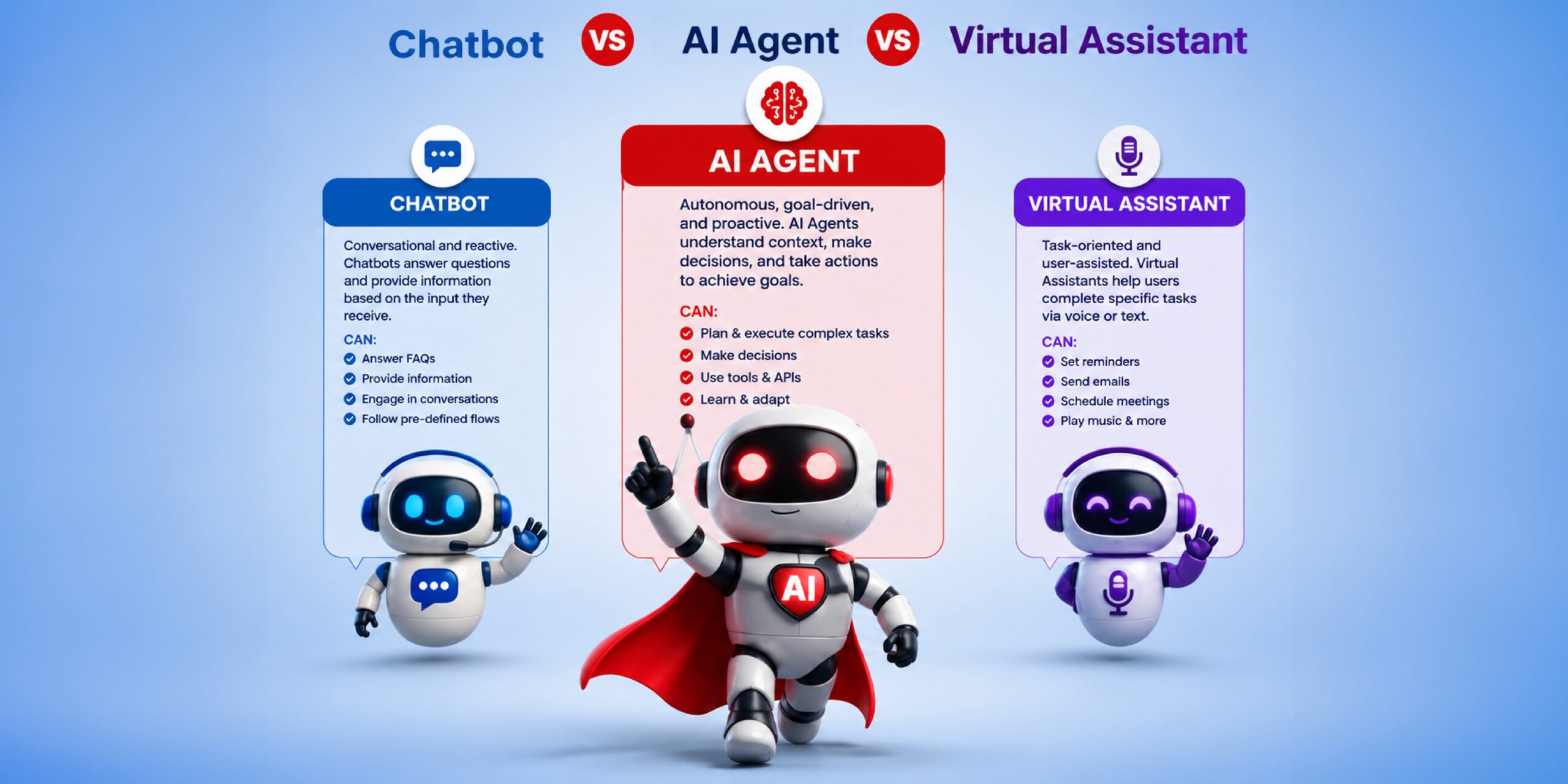
    In recent years, more and more businesses have started using automation technology to respond to customers faster, reduce manual work, and increase conversion opportunities. However, amid the popularity of terms like chatbot, virtual assistant, and AI agent, many business owners and decision makers still consider the three to be the same thing. In reality, from how they work, their level of intelligence, their ability to understand context, to their impact on operations and revenue, the three have fairly fundamental differences.

    Understanding the difference between AI agent, chatbot, and virtual assistant for business is important because the wrong technology can keep business processes feeling manual, even though they appear to be “automated.” Many companies feel they already have a chatbot, but customers still have to wait for a human admin to resolve their issue. There are also businesses that use a virtual assistant, but its function is still limited to answering simple questions, not truly helping customers move from inquiry to transaction. This is where the AI agent becomes a more advanced category, because it doesn’t just answer, it also understands intent, takes action, runs workflows, and helps businesses complete processes more independently.

    At Cekat.AI, we see that the main challenge for modern businesses is no longer simply “how to reply to chats faster,” but how every customer conversation can be managed, understood, followed up on, and converted into more measurable revenue. That’s why the discussion of chatbot vs AI agent can’t stop at conversational technology alone. The difference has to be seen in how far the system can help a business work more efficiently, more consistently, and stay better prepared for a constantly increasing volume of customer interaction.

    Rule-Based Chatbot: Good for Simple Answers with Fixed Patterns

    A chatbot is the most common form of conversational automation used by businesses. In many cases, a chatbot works on a rule-based system, meaning it responds to customers based on predetermined rules, keywords, or conversation flows. For example, when a customer types “price,” the system shows a price list. When a customer selects “check order,” the chatbot asks for the invoice number. When a customer asks something outside the available template, the chatbot usually fails to understand the context and redirects the customer to a human admin.

    The advantages of a rule-based chatbot are that it’s simple, quick to implement, and fairly effective for highly repetitive customer service needs. For businesses that only want to answer basic questions like operating hours, store address, payment methods, or simple order status, a chatbot can be a reasonable starting solution. However, its limitations start to show once customers ask questions in more natural language, with more complex context, or with needs that don’t fully follow the flow that was designed.

    In a business context, a rule-based chatbot is often the first step toward automation. But if your business’s customer journey already involves many channels, many types of inquiries, many variations in needs, and follow-up processes that affect conversion, a chatbot alone usually isn’t enough. This kind of system can help reduce the burden of simple questions, but it isn’t necessarily able to maintain engagement quality, understand customer intent, or help the business follow up on sales opportunities more strategically.

    Virtual Assistant: More Flexible, but Still Often Limited to Task Help

    A virtual assistant is one level more flexible than a rule-based chatbot. Generally, a virtual assistant is designed to help users carry out specific tasks, such as scheduling meetings, giving reminders, looking up information, directing customers to a particular service, or helping answer questions in a more natural style. Where a rule-based chatbot depends heavily on a rigid flow, a virtual assistant usually has better language understanding and a more conversational interaction experience.

    However, in a business context, a virtual assistant doesn’t always mean a truly structured system. Many virtual assistants still work as a “digital assistant” that helps with certain tasks, but aren’t necessarily able to make operational decisions, manage customer data comprehensively, run automatic follow-ups, or connect conversations to a CRM system and business workflow. In other words, a virtual assistant can feel smarter than a chatbot, but isn’t necessarily strong enough to become an operational layer with a direct impact on revenue.

    A virtual assistant is well suited for use when a business needs digital help to speed up administrative tasks or simple, more personal interactions. For example, helping a customer choose a consultation schedule, answering general questions in more natural language, or giving initial direction before a customer is handled by the sales or customer service team. But once a business starts needing a system that can understand intent, manage leads, update customer status, run follow-ups, and support the conversion process, that need has already moved into AI agent territory.

    AI Agent: A System That Doesn’t Just Answer, It Acts for the Business

    An AI agent is artificial-intelligence-based software that can understand context, determine the next step, and act in a structured way to complete business tasks. Unlike a chatbot that only responds based on a certain flow, an AI agent can read customer intent, understand conversation history, adapt its responses to customer needs, run workflows, manage data, and help the business move from conversation to more concrete action.

    In practice, an AI agent for business doesn’t only act as a chat responder. An AI agent can help filter leads, identify customer needs, gather important information, schedule meetings, give product recommendations, run automatic follow-ups, update the CRM, and even help teams spot revenue opportunities that previously went unnoticed within chats. This role is far more strategic than an ordinary chatbot, because an AI agent works as part of the business’s operational system, not just as an add-on feature on a communication channel.

    At Cekat.AI, we position the AI agent as a layer that helps businesses connect conversation, customer data, automation, and the revenue process within a single platform. For us, a customer conversation isn’t just a chat that needs a reply, it’s a source of intent that needs to be captured, understood, and followed up on. This is why the AI agent is becoming an increasingly relevant choice for businesses that want to improve response time, improve follow-up quality, reduce manual work, and make sure no customer opportunity is lost along the way.

    The Difference Between AI Agent, Chatbot, and Virtual Assistant for Business

    To make it easier to understand, the difference between AI agent, chatbot, and virtual assistant for business can be seen in how they work, their ability to understand context, their flexibility, and their impact on operational processes. A chatbot is usually suited to answering basic questions. A virtual assistant is suited to helping with certain tasks with a more natural experience. An AI agent is suited to businesses that need a more advanced system, one that can understand conversations, take action, and run business processes more independently.

    Comparison Aspect

    Rule-Based Chatbot

    Virtual Assistant

    AI Agent

    Main way of working

    Follows a predetermined flow, keywords, and rules

    Helps with certain tasks through more natural interaction

    Understands context, determines the next step, and carries out business actions

    Level of intelligence

    Limited to scenarios that have already been built

    More flexible, but still task-based

    More advanced because it can understand intent and take action

    Natural language understanding

    Low to moderate, depending on the scenario

    Moderate to high

    High, especially when connected to business data and context

    Ability to understand customer context

    Limited

    Partial, depending on integration

    Stronger, because it can read history, intent, and customer status

    Ability to run workflows

    Very limited

    Limited to certain tasks

    Can run business workflows such as follow-up, tagging, routing, CRM updates, and escalation

    Best suited for

    Simple FAQs, operating hours, basic info, service menus

    Scheduling, reminders, initial guidance, administrative help

    Lead qualification, customer engagement, sales follow-up, CRM automation, and revenue workflows

    Impact on revenue

    Indirect

    Partially supports the process

    More direct, because it helps capture, manage, and convert customer intent

    Limitation risk

    Easily fails when a question falls outside the flow

    Still needs a human for many decisions

    Requires the right platform and setup to work optimally

    Example use

    “What time does the store open?” and the chatbot answers automatically

    “Let me help you schedule your consultation”

    “I understand your needs, gather the necessary data, update the CRM, then schedule a follow-up with the sales team”

    From this table, it’s clear that the chatbot vs AI agent discussion isn’t just about which one is more modern. The difference lies in the business role each one can play. A chatbot answers. A virtual assistant helps. An AI agent works. For businesses that still have low conversation volume and simple needs, a chatbot may still be enough. But for businesses that already have many leads, many channels, many admins, and many revenue opportunities that need following up, an AI agent is a far more relevant choice.

    Rule-Based vs AI: The Difference Lies in the Ability to Understand Intent

    One of the most important differences between a traditional chatbot and an AI agent lies in the rule-based vs AI approach. A rule-based system works on the logic of “if the customer asks A, then answer B.” This approach is effective as long as customers ask questions that match a predicted pattern. But in business reality, customers rarely speak in a neat format. They may ask using mixed language, incomplete sentences, shifting context, or needs that aren’t yet clear from the start.

    AI works with a more adaptive approach. An AI agent can understand the intent behind a customer’s message, not just read keywords. For example, when a customer writes, “I need something I can pay for next month but the item ships this week,” a rule-based chatbot may struggle to determine a response if there’s no matching keyword. An AI agent can pick up that the customer is talking about a payment need, a shipping timeline, and a potential transaction. From there, the system can ask follow-up questions, provide relevant information, or direct the customer to the right process.

    For business owners and decision makers, this difference matters a great deal because the quality of a customer’s response directly affects trust, the speed of decision-making, and conversion opportunities. When a system only answers based on a template, the customer experience can feel rigid. But when a system is able to understand needs and follow up on conversations contextually, the business has a much better chance of holding onto customer interest before that intent fades.

    When Is a Chatbot Enough for a Business?

    A chatbot is still relevant for businesses with simple conversational needs and highly repetitive question patterns. If most customers only ask about basic information such as address, operating hours, service list, payment methods, or a catalog link, a rule-based chatbot can help reduce the admin’s workload. This kind of system is also well suited for early-stage businesses that want to try automation for the first time without deep integration complexity.

    However, a chatbot becomes less ideal once a business starts facing more dynamic conversations. For example, customers asking for product recommendations based on personal needs, comparing services, requesting a specific promo, asking about stock availability under specific conditions, or needing to be guided into the purchase process. In situations like these, a chatbot often only serves as the initial entry point, while resolution still depends on a human admin.

    In other words, a chatbot is a good fit when your business objective is basic response efficiency. But if that objective has grown into improving conversion, maintaining consistent follow-up, managing leads, and reducing revenue leaks from unhandled conversations, then it’s time for the business to start considering an AI agent.

    When Is a Virtual Assistant the Better Choice?

    A virtual assistant is the right choice when a business needs digital help that’s more personal than a chatbot, but doesn’t yet need a system that runs the full business workflow. For example, a virtual assistant can help customers pick a consultation schedule, send appointment reminders, give initial direction, or help customers find certain information in a more natural way.

    In service businesses, clinics, education, financial services, hospitality, or B2B, a virtual assistant can help create a more comfortable experience in the early stage of interaction. Customers don’t feel like they’re talking to an overly rigid system, while the internal team benefits because part of the administrative process can be automated. However, the effectiveness of a virtual assistant still depends on how deeply that system is connected to business data and processes.

    If a virtual assistant stands alone without a connection to a CRM, omnichannel inbox, customer segmentation, automation, or sales pipeline, its impact stops at the level of conversational help. The business may appear more responsive, but not necessarily more measurable. That’s why many companies eventually need a more integrated platform, namely an AI agent platform that can work across conversations, data, and workflows.

    When Does a Business Need to Upgrade to an AI Agent?

    A business needs to upgrade to an AI agent when customer conversations have become too important a revenue source to manage manually. The signs usually show up as rising chat volume, an overwhelmed admin team, inconsistent response time, leads slipping through the cracks, delayed follow-ups, and difficulty knowing which campaign is actually generating sales. At this stage, the business problem is no longer just “chats going unanswered,” but “customer intent failing to convert into revenue.”

    Upgrading to an AI agent also becomes important once a business has many communication channels. Customers may come from ads, the website, WhatsApp, Instagram, live chat, marketplaces, referrals, or events. If each channel is managed separately, customer data ends up scattered and the team struggles to see the full picture of the customer relationship. An AI agent connected to an omnichannel platform and a CRM can help unify that context, so every conversation isn’t isolated but becomes part of a more measurable customer journey.

    In addition, an AI agent becomes relevant when a business wants to reduce its dependence on manual processes. In many companies, admins have to answer repetitive questions, record customer data, add tags, remember follow-ups, hand leads over to sales, and update statuses manually. Processes like these are error-prone, hard to scale, and difficult to monitor. With an AI agent, most of these processes can be handled automatically, so the human team can focus on more strategic decisions, more complex cases, and opportunities with higher transaction value.

    Business Condition

    Solution That’s Still Sufficient

    The Right Time to Upgrade

    Customer questions are still simple and repetitive

    Rule-based chatbot

    No need to upgrade yet if there’s no follow-up or CRM requirement

    Customers need help with scheduling or initial guidance

    Virtual assistant

    Upgrade if the process after scheduling is still manual and frequently leaks

    High lead volume from ads or campaigns

    AI agent

    Needs an upgrade because speed-to-lead and follow-up affect conversion

    Chats coming in from many channels

    AI agent + omnichannel platform

    Needs an upgrade so data and conversations don’t get scattered

    Admin overwhelmed answering chats and recording data

    AI agent + CRM automation

    Needs an upgrade to reduce manual work and human error

    Follow-ups are often late or inconsistent

    AI agent + workflow automation

    Needs an upgrade because revenue opportunities can be lost after an inquiry

    Management struggles to see lead performance through to revenue

    AI agent platform

    Needs an upgrade so the business has clearer visibility

    Why an AI Agent Is More Relevant for Decision Makers

    For business owners and decision makers, conversational technology shouldn’t be judged only by how quickly the system replies to a message. What matters more is how much that technology helps the business reduce operational costs, improve the customer experience, increase conversion, and provide clearer visibility into the revenue pipeline. From this perspective, an AI agent carries far greater strategic value than an ordinary chatbot or a standalone virtual assistant.

    A chatbot can help reduce repetitive questions. A virtual assistant can help create more natural interactions. But an AI agent can become part of the business’s growth system because it works more closely with customer intent, customer data, and the sales process. An AI agent helps a business understand who its incoming customers are, what they need, how far along their intent is, what action should be taken next, and how that process can be followed through without relying entirely on humans.

    For decision makers, this means the business gains not just automation, but control. Control over response time. Control over follow-up quality. Control over customer data. Control over the pipeline. And ultimately, control over revenue that was previously often lost to manual processes, scattered communication, or inconsistent follow-up.

    Cekat.AI as a More Advanced AI Agent Platform for Businesses in Indonesia

    Cekat.AI exists as an AI Agent platform designed to help Indonesian businesses manage customer conversations, automate the customer journey, and turn interactions into insight and more measurable revenue opportunities. We see that businesses in Indonesia face very specific challenges: customers active across many channels, high chat volume, rising expectations for fast responses, and operational teams that often still have to manage all of it manually.

    That’s why Cekat.AI doesn’t position AI merely as an add-on chatbot. Cekat.AI builds the AI agent as part of a customer engagement and revenue platform that can help businesses capture customer intent, manage conversations across channels, save data to the CRM, run follow-ups, and help teams view business processes in a more centralized way. With this approach, the AI agent isn’t just a tool for answering questions, it becomes a system that helps the business work faster, tidier, and more scalably.

    As the most advanced AI Agent platform in Indonesia for business, Cekat.AI understands that a company’s needs don’t stop at automated responses. Businesses need a system that can bring together WhatsApp, Instagram, live chat, and other channels into a single workflow. Businesses also need a CRM that lets every customer be recognized, tagged, grouped, and followed up on. Meanwhile, marketing and sales teams need automation so that every lead not only comes in, but also moves toward conversion.

    With Cekat.AI, businesses can build a faster customer experience without losing context. Teams can reduce manual work without losing control. Decision makers can see the customer journey more clearly without having to rely on fragmented reports. This is the big difference between using an ordinary chatbot and adopting an AI agent platform that’s genuinely designed to support business growth as a whole.

    An AI Agent Doesn’t Replace the Team, It Strengthens the Business System

    One concern that often comes up when businesses start discussing AI is whether the technology will replace human roles. In a business context, a more accurate way to look at it is to see the AI agent as something that strengthens the working system, not a total replacement for humans. An AI agent helps handle repetitive work, reads initial intent, gathers information, runs follow-ups, and makes sure the process doesn’t stall just because the admin is busy or chat volume is high.

    Human teams remain essential for handling complex cases, building strategic relationships, negotiating, making decisions, and giving a personal touch to high-value customers. But with an AI agent, teams are no longer burdened by repetitive administrative work. They can work with tidier data, clearer priorities, and fuller customer context.

    For a business, the combination of an AI agent and a human team creates a more efficient operating model. Customers get a fast response. The team gets system support. Management gets visibility. And the business gets a much better chance of protecting revenue that would otherwise be lost in the middle of a manual process.

    Conclusion: The Choice of Technology Should Match Business Complexity

    The difference between AI agent, chatbot, and virtual assistant for business lies in the depth of function and its impact on operational processes. A rule-based chatbot is suited to answering simple questions with fixed patterns. A virtual assistant is suited to helping with certain tasks through a more natural interaction experience. An AI agent is suited to businesses that need a more advanced system, one that can understand intent, take action, run workflows, and help connect conversations to revenue.

    If your business is still at an early stage and only needs automated responses to basic questions, a chatbot may already be enough. If your business needs more natural conversational help for certain tasks, a virtual assistant can be the right choice. But if your business is already facing high lead volume, many communication channels, inconsistent follow-up, scattered customer data, and revenue opportunities that often slip away after a customer reaches out, then it’s time to upgrade to an AI agent.

    At Cekat.AI, we believe the future of customer engagement isn’t just about replying to chats faster, it’s about building a system that can understand, manage, and convert every customer interaction into more measurable business growth. With AI agent, omnichannel, CRM, and automation in a single platform, Cekat.AI helps Indonesian businesses move from mere automated responses toward smarter revenue operations.

    If your business is considering when the right time is to upgrade from a chatbot or virtual assistant to an AI agent, now is the right moment to take a closer look at your customer journey process. Get a free consultation with the Cekat.AI team and discover how an AI agent can help your business respond faster, follow up more consistently, and turn more conversations into revenue.

  • Designing the WhatsApp Customer Journey: From Awareness to Repeat Purchase

    In many businesses, WhatsApp is treated as nothing more than a place for customers to ask questions. But for customers, WhatsApp is actually the touchpoint closest to the buying decision. They see an ad, get interested, click the chat button, ask about the product, compare options, make a payment, then come back again when they need a recommendation, help, or the next promo.

    The problem is, many businesses haven’t designed that journey as a whole. The WhatsApp customer journey often stops at the admin’s reply. Ads are running, traffic is coming in, but conversations aren’t guided toward a purchase, purchases aren’t followed through into repeat purchases, and satisfied customers are never turned into referrals.

    This is where WhatsApp needs to be seen as part of the revenue system, not just a communication channel. With a well-designed journey, WhatsApp can help businesses connect awareness, consideration, purchase, retention, and advocacy into a single, more measurable flow.

    The WhatsApp Customer Journey Starts with Intent

    Customers who come into WhatsApp usually already carry intent. They’re not just passively viewing content, they’re already interested enough to open a conversation. That means the first moment after they click an ad or the chat button is a critical one.

    At the awareness stage, a business’s job isn’t just to make people aware that the product exists. The more important job is making sure interest generated by an ad flows straight into the right conversation. When someone clicks an ad and lands in WhatsApp, the system needs to be able to capture the traffic source, understand the customer’s initial need, and deliver a relevant response from the very first message.

    Without a well-organized system, every inquiry looks the same. Yet customers who come from a promo ad, educational content, a referral, or a specific campaign each carry a different context. A good WhatsApp customer journey has to be able to read that context so the business doesn’t treat every lead with the same approach.

    From Awareness to Consideration: Nurturing Can’t Always Be Manual

    After a customer enters WhatsApp, they won’t necessarily buy right away. They might still be comparing prices, looking for information on benefits, asking about product variants, requesting a recommendation, or waiting for the right moment to check out.

    At the consideration stage, businesses need to nurture the lead. But manual nurturing is often inconsistent. An admin can forget to follow up, messages can pile up, and each customer can end up getting a different explanation. As a result, a genuinely promising lead can be lost simply because it wasn’t guided properly.

    With an automated WhatsApp funnel, the nurturing process can be made more systematic. A customer who just asked a question can immediately get product information, key benefits, testimonials, a relevant promo, or a recommendation based on their needs. If the customer hasn’t bought yet, the system can help send a more structured follow-up without forcing the team to remember everything manually.

    For marketing strategists and business owners, this matters because WhatsApp isn’t just a place to answer questions, it’s a place to build conviction before the customer buys.

    Purchase: Checkout via Chat Needs to Be as Easy as Possible

    The purchase stage is a crucial point in a business’s WhatsApp customer journey from awareness to repeat purchase. The customer is already interested, has already asked questions, and has already started considering. At this point, the more steps they have to take, the greater the chance they’ll abandon the purchase.

    That’s why checkout via chat needs to be kept simple. Customers should be able to choose a product, get an order summary, receive payment instructions, confirm the transaction, and get order updates without having to jump between too many different platforms.

    For the business, this process also needs to stay organized behind the scenes. Every conversation needs to be connected to customer data, order status, purchase history, and follow-up activity. If checkout happens purely in chat without proper record-keeping, the business will struggle to see which channel is generating revenue, which products get asked about the most, and which customers are likely to buy again.

    With Cekat.ai, this process can be made more connected. Conversations from WhatsApp don’t just come in as chat, they can become part of a clearer sales flow, from inquiry and qualification to follow-up and transaction.

    Retention: The Journey Isn’t Over After the Purchase

    Many businesses focus too heavily on chasing new buyers, but don’t put enough design effort into the journey after a customer buys. Yet repeat purchases are often far more efficient than constantly hunting for new customers.

    At the retention stage, WhatsApp can be an especially powerful channel because it’s personal and direct. Businesses can send order updates, product-usage education, repurchase reminders, loyalty rewards, follow-on product recommendations, and relevant upsell offers.

    But retention via chat can’t rely solely on mass broadcasts. If every customer gets the same message, the communication feels generic and is easy to ignore. Effective retention requires segmentation. New customers, loyal customers, customers who haven’t bought in a while, and high-value customers should each get a different approach.

    With a well-designed WhatsApp customer journey, businesses can see the best time to follow up, which products are relevant to offer, and what kind of message best matches each customer’s history.

    Advocacy: Satisfied Customers Can Become a Growth Channel

    The final stage that often gets forgotten is advocacy. A satisfied customer can actually become a new source of growth through reviews, testimonials, user-generated content, or a referral program via WhatsApp.

    WhatsApp can be used to build advocacy in a more natural way. After a customer receives the product or experiences the benefit of a service, a business can send a message asking for feedback, guiding the customer to leave a review, or sharing a referral code they can pass on to friends.

    So it doesn’t feel forced, timing and context matter a great deal. A referral request shouldn’t be sent too soon, before the customer has had enough experience with the product. With the right system, a business can time its communication based on transaction status, interaction history, and customer satisfaction level.

    This is what makes advocacy more than just an extra activity, it’s part of the journey that can be designed from the very start.

    Why Businesses Need to Design This Journey from the Start

    Without a clear journey design, WhatsApp can become a busy place that’s impossible to measure. Plenty of chats come in, but not all of them get recorded. Plenty of customers ask questions, but not all of them get followed up. Plenty of purchases happen, but the business doesn’t know where that revenue came from. Plenty of customers are satisfied, but they’re never guided into becoming repeat buyers or referrers.

    For a business owner, this means potential revenue can leak out at many points. For a marketing strategist, it means campaigns are hard to evaluate thoroughly because the journey after the click isn’t clearly visible.

    Designing the WhatsApp customer journey helps businesses understand what happens after the audience shows interest, not just how many people clicked the ad, but how many entered the chat, how many were successfully convinced, how many checked out, how many bought again, and how many recommended the brand to others.

    Cekat.ai Helps Businesses Manage the Full Journey on WhatsApp

    Cekat.ai is here to help businesses build a complete customer journey on WhatsApp and other channels. From ads that flow into chat, automatic nurturing, and conversation management, to checkout via chat, loyalty, upsell, and referrals, all of it can be managed within a single, more organized and measurable system.

    With an omnichannel approach combining automation, AI, and analytics, Cekat.ai helps marketing, sales, and customer service teams work within the same flow. Every conversation doesn’t just end as a chat, it becomes data, insight, and a revenue opportunity the team can act on.

    Ultimately, businesses don’t just need more traffic. They need a system that can turn intent into conversation, conversation into purchase, and purchase into repeat growth.

    Build your complete customer journey with Cekat.ai.

  • Chat Personalization with AI: The Key to a Better Customer Experience

    Chat Personalization with AI: The Key to a Better Customer Experience

    In today’s fast-paced digital era, customers are no longer just looking for the best product — they’re looking for the best experience. One of the most effective ways to deliver that is through an AI Personalization Chatbot, technology that makes digital interactions feel more human, relevant, and contextual.

    For modern businesses, especially those focused on customer service and online sales, personalization is no longer optional — it’s a strategic necessity. With the help of artificial intelligence like that developed by Cekat.ai, companies can understand user behavior, recognize their preferences, and deliver a truly tailored experience.

    What Is AI Personalization?

    AI personalization is an approach in which an artificial intelligence system learns a user’s behavior patterns, interests, and needs in order to tailor content, recommendations, and the way it interacts with each individual.

    Unlike conventional chatbots that give generic answers, an AI Personalization Chatbot can adapt to the context of the conversation, interaction history, and even the customer’s emotions.

    For example:

    • If a customer frequently searches for a particular product, the chatbot can recommend related offers or complementary products.

    • If a customer has complained about the service before, the chatbot can adjust its communication tone to be more empathetic and solution-oriented.

    With this adaptive capability, businesses can create a far more natural conversational experience — like talking to a human who genuinely understands their needs.

    How Can a Chatbot Become Personal?

    AI Personalization Chatbot technology relies on a combination of several core artificial intelligence components:

    1. Natural Language Processing (NLP)

    NLP allows the chatbot to understand the intent and context of a user’s language, even when customers use everyday language, abbreviations, or non-standard spelling.

    2. Machine Learning (ML)

    With ML, the chatbot learns from previous interactions to improve response accuracy. The more it’s used, the “smarter” and more relevant its answers become.

    3. User Profiling & Data Behavior Analysis

    Every customer interaction generates data — such as product preferences, active hours, or communication style. The chatbot uses this data to build a unique profile for each customer and tailor interactions based on that profile.

    4. Emotion Recognition

    The latest AI technology can detect emotional tone from text or voice. This allows the chatbot to adjust how it speaks: gentler when a customer is disappointed, more upbeat when a customer shows interest.

    The result is a dynamic, personal conversation that strengthens customer trust in the brand.

    Benefits of an AI Personalization Chatbot for Business

    Implementing AI-based personalization has a direct impact on customer satisfaction and overall business performance. Here are the main benefits:

    1. Higher Customer Retention

    Customers who feel understood are more likely to come back. A chatbot that remembers preferences and purchase history creates a continuous experience that builds loyalty.

    2. Higher Conversion

    With relevant recommendations and fast response times, a chatbot can help customers make purchase decisions more quickly.

    3. Operational Efficiency

    AI chatbots can serve thousands of customers simultaneously without sacrificing the quality of interaction, saving both time and labor costs.

    4. Consistent Customer Experience Across Channels

    An AI Personalization Chatbot can be integrated across multiple platforms — from websites and WhatsApp to social media — ensuring a consistent experience at every customer touchpoint.

    5. Deeper Business Insights

    Every conversation generates valuable data. AI analyzes that data to provide insights into customer behavior trends, sentiment, and new upselling opportunities.

    Case Study: Chat Personalization with Cekat.ai

    Many businesses have experienced a significant impact after implementing the AI Personalization Chatbot solution from Cekat.ai.

    One example comes from the omnichannel retail sector, where a brand saw a 40% increase in customer engagement after its chatbot began tailoring product recommendations based on users’ search history and interactions.

    Cekat.ai uses an adaptive AI approach, in which the system continuously learns from every interaction to more accurately understand business context and customer character. Its flexible integration with CRM and communication platforms allows customer data to flow seamlessly, creating thorough personalization at every touchpoint.

    Why Chat Personalization Is the Future of Customer Experience

    Modern consumers don’t want to be treated like a number in a queue — they want to feel known. AI-personalized chatbots let businesses build more meaningful, emotional relationships.

    Global trends show that more than 70% of customers are willing to interact with a chatbot if its responses are relevant and personal. That means businesses that adopt AI personalization early will gain a significant competitive edge in building an unforgettable customer experience.

    An AI Personalization Chatbot isn’t just an automation tool — it’s a strategic asset for building a deep, relevant, and sustainable customer experience. By understanding user context, preferences, and emotions, chatbots like the one built by Cekat.ai help businesses deliver a human touch in the digital era.

    Amid rising customer expectations, AI-based personalization has become the key to retaining loyalty and strengthening brand image. If your business wants to create more human and effective conversations, now is the time to switch to an AI solution that truly knows your customers — with Cekat.ai.

    FAQ (People Also Ask)

    1. What is AI personalization?
      AI personalization is the process of tailoring interactions, content, or services based on individual customer data and preferences using artificial intelligence.

    2. How can a chatbot become personal?
      A chatbot becomes personal by recognizing user behavior, learning from interaction history, and adjusting its communication style, recommendations, and conversational tone based on the user’s context and emotions.

    3. What are the benefits of AI personalization for business?
      The benefits include improved customer retention, operational efficiency, higher sales conversion, a consistent customer experience across channels, and sharper data-driven business insights.

  • Multi-Agent Systems in WhatsApp API

    Multi-Agent Systems in WhatsApp API

    Executive Summary & Architectural Benefits

    • Specialized Task Division: Replaces monolithic chatbots by dividing conversational duties among dedicated, task-based AI agents.
    • Intelligent Orchestration: Employs a central controller to direct context, prevent agent overlap, and maintain ultra-low latency.
    • Higher Contextual Accuracy: Eliminates model hallucination and context overload by scoping data access to individual agent roles.
    • Seamless Human Escalation: Monitors user sentiment in real time to transfer complex cases to human support reps with full context.

    A Multi-Agent System (MAS) in WhatsApp API is an advanced AI architectural approach where multiple AI agents with specialized roles collaborate through an intelligent orchestration mechanism. This modular design is specifically engineered to overcome the inherent operational limits of single-model chatbots when managing complex, high-volume, and multi-contextual business conversations.

    Many organizations adopt the Official WhatsApp Business API under the flawed assumption that a single, generalized chatbot can manage every incoming customer interaction. While this monolithic approach seems simple on the surface, it is architecturally fragile. When one single AI model is forced to interpret intent, query knowledge bases, execute transaction APIs, evaluate sentiment, and manage human handovers simultaneously, system prompt drift and response hallucination increase exponentially.

    Multi-Agent Systems did not emerge as a passing tech trend—they developed as a direct technical response to real-world enterprise complexity. By decoupling a massive “does-everything” bot into targeted, specialized agents, businesses achieve a conversational setup that is measurably more scalable, controllable, and reliable.

    What Is a Multi-Agent System in WhatsApp API?

    A Multi-Agent System is a distributed software architecture where several autonomous AI agents work in concert rather than isolation. Under this framework, each individual agent possesses:

    • A strictly bounded operational task scope
    • A well-defined domain objective
    • Data access restricted strictly to its function (principle of least privilege)

    Within the WhatsApp Business API ecosystem, MAS separates conversational responsibilities so that each sub-system excels at a specific workflow. This contrasts fundamentally with traditional monolithic chatbots, which stack intent classification, database lookups, and business logic into a single bloated prompt context.

    Why Does the Single-Agent Approach Become an Operational Bottleneck?

    Single-agent chatbots rarely fail due to a lack of underlying model intelligence; rather, they fail because they are overburdened with competing responsibilities. Primary architectural points of failure include:

    1. Context Overload: Supplying excessive instructions and reference documents into one prompt window degrades output precision, inflates token costs, and induces hallucinations.
    2. Restricted Scalability: Introducing new business capabilities requires modifying core system prompts, risking systemic breakage instead of modular expansion.
    3. Poor Observability: When conversational errors occur, diagnosing whether the failure stemmed from intent misclassification, missing knowledge data, or flawed execution logic becomes nearly impossible.

    Multi-agent systems resolve these bottlenecks by breaking operational complexity down into independent units that can be tested, monitored, and optimized individually.

    Task-Based Agents: The Core Building Blocks of MAS

    The task-based agent principle structures each AI component as a domain specialist. Typical functional role divisions in a WhatsApp API deployment include:

    • Intent Agent: Analyzes incoming user messages in real time to categorize the primary inquiry type.
    • Knowledge Agent: Queries enterprise documentation to deliver factual answers from verified reference sources.
    • Transaction Agent: Interfaces with backend systems to process orders, payment links, booking confirmations, and account lookups.
    • Sentiment Agent: Continuously evaluates user tone to detect frustration, urgency, or dissatisfaction.
    • Human Handover Agent: Manages smooth routing to human customer support representatives alongside a structured interaction history.

    This division mirrors professional human organization: specialized roles ensure clear accountability, tighter security boundaries, and consistent output quality.

    Orchestration: The Engine Behind Multi-Agent Coordination

    Without an intelligent orchestrator, a multi-agent environment risks becoming a chaotic set of overlapping models. The orchestrator functions as the primary routing engine, responsible for:

    • Determining which specialized agent should activate based on real-time context
    • Sequencing multi-step task execution across backend endpoints
    • Maintaining and passing state context between conversational nodes
    • Enforcing fallback procedures and human escalation triggers

    In messaging environments like WhatsApp, orchestration is crucial because user interactions are synchronous and highly sensitive to latency. Customers do not see the underlying multi-agent workflows they only experience the speed and accuracy of the final reply.

    A Practical Example of a Multi-Agent Flow on WhatsApp

    1. An incoming customer message is processed instantly by the Intent Agent.
    2. The Orchestrator routes the request along the optimal execution path (e.g., FAQ retrieval, transactional lookup, or complaint escalation).
    3. The assigned Specialist Agent executes the task using its bounded knowledge or API integration.
    4. The Sentiment Agent continuously monitors the user’s emotional tone in the background.
    5. If sentiment thresholds drop or complex issues arise, the Human Handover Agent transfers the thread to live agents using an omnichannel inbox without losing context.

    While this workflow appears seamless to the user, its underlying strength lies in structural isolation: system complexity is handled internally without degrading user experience.

    Measurable Business Impact of Multi-Agent Deployments

    Deploying a structured multi-agent architecture yields clear operational benefits:

    • Consistent, Factual Responses: Dramatically reduces false information by isolating knowledge sources per task.
    • Accelerated Resolution Times: Directs inquiries to targeted processing logic instantly, reducing conversation steps.
    • Precise Human Escalations: Transfers only complex cases to human teams, improving ticket containment rates.
    • Predictable Compute Costs: Minimizes token consumption per interaction by deploying smaller, specialized prompts.
    • Enhanced Customer Satisfaction (CSAT): Delivers fast, contextual replies that closely mimic interactions with expert human specialists.

    To evaluate system health accurately, teams should measure metrics like containment rate, routing accuracy, and prompt token efficiency alongside basic response volume.

    A Balanced Perspective: When Is a Multi-Agent Setup Over-Engineering?

    Despite its architectural strengths, a Multi-Agent System is not mandatory for every use case. For organizations with low chat volumes or straightforward FAQ requirements, implementing MAS can introduce unnecessary technical overhead. Primary implementation challenges include:

    • Suboptimal orchestration logic that introduces artificial response latency
    • Complex data governance requirements across multiple system agents
    • Higher initial monitoring overhead to track inter-agent handoffs

    Architectural decisions must be guided by actual operational needs rather than technology trends alone.

    Multi-Agent Systems in WhatsApp API represent a mature evolution in enterprise conversational AI architecture. By pairing specialized task-based agents with central orchestration, organizations can manage enterprise-scale communication securely, accurately, and efficiently. The core business value lies not in technological novelty, but in the precision of an architectural design aligned directly with operational workflows.

    Build Conversational AI That Works Like a High-Performing Team

    Cekat.ai delivers a enterprise-grade multi-agent WhatsApp API solution featuring native agentic AI capabilities, intelligent orchestration, and no-code workflow builders tailored for real business operations.

    Explore how Cekat.ai can elevate your conversational sales and customer support infrastructure today.


    Frequently Asked Questions (FAQ)

    1. What is the difference between a single-agent chatbot and a Multi-Agent System (MAS)?

    A single-agent chatbot relies on one general prompt and model to process all incoming requests, leading to context overload and hallucinations. A Multi-Agent System breaks tasks down among specialized agents (such as Intent, Knowledge, or Transaction agents) managed by a central orchestrator for higher accuracy.

    2. How does orchestration work in a Multi-Agent WhatsApp API setup?

    The orchestrator acts as a traffic controller. It analyzes the user’s message, selects the appropriate specialized agent, manages data flow between agents, and ensures responses are delivered without adding noticeable latency.

    3. Can Multi-Agent Systems integrate with existing enterprise CRMs?

    Yes. Specialized Transaction and Knowledge agents can connect to external CRM platforms, inventory databases, and payment gateways via webhooks and REST APIs to fetch real-time data automatically.

    4. Does a Multi-Agent System slow down WhatsApp response speeds?

    When properly architected, MAS can actually decrease latency. By using smaller, highly targeted prompts for specific tasks instead of massive system prompts, individual agent processing times are significantly reduced.


  • AI Agent for Property Businesses: Lead Qualification and Automated Follow-Up

    AI Agent for Property Businesses: Lead Qualification and Automated Follow-Up

    In the property business, the biggest challenge isn’t just getting leads, but making sure every incoming lead is really handled quickly, in a structured way, and guided into the right sales process. Property developers and agents can receive hundreds to thousands of inquiries from digital ads, WhatsApp, Instagram, the website, property portals, and referrals. But not every prospective buyer has the same level of readiness. Some already have a budget, have decided on a location, and are ready to visit a unit. Others are still comparing prices, looking for area references, waiting for a promo, or don’t yet know which property type suits their needs.

    The problem is, when every lead is treated the same way, the sales team ends up spending too much time chasing prospective buyers who aren’t ready yet, while hot leads risk a late response. This is where a property AI agent becomes a strategic solution to help property businesses handle lead qualification and automated follow-up more effectively. Through Cekat.AI, property developers and agents can build an automated conversation system capable of understanding prospective buyers’ needs, collecting important data, prioritizing the most promising leads, and making sure every prospect keeps getting consistent follow-up.

    Why the Property Industry Needs an AI Agent for Lead Qualification

    The customer journey in a property purchase is usually long, complex, and full of consideration. Prospective buyers don’t make a decision right away just because they saw an ad for a house, apartment, shophouse, or commercial unit. They usually ask about price, location, building size, land size, payment scheme, mortgage installments, down payment promos, legal status, area facilities, transportation access, and investment potential. Every one of these questions needs a fast, accurate response, because in the property industry, momentum of interest largely determines the quality of the sales opportunity.

    Many developers and property agents still manage inquiries manually. The sales team has to read chats one by one, ask for the same basic information again, record prospective buyer data separately, and remember on their own when to follow up. A process like this easily leaks opportunities. A genuinely promising lead can get buried among other chats. A prospective buyer who just asked a question can feel ignored because the response took too long. Prospects who aren’t ready to buy yet also often disappear entirely because they never enter a consistent nurturing flow.

    A property AI agent helps solve this problem by acting as the first layer in the conversation with prospective buyers. An AI agent can welcome leads automatically, ask about their main needs, identify unit preferences, understand budget, record the target location, and guide the prospect to the next stage. With this system, the sales team no longer has to start every conversation from zero. They can go straight to focusing on leads that are already qualified, have clear needs, and show stronger buying intent.

    Automated Lead Qualification Based on Budget, Location, and Unit Type

    In property sales, basic information such as budget, location, and unit type strongly determines lead quality. A prospective buyer with a budget of Rp800 million naturally needs a different approach than a prospective buyer with a budget of Rp3 billion. A prospect looking for a family home is also different from an investor looking for a unit with capital gain or rental yield potential. The same goes for prospective buyers looking for a landed house, an apartment, a shophouse, a land plot, or a commercial unit.

    Through Cekat.AI, an AI agent can help perform automated lead qualification from the very start of the conversation. When a prospective buyer comes in from an ad or contacts via WhatsApp, an AI agent can ask about budget range, area of interest, property type being sought, purpose of purchase, estimated purchase timeline, and payment scheme preference. This information can then be used to group leads by their potential level.

    For example, a prospective buyer who already has a clear budget, wants to buy soon, and is willing to schedule a unit visit can be categorized as a hot lead. Meanwhile, a prospect who’s still gathering general information, hasn’t decided on a budget, or has no purchase timeline yet can be placed into a warm or cold lead category. With this classification, the sales team doesn’t need to guess which lead to prioritize. They can immediately see which prospects are most ready to be contacted further.

    For property developers, this system matters a great deal because lead volume from digital campaigns is often high, but quality varies widely. Without a tidy qualification process, ad spend can appear to be generating a lot of leads, but not all of them move toward site visits, booking fees, purchase intent forms, or transactions. An AI agent helps make sure every lead not only comes in, but also gets processed into data that’s more ready to act on.

    Faster, More Structured Unit Visit Scheduling

    In the property business, a site visit or unit tour is one of the most crucial moments in the sales process. A prospective buyer who’s already willing to see the show unit, sample house, cluster, or project area usually has higher intent than someone who’s only asking about price. Because of that, the visit scheduling process needs to be made as easy as possible. The more friction there is in booking a schedule, the higher the chance a prospective buyer delays their decision or moves to a competitor.

    An AI agent for property can help automate the unit visit scheduling process. Once the AI agent identifies that a prospective buyer is interested in seeing a unit, the system can offer schedule options, confirm the visit time, record the name and contact number, and then send location details or arrival instructions. If needed, the AI agent can also remind the prospective buyer before the scheduled visit.

    With a flow like this, the sales team no longer has to go back and forth manually checking time availability. Sales can also get fuller context before meeting the prospective buyer, such as the unit type they’re interested in, budget range, and main needs. The result: the conversation during the visit becomes more relevant, and the chance of closing gets stronger because sales walks in with information already in hand.

    For property agents handling many listings, an AI agent also helps filter prospective buyers based on the most suitable property. If someone is looking for a house in a certain area within a specific budget, an AI agent can help direct the conversation to the relevant listing. This makes the agent’s work more efficient because their time isn’t wasted answering repeated questions from prospects who don’t match the available listings.

    Property Buyer Follow-Up That No Longer Depends on Sales’ Memory

    Follow-up is one of the most decisive factors in property sales. Many prospective buyers don’t make a decision right after the first conversation. They may need to discuss it with a spouse, compare several locations, check their mortgage eligibility, wait for an annual bonus, or consider a specific promo. In situations like this, consistent follow-up can keep the relationship warm until the prospective buyer is ready to move to the next stage.

    But manual follow-up is often inconsistent. Sales can forget to reach back out. Conversation notes can get scattered across personal WhatsApp. Prospects who aren’t ready to buy yet often don’t get further nurturing. As a result, sales opportunities that could actually still be developed gradually end up lost simply because there’s no system maintaining the communication.

    With Cekat.AI, property buyer follow-up can be made more automated and structured. An AI agent can help send follow-up messages based on lead status, such as after a prospective buyer asks about price, after receiving a brochure, after scheduling a visit, after a site visit, or after saying they’re still considering. Follow-up messages can be tailored to the conversation’s context, making them feel more relevant rather than generic.

    For example, a prospective buyer who already asked about a 60-square-meter house type in a certain area can get a follow-up about unit availability, down payment promos, estimated installments, or an invitation to see the show unit. A prospect who’s already visited the location but hasn’t booked can get a reminder about unit benefits, area facilities, or the promo deadline. Meanwhile, cold leads who aren’t ready to buy yet can still stay in a nurturing flow with education about the location, investment potential, or tips for choosing a first property.

    Nurturing Cold Leads So They Don’t Just Disappear

    In the property industry, a cold lead doesn’t mean a worthless lead. Many prospective property buyers need months before they’re finally ready to buy. They may not have enough funds yet, are still comparing locations, or aren’t confident yet about a big decision like buying their first home. If a developer or property agent only focuses on leads that are immediately hot, a lot of long-term potential goes untapped.

    A property AI agent helps keep cold leads within the business’s communication ecosystem. Through automated nurturing, prospective buyers can periodically receive relevant information, such as price updates, limited promos, new units, construction progress, area facilities, buyer testimonials, mortgage guides, or property investment insights. With this approach, the property brand stays present in the prospective buyer’s mind without sales having to manually chase them all the time.

    Cekat.AI helps property businesses build a more segmented nurturing flow. Prospects interested in a family home can get different messages than apartment investors. Prospective buyers with a mid-range budget can receive different unit recommendations than premium buyers. With this kind of segmentation, communication becomes more personal and long-term conversion opportunities stay better protected.

    Good nurturing also helps strengthen trust. Buying property is a major decision involving a sense of security, developer credibility, location quality, and asset value prospects. When prospective buyers get consistent, educational, and relevant information, it becomes much easier for them to build confidence in the project or listing being offered.

    More Targeted Property Promo Notifications

    Promotions play a big role in driving property purchase decisions, especially when a prospective buyer is still hesitant. Low down payment promos, booking fee discounts, free mortgage processing fees, installment subsidies, furniture bonuses, or early-bird pricing can trigger a prospect to move faster. But promos sent in bulk without segmentation are often less effective because not every prospective buyer has the same needs.

    AI agent and automation from Cekat.AI help developers and property agents send promo notifications more precisely. A prospective buyer who previously searched for a unit under Rp1 billion can receive promos for units matching that budget. A prospect interested in a specific cluster can receive availability updates for units in that same cluster. A prospective buyer who once asked about mortgages can receive information about installment programs or bank partnerships.

    This way, a promo isn’t just a generic broadcast message, but communication that’s relevant to the prospective buyer’s needs. This relevance is exactly what drives a higher response rate. For property businesses, this approach also helps maintain database quality and reduces reliance on large, untargeted promotions.

    Property AI Agent ROI: Sales Focus on Hot Leads, Not All Leads

    The biggest ROI from a property AI agent lies in sales time efficiency and improved follow-up quality. In a manual process, sales has to handle every inquiry with the same intensity, from simple questions to prospects who are genuinely ready to buy. As a result, a lot of sales time gets consumed answering repetitive questions like price, location, unit type, promos, and payment schemes. Yet sales’ greatest value should really be in strategic conversations with prospective buyers who have already shown high intent.

    For example, imagine a developer receiving 1,000 leads in a month from digital ads and WhatsApp. Without an AI agent, the sales team has to sort through all of them manually. If only 20 percent of the total leads are truly promising, a lot of sales time gets spent processing 800 leads that aren’t ready to buy yet. With a property AI agent, initial steps like welcoming prospective buyers, asking about needs, gathering budget, recording target location, and identifying purchase timeline can be done automatically. The sales team can then immediately prioritize the 200 hotter leads to contact more intensively.

    This efficiency doesn’t just reduce workload — it also improves conversion chances because hot leads get attention faster. Sales can spend their time on consultation, negotiation, unit presentations, post-visit follow-up, and closing. Meanwhile, warm and cold leads still get managed through automation so they don’t fall out of the pipeline. In other words, an AI agent helps create a property sales system that’s more balanced between response speed, lead quality, and nurturing consistency.

    For management, ROI also shows up in clearer data. Developers and property agents can understand where leads come from, which unit type is most in demand, the most common budget range among prospective buyers, the most frequently searched location, and how many leads move from inquiry to site visit or booking. This data helps the business make better decisions on campaigns, pricing, promotions, and sales priorities.

    Cekat.AI as an AI Agent Solution for Property Businesses

    Cekat.AI is here to help property developers and agents build an engagement system that’s faster, more measurable, and more scalable. We understand that the property business needs more than just a chatbot. What’s needed is a system capable of managing conversations, qualifying leads, recording prospect data, automating follow-up, and helping the sales team focus on the most valuable opportunities.

    Through Cekat.AI, property businesses can manage conversations from various channels within one tidier ecosystem. An AI agent can be used to answer initial questions, gather prospective buyer information, recommend the next flow, help with visit booking, and activate automated follow-up based on lead status. With integrated CRM and automation, every conversation can be turned into actionable data, not just chats piling up in an inbox.

    For property developers, Cekat.AI helps improve lead management quality from digital campaigns. Every lead coming in from an ad can be welcomed, processed, and categorized by potential right away. For property agents, Cekat.AI helps save time answering repetitive questions and keeps prospects active through consistent follow-up. For sales teams, Cekat.AI helps them work with more focus because they don’t have to chase every lead manually.

    Ultimately, a property AI agent isn’t just about automating conversations. It’s about building a sales system that’s more responsive, more personal, and better prepared for prospective buyers’ increasingly digital behavior. When a prospective buyer contacts your business, they expect a fast response. When they show interest, they need to be guided properly. When they’re not ready to buy yet, they need to be nurtured until the timing is right. All of these processes can become more efficient with an AI agent and automation designed for the needs of the property industry.

    Start Qualifying Property Leads Automatically

    Property businesses that want to grow can no longer rely on lead volume alone. What matters more is how each lead is managed once it comes in. A lead that gets qualified quickly is easier to prioritize. A prospective buyer who receives consistent follow-up is more likely to move toward a visit. A prospect who isn’t ready to buy yet can still be nurtured through automation. And the sales team can focus on the hot leads most likely to turn into transactions.

    With Cekat.AI, property developers and agents can start building a more structured lead qualification and automated follow-up system. From a prospective buyer’s first question to unit visit scheduling, from nurturing cold leads to promo notifications, Cekat.AI helps property businesses create a more efficient and measurable sales flow.

    Start qualifying property leads automatically with Cekat.AI, and help your sales team focus on the prospects most ready to become buyers.