Category: Finance

  • Legal & Secure Opt-In for WhatsApp API

    Legal & Secure Opt-In for WhatsApp API

    Executive Summary & Value Proposition

    • Legal & Regulatory Compliance: Capture explicit user consent to align with data privacy frameworks and Meta’s official messaging policies.
    • Account Suspension Protection: Drastically reduce user spam report rates and safeguard your business phone number’s Quality Rating.
    • Marketing Conversion Optimization: Dispatch promotional messages via official wa blast solutions strictly to verified opt-in audiences.
    • Integrated Consent Management: Record digital consent audit trails and execute real-time opt-out exclusions using an enterprise CRM application.

    In instant messaging digital communications, opt-in consent extends far beyond technical formality. On the official WhatsApp Business API channel, user opt-in forms the essential foundation of legal compliance, customer trust, and long-term business sustainability. Lacking valid consent, outbound messages face high spam risks, messaging limits get restricted, and brand credibility deteriorates rapidly.

    This comprehensive guide explores legal, secure WhatsApp API opt-in management—covering data protection frameworks, UX best practices, and technical consent tracking.

    What Is a WhatsApp API Opt-In?

    A WhatsApp API opt-in is an explicit affirmative consent provided by a customer agreeing to receive communications from a business via WhatsApp. Consent must be clear, verifiable through digital audit trails, and frictionlessly revocable (opt-out) at any time.

    Meta strictly mandates that enterprises may only initiate outbound template conversations to users who have provided prior consent—whether for utility notifications, support updates, or marketing campaigns.

    Core rules of consent management:

    • No opt-in consent → Messages classified as unauthorized spam violations.
    • Ambiguous consent → High user complaint risks and automated Meta account restrictions.

    Why Is Opt-In Consent Critical for Your Business?

    1. Data Protection Regulatory Compliance

    Proper opt-in consent ensures compliance with global and local data privacy frameworks (such as affirmative consent, purpose specification, and data minimization). This directly protects customer phone numbers and interaction histories stored within your customer data management system.

    2. Customer Trust & High Message Deliverability

    Customers who knowingly opt-in demonstrate significantly higher engagement, open messages faster, and rarely report communications as spam—directly elevating overall message deliverability rates.

    3. Account Sustainability & Health

    Meta security algorithms evaluate business accounts based on user interaction signals and block rates. Proper consent architecture minimizes risks of daily limit downgrades or permanent bans. Learn more in our guide on WhatsApp API compliance with Meta policies.

    Valid Forms of Opt-In Recognized by Meta

    Opt-in acquisition must require affirmative user action and must never be gathered covertly.

    Valid Opt-In Methods:

    • Form checkboxes on website registration pages that are unchecked by default alongside clear consent language.
    • Interactive CTA buttons stating “Agree to receive order updates via WhatsApp.”
    • Explicit secondary confirmation via initial chat message (Double Opt-In).

    Invalid / High-Risk Opt-In Methods:

    • Implied consent without any active user checking or clicking action.
    • Forced opt-in required as an unrelated prerequisite for basic service access.
    • Consent clauses hidden deep within confusing legal terms and conditions.

    Double Opt-In: Recommended Industry Best Practice

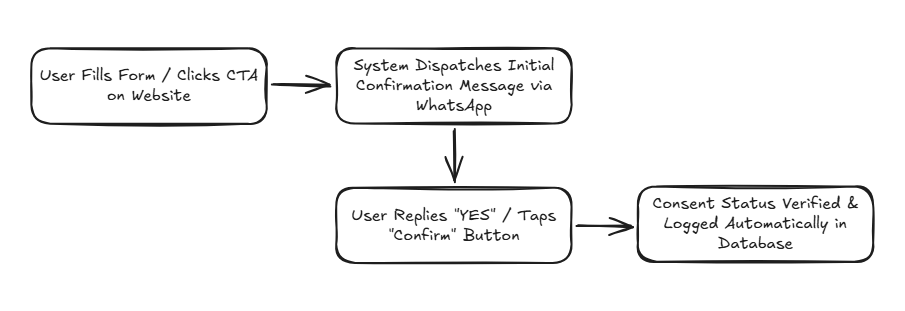
    Double opt-in adds a secondary verification layer to confirm that the registered phone number belongs to the user and that they genuinely wish to receive communications.

    Double Opt-In Workflow:

    Double Opt In flow

    Primary benefits of Double Opt-In include creating rock-solid legal audit proof, eliminating wrong-number dispatches, and building exceptional UX transparency.

    Designing High-Converting, Compliant Opt-In UX

    A common operational mistake is assuming legal compliance destroys interface user experience (UX). In reality, clear and transparent UX design actively increases opt-in conversion rates.

    Effective Opt-In UX Principles:

    • Use plain, helpful language rather than dense legal jargon.
    • Specify exact message categories (order alerts, CS support, or promotional deals).
    • Provide estimated message frequency expectations.
    • Display prominent, intuitive opt-out instructions.

    Example Microcopy:
    “We’ll send order delivery updates and customer support via WhatsApp. Reply STOP at any time to unsubscribe.”

    Opt-Out Management: Mandatory, Simple, & Real-Time

    Opt-out functionality is the mandatory counterpart to opt-in consent. Meta guidelines require businesses to honor user stop requests without technical friction.

    Opt-Out Best Practices:

    • Support simple keywords like STOP, UNSUBSCRIBE, or CANCEL.
    • Provide interactive “Unsubscribe” buttons on promotional whatsapp broadcast campaigns.
    • Process opt-out requests instantly in real-time via workflow automation to exclude numbers from future dispatches immediately.

    Technical Consent Management Implementation

    To remain audit-ready and secure long-term, organizations must log consent records systematically within their CRM platform.

    Essential Consent Audit Trail Parameters:

    Data Parameter Audit Function & Purpose
    Phone Number Recipient’s verified WhatsApp phone number.
    Timestamp Exact time and date consent was granted.
    Opt-In Source Origin touchpoint (Website Form, QR Code, Checkout Page, etc.).
    Consent Type Verification level (Single Opt-In or Double Opt-In).
    Opt-Out Status Real-time active/revoked consent status.

    Common Consent Management Mistakes to Avoid

    • Importing legacy contact databases from spreadsheets without re-verifying consent.
    • Treating business card exchanges or old support chats as promotional marketing consent.
    • Failing to sync opt-out statuses in real-time across all marketing software systems.
    • Sending promotional marketing blasts when users only consented to transactional utility alerts.

    Learn how to avoid account suspensions in our guide on how to avoid spam flags on WhatsApp API.

    Manage Compliant WhatsApp API Opt-Ins with Cekat.ai

    Managing legal, secure WhatsApp API opt-ins combines regulatory compliance with smart UX design. Enterprise organizations building long-term communication strategies must view consent not as an obstacle, but as a core customer trust asset.

    The Cekat.ai platform empowers your enterprise to design compliant, transparent, and user-friendly opt-in workflows. Complete with automated Double Opt-In verification, CRM digital audit trails, and real-time opt-out execution, Cekat.ai ensures messaging campaigns operate safely without phone number suspension risks.

    Manage customer consent and execute secure WhatsApp API communications today with Cekat.ai.


    Frequently Asked Questions (FAQ)

    1. Can I send WhatsApp messages to previous customers without explicit opt-in consent?

    For transactional utility notifications (like receipts or order updates), implied transactional consent applies. However, for promotional marketing messages, you must acquire explicit opt-in consent separately.

    2. What is the difference between Single Opt-In and Double Opt-In?

    Single Opt-In occurs when a user checks a form box on a website. Double Opt-In requires the user to confirm their consent secondary by replying to an initial WhatsApp message.

    3. What happens if a business continues messaging a user after they opt-out?

    Ignoring opt-outs severely violates Meta policies. Users will report your number as spam, leading to rapid Quality Rating degradation and permanent business account bans.

    4. How does Cekat.ai automate customer consent management?

    Cekat.ai automatically logs timestamps, sources, and consent statuses in its unified CRM dashboard, instantly excluding contacts from future messaging queues if opt-out keywords are triggered.


  • AI Agent for Clinic & Salon Reservation Systems: 24/7 Automated Booking Without Admin Staff

    AI Agent for Clinic & Salon Reservation Systems: 24/7 Automated Booking Without Admin Staff

    Imagine this. A prospective patient wants to book a treatment at eleven at night. They open your clinic’s WhatsApp, type a message, and get no reply until the next morning. There’s a good chance they’ve already booked somewhere else before your admin even starts work.

    This problem isn’t trivial. In the beauty clinic and salon business, response speed often determines whether a transaction happens or not.

    This is where an AI agent for clinic and salon reservations starts to make a difference. Not just a tool, but a system that truly changes how a business serves its customers.

    AI Agent for Clinic Reservations

    An AI Agent for clinic reservations is a system that automatically receives, confirms, and reminds patients about bookings via WhatsApp, Instagram, or a website, without needing admin staff on standby 24 hours a day.

    Unlike a rigid, ordinary chatbot, an AI Agent can understand conversational context. Customers can type naturally, like:

    “I’d like a facial tomorrow afternoon”

    and the system immediately directs them to an available slot.

    This technology is typically used as:

    • an automated clinic booking system

    • a chat-based AI salon reservation tool

    • a schedule-integrated reservation chatbot

    • a digital clinic queue system

    Why Manual Reservation Systems Are Becoming Irrelevant

    Many clinic owners think a manual system is still good enough. But if you look closer, there are some assumptions that are often wrong.

    • The first assumption is that all customers book during working hours. In fact, a lot of bookings happen at night.

    • The second assumption is that admin staff can always respond quickly. During busy hours, this is nearly impossible.

    • The third assumption is that manual record-keeping is still safe. In reality, the risk of double bookings and input errors is very high.

    From this, it’s clear the problem isn’t with your team, but with the system being used.

    How Automated Booking with an AI Agent Works

    To make this more concrete, here’s a simple walkthrough of how this system works in practice:

    Step 1
    The patient sends a message, even outside operating hours

    Step 2
    The AI immediately understands the patient wants to book

    Step 3
    The system checks the clinic’s schedule automatically in real time

    Step 4
    The AI offers available slots and confirms the booking

    Step 5
    The patient receives an automatic reminder before their scheduled visit

    This process happens in a matter of seconds, without any admin involvement.

    The Real Impact That Matters Most

    Rather than discuss features, it’s more important to look at the impact a business actually feels.

    1. No More Missed Bookings

    Every incoming chat is handled immediately, no matter the time. This directly boosts conversion.

    2. Admin Staff Can Focus on More Important Things

    Tasks like answering repetitive questions and managing schedules can be taken over by AI. Your team can focus on in-location service and direct customer interaction.

    3. Neater Schedules with Fewer Errors

    With a system directly connected to slot availability:

    • no double bookings

    • no incorrect record-keeping

    • all schedules are recorded automatically

    4. Fewer No-Shows Without Manual Follow-Up

    Automatic reminders help customers remember their schedule. It’s a simple thing, but it has a big impact on revenue.

    5. Customers Feel They’re Getting Personal Service

    AI stores customer history. From this, the system can provide relevant treatment recommendations, not just generic responses.

    A Simple Case Study

    One beauty clinic that started using an automated beauty clinic booking system saw a fairly clear change within a short time.

    Indicator

    Before

    After

    Response time

    about 15 minutes

    less than 1 minute

    Incoming bookings

    limited to working hours

    coming in 24 hours a day

    Admin workload

    high

    much lower

    No-shows

    fairly frequent

    reduced

    What’s interesting is that this improvement didn’t come from adding more staff, but from changing the way of working.

    Does Every Clinic Need an AI Agent?

    Not every business needs this right away. This is where it’s important to think critically.

    If your booking volume is still very small, automation might not yet have a major impact.

    But if you’re starting to experience:

    • unanswered chats

    • a messy schedule

    • an overwhelmed admin team

    • customers who frequently have to wait

    then the problem clearly lies in the system, not the people.

    FAQ About AI Agents for Clinic & Salon Reservations

    Can an AI agent handle bookings outside working hours?
    Yes. The system runs 24 hours a day so no chat is missed.

    What if the schedule is full — can the AI offer alternatives?
    Yes. The AI will offer other available time slots.

    Can the AI send automatic reminders?
    Yes. Reminders are sent before the scheduled visit without needing a manual nudge.

    How much does an AI booking system for clinics cost?
    Cost depends on your needs and scale, but it’s usually more cost-effective than hiring additional admin staff.

    Can it integrate with Google Calendar or other software?
    Yes. The system can connect with the tools you already use.

    How secure is patient data?
    Data is stored with security systems and encryption that meet industry standards.

    Using AI for schedule management is no longer about following a trend. It’s about fixing the bottleneck that has been holding back business growth.

    An AI Agent helps ensure every booking opportunity is captured, every schedule is neatly recorded, and every customer gets a fast response without depending on admin availability.

    Time to Switch to a More Efficient Booking System

    Cekat.ai is specifically designed to help clinics and salons run a simple yet powerful automated booking system. You don’t need to overhaul your entire operation — just start with the most critical point: reservations.

    With integration into WhatsApp, Instagram, and your website, your business still feels personal to customers, while running far more efficiently behind the scenes.

    Try the free demo and see for yourself how a small change in your system can make a big impact on your business operations and revenue.

  • Optimizing Time for Patient Consultations & Follow-Ups in the Health & Beauty Business with AI Technology

    Optimizing Time for Patient Consultations & Follow-Ups in the Health & Beauty Business with AI Technology

    In the health & beauty industry, time is one of the most important assets. Whether it’s a beauty clinic, spa, health salon, or skincare center, all of them need efficient time management to maintain service quality and patient satisfaction. The main challenge faced by many businesses in this sector is how to deliver personal consultations, carry out consistent follow-ups, and keep operations running smoothly at the same time. Many professionals have to split their focus between direct patient service and administrative tasks, such as recording data, answering patient questions, and scheduling check-ups. This often results in suboptimal service, slower responses to patients, and even a decline in the overall customer experience.

    Artificial Intelligence (AI) technology offers an innovative solution to these challenges. One AI product specifically designed to support business operational efficiency is Cekat.AI. As an AI agent and service, Cekat.AI helps health & beauty businesses automatically optimize the patient consultation and follow-up process, without reducing the quality of the personal interaction that lies at the core of health and beauty services. By leveraging AI, businesses not only speed up internal processes but also create a more responsive, comfortable, and trustworthy patient experience.

    Why Time Efficiency Is a Priority in the Health & Beauty Business

    Time efficiency isn’t just about internal productivity, it’s also a critical factor in building patient loyalty and business reputation. Long consultations or delayed follow-ups can lower patient satisfaction and even cause patients to switch to a competitor.

    A study published in the Journal of Cosmetic Dermatology (2022) found that patients rate response speed, service personalization, and ease of communication as the three main factors when choosing a beauty clinic. This means a business’s ability to respond quickly to patient questions and provide recommendations tailored to their needs has a direct impact on customer retention.

    In addition, professionals in the health & beauty business often face time pressure because they must handle patients directly, manage schedules, and ensure medical or treatment documentation is done correctly. Without the right solution, this can lead to staff burnout, a decline in service quality, and a risk of administrative errors.

    How Cekat.AI Helps Streamline the Patient Consultation Process

    Cekat.AI serves as a tool that enables the patient consultation process to happen faster, more accurately, and more personally. Here’s a detailed explanation of how this AI works:

    1. AI-Powered Chat for Initial Consultation

    Cekat.AI can be used for a patient’s initial consultation via digital chat, whether on a website, app, or instant messaging platform. This AI system asks important information such as:

    • The patient’s health history

    • Skin type or body condition

    • Specific complaints or treatment goals

    The data collected by the AI is then analyzed and prepared for the professional before the face-to-face consultation. This way, the doctor or therapist already has a complete picture of the patient, so the consultation session can focus more on treatment solutions rather than repeating basic questions. This process significantly reduces consultation duration and improves staff productivity.

    2. Personalization of Treatment Recommendations

    One of Cekat.AI’s key strengths is its ability to provide personalized recommendations based on a patient’s profile. For example:

    • For patients seeking anti-aging treatment, the AI analyzes skin condition, sensitivity, and previous treatment history.

    • The AI can recommend the most suitable combination of clinical treatments and at-home care products.

    This personalization not only speeds up the consultation process but also improves treatment success rates and patient satisfaction. Patients feel individually cared for, rather than simply receiving generic advice.

    Optimizing Patient Follow-Up with Cekat.AI

    Patient follow-up is a crucial process in the health & beauty business because it helps monitor treatment results and ensures patients receive appropriate continued care. With Cekat.AI, follow-up becomes more efficient in several ways:

    1. Automated Schedule Reminders

    The AI sends automatic reminders via SMS, email, or chat apps about:

    • Routine check-up schedules

    • Follow-up treatment actions

    • Use of recommended products

    This automation reduces the risk of patients forgetting appointments, minimizes cancellations, and ensures the follow-up process runs consistently.

    2. Patient Status Analysis and Reporting

    Cekat.AI can monitor patient feedback and record responses to treatment. This data is analyzed to generate reports that help staff:

    • Identify patients who need special attention

    • Adjust treatment recommendations based on the latest condition

    • Identify trends and patterns in patient needs

    These reports are generated automatically, allowing professionals to make data-driven decisions quickly and accurately.

    3. Real-Time Interaction for Patient Questions

    Patients often have additional questions after treatment, for example regarding side effects or the products used. Cekat.AI can answer basic questions in real time, providing accurate information and helping patients feel reassured without having to wait for direct interaction with staff. This reduces the burden on staff and improves service quality.

    Benefits of Implementing Cekat.AI in the Health & Beauty Business

    Implementing Cekat.AI provides significant strategic and operational benefits:

    1. Operational Efficiency:
      Reduces the time staff spend on administrative tasks so they can focus on core services.

    2. Improved Patient Satisfaction:
      Fast, personal, and consistent interaction boosts patient loyalty and business reputation.

    3. Data-Driven Decision Making:
      AI provides insights for treatment planning and business strategy, resulting in more accurate and effective decisions.

    4. Service Flexibility:
      Patients can access consultation and follow-up services anytime, increasing patient convenience and engagement.

    5. Reduced Risk of Errors:
      AI helps record patient data accurately and ensures no information is missed.

    In the health & beauty business, time efficiency in patient consultations and follow-ups is not just an operational need, but also a strategy for boosting patient satisfaction and loyalty. Cekat.AI provides an AI-based solution that enables businesses to:

    • Conduct initial consultations more quickly and personally

    • Provide treatment recommendations suited to individual needs

    • Carry out patient follow-up automatically and consistently

    By adopting this technology, health & beauty businesses not only work more efficiently but also deliver a more professional and satisfying patient experience. Cekat.AI is an innovative tool that transforms how businesses manage communication, service, and patient data, allowing businesses to focus on service development and long-term growth.

    References

    1. Journal of Cosmetic Dermatology, “Patient Satisfaction and Time Efficiency in Aesthetic Clinics,” 2022.

    2. Google AI Overview, “AI in Healthcare and Customer Experience Optimization,” 2023.

    3. Harvard Business Review, “How AI Improves Customer Engagement and Operational Efficiency,” 2021.

  • 24-Hour Window WhatsApp API: How It Works & Strategies to Avoid Extra Costs

    24-Hour Window WhatsApp API: How It Works & Strategies to Avoid Extra Costs

    In the WhatsApp Business API ecosystem, not all conversations are treated equally. One of the most crucial rules—and often a source of wasted spending—is the 24-hour window. Many businesses already use WhatsApp API but don’t fully understand how this rule works, when the window resets, and how automation can be used to keep costs efficient without sacrificing the customer experience.

    This article discusses in depth and practically how the WhatsApp API 24-hour window works, its impact on cost, and automation-based optimization strategies relevant for modern businesses in 2025.

    What Is the WhatsApp API 24-Hour Window?

    The WhatsApp API 24-hour window is a period of 24 hours from the customer’s last message (user-initiated message) sent to the business. While this window is active, the business is free to reply without using paid templates (free-form messages).

    Key points that are often misunderstood:

    • The window is not counted from when the business replies, but from the last time the customer sent a message

    • Every new message from the customer resets the window to the next 24 hours

    • Once the window closes, the business can only send messages using approved templates (utility, authentication, or marketing)

    Put simply: the customer controls the conversation’s timing.

    How Does the 24-Hour Window Reset Work?

    The window resets every time the customer sends a new message, whether that’s:

    • Typing a message manually

    • Tapping a quick reply button

    • Clicking a CTA button inside the chat

    • Sending an automation-triggered message (e.g. selecting a menu option)

    This means a good automation strategy doesn’t just answer questions, it also encourages active customer interaction to keep the window alive.

    Common mistakes:

    • Businesses assume auto-replies alone are enough — the window still expires if the customer doesn’t respond

    • Passive follow-ups without a CTA — the conversation dies and template costs rise

    What Happens If the 24 Hours Pass?

    If the 24-hour window expires and the customer doesn’t send a new message, then:

    1. The business cannot send free-form messages

    2. Every outbound message must use an approved template

    3. That message incurs a conversation fee based on category (utility, marketing, authentication)

    The impact is felt immediately:

    • WhatsApp API costs rise without businesses noticing

    • A simple follow-up (e.g. “Still interested?”) turns into a paid message

    • The conversion funnel becomes more expensive and rigid

    This is where many businesses feel WhatsApp API is expensive, when the root cause is actually poor window management.

    Impact of the 24-Hour Window on WhatsApp API Costs

    Structurally, WhatsApp API costs are influenced by:

    • Type of conversation (free-form vs template)

    • Template category

    • Frequency of new conversations

    If the window isn’t optimized:

    • A single customer journey can trigger multiple paid conversations

    • Customer service becomes reactive instead of proactive

    • WhatsApp ROI drops even when chat volume is high

    On the other hand, businesses that control the window with automation typically:

    • Reduce template usage

    • Keep conversations natural

    • Significantly cut cost per customer

    Automation Strategies Before the 24-Hour Window Expires

    This is where an AI and automation approach becomes crucial. Not just auto-replies, but conversation orchestration.

    1. Smart Prompts to Encourage Responses

    Before the window closes, the system can:

    • Send contextual questions

    • Provide quick reply options

    • Guide the user to the next step (choose a product, schedule, confirm)

    The goal isn’t spam, but creating a natural reason for the user to reply.

    2. Context-Aware Follow-Up

    Automation reads:

    • The topic of the last conversation

    • Customer status (lead, buyer, pending)

    • Customer intent

    So follow-ups feel relevant instead of generic.

    3. Auto-Escalation to a Human Agent

    If the AI detects:

    • Confusion

    • High intent

    • Risk of drop-off

    The chat can be handed off to an agent before the window expires, preventing the conversation from dying out.

    Real-World Example: Expired Window vs Optimized Window

    Case A (without a window strategy):
    Customer asks about price → business replies → customer goes silent
    3 days later the business follows up → must use a template → cost increases → low response rate

    Case B (with automation):
    Customer asks about price → AI replies + quick reply “Want to see our packages?”
    Customer clicks → window resets → AI continues the conversation → deal closes without additional templates

    The difference isn’t in WhatsApp itself, but in the conversation flow design.

    (People Also Ask)

    What is the WhatsApp API 24-hour window?
    A 24-hour period from the customer’s last message, during which the business can reply freely without paid templates.

    What happens if the 24 hours pass?
    The business can only send messages using approved templates and will be charged for a new conversation.

    Why Do Many Businesses Get the 24-Hour Window Wrong?

    Common misconceptions:

    • “WhatsApp API is expensive” — when actually the window isn’t managed

    • “Automation causes spam” — when the real issue is poor flow design

    • “Templates are mandatory” — actually only after the window expires

    The right approach is managing the conversation, not just sending messages.

    Optimize the 24-Hour Window with Cekat.ai Automation

    Cekat.ai is designed to help businesses control, extend, and maximize the value of the WhatsApp API 24-hour window through AI-driven conversation flows. With a context-, intent-, and smart automation-based approach, Cekat.ai helps businesses keep conversations alive, relevant, and efficient—without burning budget on unnecessary templates.

    If WhatsApp is your main customer interaction channel, then mastering the 24-hour window is no longer optional—it’s a fundamental strategy. Cekat.ai helps you not just reply to chats, but orchestrate conversations that truly work for your business.

  • AI Agent for Retail Businesses: Boost Sales and Store Efficiency with AI

    AI Agent for Retail Businesses: Boost Sales and Store Efficiency with AI

    An AI Agent for retail businesses is an artificial intelligence system that automates customer communication, provides data-driven product recommendations, manages stock and order information in real time, and helps increase sales conversion across every channel from WhatsApp and Instagram to marketplaces, without requiring manual team intervention in every interaction.

    Modern retail businesses operate under increasingly complex pressure: customers expect instant responses, personalized recommendations, accurate stock information, and a consistent shopping experience across every channel. At the same time, chat volume keeps growing faster than the capacity of existing CS teams.

    Data from real implementations shows that retailers using an AI Agent have successfully automated 80% of customer questions, cut response time from an average of 20 minutes to under 5 seconds, increased sales conversion by up to 35%, and managed thousands of conversations simultaneously without adding a single new staff member.

    Retail Business Challenges Solved by AI Agent

    Most retailers face the same challenges as customer volume starts to rise while team capacity fails to grow proportionally. Here is a breakdown of the problems, their business impact, and the solutions offered by AI Agent:

    Operational Challenge

    Business Impact

    AI Agent Solution

    Very high customer chat volume

    Slow responses, customers switch to competitors

    AI answers all chats instantly 24/7 with no volume limit

    Repeated questions about stock, size, shipping

    Staff time wasted on the same questions every day

    AI answers FAQs automatically with real-time stock data

    High abandoned cart rate

    Potential revenue lost before the transaction is completed

    AI sends automatic reminders with timely incentives

    Untargeted promotions

    Low CTR, customers annoyed by irrelevant messages

    AI automatically segments and sends relevant promos per customer

    No follow-up after a transaction

    Low repeat purchase rate, customer loyalty not maintained

    AI sends automatic follow-ups, requests reviews, and offers relevant products

    Product recommendations aren’t personalized

    Missed upsell and cross-sell opportunities

    AI recommends products based on customer history and behavior

    Customer data is unstructured

    Cannot segment or personalize communication

    All interactions are automatically saved to the customer profile in the CRM

    CS staff overwhelmed during peak hours or hard sales

    Service quality drops, cart abandonment rises during promos

    AI handles volume spikes, staff focus on complex cases and negotiation

    A consistent pattern: every problem above is rooted in the same thing, limited communication capacity. AI Agent solves this capacity problem permanently, allowing retail businesses to grow without proportionally growing operational overhead.

    10 AI Agent Use Cases for Retail Businesses

    Here are ten of the most impactful AI Agent applications for retail businesses, whether online stores or retailers with digital channels:

    AI Agent Use Case

    How It Works

    Impact for Retail

    Automatic product stock check

    AI connects to the inventory system and answers questions about product availability, size, and variants in real time

    Customers get instant stock info, conversion from inquiries increases

    AI-based product recommendations

    Analyzes purchase history, viewed products, and trends to recommend relevant products

    Average order value rises, upsell and cross-sell opportunities are captured

    Automatic order tracking

    Integrates with logistics systems to provide real-time shipping status updates without manual intervention

    “Where is my order” questions disappear, CS is freed from repetitive tasks

    24/7 omnichannel customer service

    Handles conversations from WhatsApp, Instagram, marketplaces, and website chat in one integrated system

    No customer goes unattended, satisfaction increases

    Abandoned cart recovery

    Detects abandoned carts and sends reminders with incentive offers at the optimal timing

    Cart abandonment conversion increases 15-30%

    Segmented promo broadcasts

    Sends promotions based on segmentation: purchase category, frequency, transaction value, and loyalty status

    Open rate and promo conversion far higher than generic blasts

    Automatic review requests

    Sends a message asking for a review a few days after the customer receives the product

    Store rating improves, organic reviews increase without manual effort

    Automatic loyalty program

    Manages member communication, points notifications, exclusive offers, and point-expiry reminders

    Customer retention improves, lifetime value per customer rises

    Restock notifications

    Detects customers who asked about an out-of-stock product and automatically notifies them when it’s back in stock

    Sales from previously sold-out products are no longer missed

    New customer onboarding

    Sends welcome messages, shopping guides, and special offers for first-time buyers

    First purchase conversion increases, initial customer experience is more positive

    The Cekat.ai platform integrates all the use cases above into one system connected to the WhatsApp Business API, customer CRM, and store inventory system.

    Example AI Agent Conversations in a Retail Store

    Scenario 1: Stock Check and Purchase

    Customer: Do you have Nike Air Max size 42 in black?

    AI Agent: Hello! Nike Air Max size 42 in black is still available. Price Rp 1,350,000. Would you like to order right away, or do you have any other questions first?

    Customer: I’ll order right away

    AI Agent: Great! Please confirm your shipping address and preferred payment method. Estimated delivery is 2-3 business days to Jakarta.

    Scenario 2: Abandoned Cart Recovery

    (Automatically sent 2 hours after the customer abandons the cart)

    AI Agent: Hi [name]! Are you still interested in [product name] in your cart? Stock is running low. Use code HEMAT10 for a 10% discount if you order now. Order link: [link]

    Scenario 3: Follow-Up and Review Request

    (Automatically sent 3 days after the product is received)

    AI Agent: Hi [name], we hope you’re happy with the product you received! If you have any questions or issues with your order, we’re here to help. If you’re satisfied, could you help us out with a rating and review on [marketplace]? Your review means a lot to us.

    All these conversations run automatically without staff intervention, yet still feel personal because they use the customer’s name and specific transaction context.

    AI Agent for Online Stores vs Physical Stores: Implementation Differences

    An AI Agent can be used by both, but the implementation approach and focus differ. Here’s a complete comparison:

    Aspect

    Online Store

    Physical Store with Online Channel

    Main communication channel

    Marketplace chat, WhatsApp, Instagram, website live chat

    WhatsApp, loyalty program, Instagram

    Main AI function

    Automated CS, order tracking, abandoned cart recovery, review requests

    Customer engagement, promo notifications, loyalty program

    Product recommendations

    Based on browsing history, purchases, and real-time trends

    Based on previous purchases and saved preferences

    Promotion management

    Flash sales, digital discounts, automatic voucher codes

    Membership promos, ready-for-pickup notifications, store events

    Order tracking

    Courier integration, real-time status updates to customers

    Ready-to-pickup notifications, pickup status

    Stock management

    Real-time stock check, restock notifications, automatic waitlist

    Branch availability information, stock transfer between stores

    Customer data

    Digital transaction data, browsing behavior, social engagement

    Purchase history, product preferences, visit frequency

    AI operating hours

    24/7 with no limits

    24/7 for communication, store still opens at set hours

    Retail businesses with an omnichannel strategy (both physical and online stores) benefit the most because AI Agent becomes a unified communication layer that maintains a consistent customer experience across every channel.

    AI Agent Integration with Retail Platforms in Indonesia

    Indonesia’s digital retail ecosystem has unique characteristics that need to be supported by the AI Agent platform. Here are the most critical integrations:

    Communication Channels

    • WhatsApp Business API: The most dominant business communication channel in Indonesia. AI Agent answers questions, processes orders, and sends automatic updates via WhatsApp.

    • Instagram Direct Message: For businesses that actively sell through Instagram content, AI automatically replies to DMs and converts inquiries into orders.

    • Marketplace chat (Tokopedia, Shopee): Integration with marketplace chat to handle customer questions directly from the buying and selling platform.

    • Website live chat: For stores with their own website, AI Agent serves visitors who need help before deciding to purchase.

    Operational Systems

    • Inventory and stock management system: Real-time stock sync so AI always provides accurate availability information.

    • Order management system: Integration for order tracking, payment confirmation, and automatic shipping status updates.

    • Logistics and courier platforms: Integration with JNE, J&T, SiCepat, and other shipping platforms for real-time shipping status.

    • Customer CRM: All customer interactions are stored centrally for communication personalization and analytics.

    Cekat.ai supports integration with Indonesia’s retail ecosystem, including official WhatsApp Business API, local marketplaces, and commonly used store management systems.

    Case Study: Online Fashion Store That Increased Sales by 35 Percent

    An online fashion store in Indonesia focused on women’s clothing faced a very common challenge: chat volume exploded after becoming active on Instagram and TikTok, but the CS team consisted of only 2 people who couldn’t keep up with that growth rate.

    Condition Before Implementation

    • Incoming chat volume: more than 500 messages per day from WhatsApp and Instagram

    • Content of 85% of questions: repetitive, about size, color stock, and shipping estimates

    • Response time: an average of 20 minutes, up to 2 hours outside working hours

    • Impact: many prospective buyers didn’t complete their orders because they got tired of waiting

    • Abandoned cart: high, but no system existed to recover it

    Implementation Process

    The store implemented AI Agent through Cekat.ai within 5 days, covering:

    • WhatsApp Business API and Instagram DM integration

    • Product knowledge base configuration: 200+ products with descriptions, sizes, color variants, and stock

    • Setup of a real-time stock check flow integrated with the inventory system

    • Abandoned cart recovery flow configuration with automatic discounts

    • Setup of post-purchase follow-up and automatic review requests

    Results Achieved in 4 Months

    Performance Metric

    Before AI Agent

    After AI Agent (4 Months)

    CS response time

    Average 20 minutes

    Under 5 seconds

    Chats handled automatically

    0% (all manual)

    80% without staff intervention

    Sales conversion

    Baseline

    Up 35%

    Stock inquiry handling

    Manual, checked one by one

    Automatic and real-time

    CS team capacity

    Limited to working hours

    Unlimited, AI active 24/7

    Abandoned cart recovery

    No system

    Automatic with reminders and incentives

    Review requests

    Manual, inconsistent

    Automatic after the product is received

    The most significant impact beyond the numbers: the CS team that used to be exhausted can now focus entirely on styling consultations, complaint handling, and content strategy. Response quality for complex cases actually improved because the team is no longer burdened by repetitive questions.

    ROI of AI Agent for Retail Businesses: A Guide to Calculating Investment Value

    Here’s a framework for calculating the real value of an AI Agent investment in a retail business:

    Value Component

    Estimated Impact

    Measurement Indicator

    CS cost savings

    Equivalent to 1-3 CS staff (Rp 4-12 million/month)

    Hours saved x cost per hour

    Conversion increase

    10-35% more completed transactions

    Conversion rate before vs after AI

    Abandoned cart recovery

    15-30% of abandoned carts converted

    Transaction value from cart recovery campaigns

    Upsell and cross-sell

    10-20% increase in average order value

    Revenue per transaction before vs after AI recommendations

    Repeat purchase increase

    15-25% more returning customers

    Purchase frequency per customer per month

    Promotion efficiency

    Promo CTR up 2-4x with segmentation

    Open rate and conversion per promo campaign

    Estimated break-even point: stores with 100+ chats per day generally reach positive ROI within the first month of implementation. Stores with lower volume typically see break-even within 2-3 months, accelerated by increased conversion from abandoned cart recovery and automatic follow-up features.

    Guide to Getting Started with AI Agent for Retail Businesses

    Here are the recommended AI Agent implementation steps for retail businesses, designed to get started quickly without disrupting ongoing operations:

    1. Audit channels and customer questions: Identify the channel with the highest chat volume and collect 50-100 of the most frequently asked customer questions. This will be the foundation of the AI knowledge base.

    2. Prepare a complete product knowledge base: Gather all product information: name, description, price, variants (size, color), shipping policy, and return policy. The more complete this data, the more accurate the AI’s responses.

    3. Integrate the main communication channels: Start with the WhatsApp Business API as the first priority, then gradually add Instagram and other channels. Cekat.ai provides step-by-step integration guidance.

    4. Connect with stock and order systems: Real-time integration with the inventory system allows AI to always provide accurate stock information and automatic notifications for changes in product availability.

    5. Configure critical automated workflows: Prioritize: abandoned cart recovery, post-purchase follow-up, review requests, and restock notifications. Start with the workflows that have direct revenue impact.

    6. Test with real customer simulations: Simulate various conversation scenarios including unusual questions and edge cases. Improve the knowledge base based on test results before going live.

    7. Go live and monitor performance closely: Activate the system and monitor intensively during the first 7-14 days. Focus on: auto-response rate, customer satisfaction, and chat conversion. Optimize based on real data.

    Cekat.ai provides ready-to-use retail templates covering flows for fashion, electronics, grocery, and various other product categories, allowing stores to start operating with AI Agent within 3-5 days.

    Types of Retail Businesses That Benefit Most from AI Agent

    • Fashion and clothing: The volume of questions about size, color stock, and product compatibility is very high. AI Agent answers all of these instantly and recommends complementary products.

    • Electronics and gadgets: Complex technical specification questions and product comparisons are very common. AI answers technical questions and helps customers choose the right product for their needs.

    • Skincare and cosmetics: Product recommendations based on skin type and concerns are highly needed. AI can perform basic virtual consultations and recommend suitable product lines.

    • Culinary and food: Menu information, allergens, opening hours, and availability need fast responses. AI handles all these questions while also managing pre-purchase orders for catering or bill payments.

    • Household appliances: Compatibility questions, warranty, and spare part availability are very common. AI answers technical questions and helps with the automatic warranty claim process.

    • Bookstores and educational products: ISBN information, edition availability, and recommendations based on reading interest. AI helps customers find the right product from a large catalog.

    FAQ: Frequently Asked Questions About AI Agent for Retail

    What is an AI Agent for retail businesses?

    An AI Agent for retail is an artificial intelligence system that automates customer communication, provides data-driven product recommendations, manages stock and order information in real time, and helps increase sales conversion across every channel from WhatsApp to marketplaces.

    Can AI Agent be used for marketplaces like Tokopedia and Shopee?

    Yes. AI Agent can be integrated with various popular marketplaces in Indonesia as well as communication channels like WhatsApp Business API and Instagram DM, so all customer conversations from various platforms can be managed in one integrated system.

    Does AI Agent replace human customer service?

    Not entirely. AI Agent handles 70-85% of routine questions like stock, price, order tracking, and FAQs, so the CS team can focus entirely on more complex cases like complaints, negotiations, and situations that require human empathy.

    Is AI Agent suitable for retail SMEs?

    Very suitable. Retail SMEs actually benefit the most because AI Agent allows a small team to operate with the capacity usually only owned by stores with large CS teams. There’s no need to add staff to handle continuously growing customer volume.

    How does AI Agent help reduce abandoned carts?

    AI detects customers who leave their cart without completing a purchase, then automatically sends a reminder with the right message and, if needed, an incentive such as a discount or free shipping at the optimal timing to maximize conversion.

    Can AI give accurate product recommendations?

    Yes. AI analyzes purchase history, previously asked-about products, categories of interest, and sales trends to recommend products that are personally relevant to each customer. The result is far more effective than generic recommendations.

    How long does it take to implement AI Agent for a retail store?

    Basic implementation can be completed in 3-7 days with the Cekat.ai platform using ready-to-use retail templates. Full integration with inventory systems, marketplaces, and CRM usually takes 1-3 weeks depending on complexity.

    How does AI Agent help improve store ratings on marketplaces?

    AI automatically sends review requests to customers a few days after the product is received, while the shopping experience is still fresh. This proactive, consistent approach generates more positive reviews compared to waiting for customers to voluntarily leave a review.

    Can AI Agent manage customer loyalty programs?

    Yes. AI can manage the entire loyalty program communication: notifications for points earned, reminders before points expire, exclusive offers for members, and automatic birthday rewards, all without manual intervention.

    What makes Cekat.ai suitable for retail businesses in Indonesia?

    Cekat.ai is optimized for the Indonesian retail ecosystem: native WhatsApp Business API integration as the main channel, natural Indonesian-language NLP support, local marketplace integration, and a no-code interface that makes it easy for non-technical teams to configure sales and CS flows.

    Modern retail businesses can no longer rely on manual CS teams to handle continuously growing customer communication volume. Customers who don’t get an instant response will switch to a competitor that can respond faster.

    AI Agent provides the right solution: a system that’s always active, responds within seconds, provides personalized recommendations, recovers abandoned carts, and builds customer loyalty through consistent communication, all without relying on limited team capacity.

    Retailers that adopt AI Agent early not only gain operational efficiency, but also build a real service advantage that customers can feel: instant responses, accurate information, and communication that feels personal even though it runs automatically.

    Platforms like Cekat.ai make this adoption easier by providing AI Agent infrastructure integrated with Indonesia’s retail ecosystem, from WhatsApp and Instagram to local marketplaces, with implementation that can start within days.

    Start Automating Your Retail Business with AI Agent from Cekat.ai

    Cekat.ai helps retail businesses implement AI Agent integrated with various sales channels, inventory systems, and customer CRM in one unified platform.

    • Automated 24/7 customer service on WhatsApp, Instagram, and marketplaces

    • Real-time stock check and order tracking without manual intervention

    • Abandoned cart recovery with automatic incentives

    • Personalized product recommendations based on customer history

    • Segmented promo broadcasts with higher conversion

    • Ready-to-use retail templates for various product categories

    • Implementation in 3-7 days without a dedicated developer

    • See the platform demo: cekat.ai

    With AI Agent, every customer conversation becomes a sales opportunity that’s never missed, at every moment, on every channel, with no team capacity limits.

  • Best AI Agent Platforms in Indonesia 2026: Review & Comparison

    Best AI Agent Platforms in Indonesia 2026: Review & Comparison

    The world of customer service and business automation in Indonesia is changing fast. If two or three years ago you were still wondering whether AI agents were truly relevant for local businesses, the answer today is clear: they are relevant, and have in fact become a strategic necessity.

    But this is where the challenge appears. The number of AI agent platforms available in Indonesia keeps growing, ranging from global solutions adapted for the local market to platforms built specifically for the needs of Indonesian businesses. Each has its own strengths, limitations, and pricing model.

    This buyer’s guide is here to help you navigate all those options objectively. We’ll cover selection criteria, compare leading platforms, and give recommendations that fit the scale and needs of your business in 2026.

    What Is an AI Agent Platform, and Why Do Indonesian Businesses Need One?

    Before diving into the comparison, it’s important to first understand what sets an AI agent platform apart from a plain chatbot.

    An AI agent is an artificial intelligence system that doesn’t just answer questions — it can also understand conversational context, make decisions, execute tasks, and adapt to complex business workflows. Unlike rule-based chatbots, which can only respond to pre-programmed commands, an AI agent uses a large language model (LLM) that enables conversations that are far more natural and flexible.

    For Indonesian businesses, this need is becoming more relevant for several reasons:

    • Indonesia’s internet users now number more than 212 million, with e-commerce transactions and digital service activity continuing to grow.

    • Indonesian customers are very accustomed to real-time service via WhatsApp, Tokopedia, Shopee, and other platforms.

    • An AI agent can operate 24/7 at no significant additional cost, addressing staffing limitations outside working hours.

    • Multilingual needs: Indonesian, English, and sometimes regional languages need to be handled within a single system.

    A good AI agent platform doesn’t just provide the technology — it also provides the infrastructure, integrations, and support that let a business implement the solution without having to build everything from scratch.

    Criteria for Choosing the Right AI Agent Platform for an Indonesian Business

    Choosing the wrong platform can waste a significant amount of budget and implementation time. Here are the main criteria you should consider before making a decision.

    Indonesian Language Comprehension

    This is the number-one factor for local businesses. Not every LLM or AI agent platform has strong natural language understanding (NLU) in Indonesian. Some global platforms still struggle with idioms, abbreviations, or the informal communication style commonly used by Indonesian customers.

    Questions to ask a vendor:

    • How accurately does their model understand everyday Indonesian, not just formal language?

    • Do they support code-switching between Indonesian and English?

    • How well do they perform on common slang or colloquial language?

    Integration with Indonesia’s Digital Ecosystem

    Businesses in Indonesia operate within a fairly specific ecosystem. You need to make sure your chosen platform can integrate with:

    • WhatsApp Business API: The most dominant communication channel in Indonesia

    • Local marketplaces: Tokopedia, Shopee, Lazada, Bukalapak

    • Payment systems: GoPay, OVO, Dana, BCA, and local banks

    • CRM and helpdesk tools: Freshdesk, Zendesk, or internal systems

    • ERP and inventory systems: Especially for e-commerce and retail businesses

    A Pricing Model That Fits Your Business Scale

    AI agent platforms in Indonesia generally use three pricing models:

    • Per conversation: Suitable for businesses whose interaction volume is hard to predict

    • Monthly subscription: Easier to budget for, usually includes a set quota

    • Usage-based: Flexible, but can be surprising if volume spikes

    Also pay attention to whether there are setup fees, custom model training fees, or charges for certain features that appear to be included on their pricing page.

    Ease of Implementation and Training

    Not every business has a strong technical team. A good platform should provide:

    • A visual interface for building conversation flows

    • The ability to train on existing documents or FAQs

    • Documentation and support in Indonesian

    • A realistic implementation timeline, ideally under 2 weeks for standard use cases

    Data Security and Regulatory Compliance

    With Indonesia’s personal data protection regulations (the PDP Law) becoming stricter, you need to make sure the platform you choose:

    • Stores data on servers that meet international security standards

    • Has a clear, transparent privacy policy

    • Can support data residency requirements if needed

    • Holds security certifications such as ISO 27001

    Analytics and Reporting Capabilities

    A good AI agent platform isn’t just about answering questions — it’s also about learning and improving. Make sure your chosen platform provides:

    • A dashboard showing key metrics: resolution rate, escalation rate, and CSAT

    • The ability to identify unanswered queries

    • Conversation logs for quality assurance purposes

    Comparison of the Best AI Agent Platforms in Indonesia 2026

    Below is a comparison of the platforms most relevant to businesses in Indonesia today, based on actual usage, features, and fit with the local ecosystem.

    Platform

    Indonesian Language

    WhatsApp

    Starting Price

    Best For

    Cekat.ai

    Excellent

    Yes (Native)

    Competitive

    SMBs to Enterprise

    Intercom

    Adequate

    Yes (via integration)

    High (USD)

    Global enterprise

    Freshdesk + Freddy AI

    Adequate

    Yes

    Mid-range

    Freshworks mid-market

    Yellow.ai

    Good

    Yes

    High

    Asian enterprise

    Tidio

    Limited

    Limited

    Low

    Website-only SMBs

    1. Cekat.ai – The AI Agent Platform Built for Indonesian Businesses

    Best for: SMBs, startups, and enterprises that want an Indonesian-language AI agent solution with strong WhatsApp integration.

    Cekat.ai is an AI agent platform designed specifically with an understanding of Indonesian business needs. Rather than simply adapting a global product, Cekat.ai was built from the perspective of local customers and business owners, from language capability to ecosystem integration.

    • Natural Indonesian Language Understanding: The model is optimized to understand everyday Indonesian, including informal style, common abbreviations, and WhatsApp communication patterns.

    • Seamless WhatsApp Business API Integration: Conversation management, intent classification, and handover to human agents in one integrated platform.

    • Fast, Easy Setup: Implementation within days. The model can be trained by uploading existing documents, FAQs, or knowledge bases.

    • Responsive Local Support: An Indonesian-speaking support team that understands local business context.

    • Actionable Analytics: A dashboard showing automatic resolution rate, customer question patterns, and agent performance per communication channel.

    The Cekat.ai platform integrates all of these capabilities into a single AI agent platform designed specifically for the needs of Indonesian businesses, with integrated WhatsApp API and AI Agent support.

    2. Intercom – A Global Solution with Strong AI Capabilities

    Best for: Enterprise companies or tech startups that need a complete customer engagement ecosystem and have a technical team.

    Intercom is one of the biggest names in the customer service platform space globally. Their AI agent feature, known as Fin, uses LLM technology to answer customer questions based on existing help center content.

    • Strengths: A very complete feature ecosystem, integration with hundreds of tools, mature product quality.

    • Limitations for Indonesia: Pricing is fairly high in USD, Indonesian language capability isn’t as strong as local platforms, and Indonesian marketplace ecosystem support is limited.

    3. Freshdesk with Freddy AI – A Solid Mid-Market Choice

    Best for: Mid-sized businesses already using the Freshworks ecosystem that want to add AI capabilities.

    Freshdesk is a popular helpdesk platform in Indonesia, and Freddy AI is the artificial intelligence layer integrated into it for auto-suggested answers, ticket classification, and automated responses.

    • Strengths: Seamless integration with the Freshworks ecosystem, more affordable pricing than Intercom.

    • Limitations: AI agent capabilities for proactive conversation are still more limited than platforms built specifically for conversational AI.

    4. Yellow.ai – A Regional Conversational AI Platform

    Best for: Mid-to-large companies in Asia that need a conversational AI platform with multilingual support.

    Yellow.ai is an India-based platform fairly well known across Asia, and it has started entering the Indonesian market. They offer fairly mature AI agent capabilities across various industries.

    • Strengths: Experience in the Asian market, multilingual support including Indonesian.

    • Limitations: Fairly high pricing for enterprise, a longer implementation curve, and a local Indonesian ecosystem that isn’t as strong as platforms focused specifically here.

    5. Tidio – An Affordable Option for SMBs

    Best for: SMBs just starting their customer service automation journey on a limited budget.

    Tidio offers a combination of live chat and chatbot with basic AI features. It’s relatively affordable and easy to integrate into a business website.

    • Strengths: Easy setup, competitive pricing for the basic plan.

    • Limitations: Limited Indonesian language capability, integration with the Indonesian business ecosystem isn’t as strong as more specialized platforms.

    How to Evaluate a Platform Before Deciding

    Reading reviews alone isn’t enough. Here are concrete steps for evaluating an AI agent platform before you commit.

    1. Define Your Primary Use Case: Before contacting any vendor, first determine what you most want to solve: reducing query volume, improving first response time on WhatsApp, automating order status checks, or improving service quality outside business hours.

    2. Ask for a Specific Demo: Don’t settle for a generic demo. Ask the vendor to demonstrate how the system responds to ambiguous questions in Indonesian, the escalation process, the dashboard view, and the knowledge base training process.

    3. Run a Proof of Concept (PoC): Use the trial period to test with real customer questions, measure accuracy, evaluate ease of use, and make sure integrations run smoothly.

    4. Calculate Total Cost of Ownership (TCO): Subscription price isn’t the only cost. Also factor in setup fees, team training, integration costs, and potential additional charges if volume increases.

    5. Evaluate Support Quality: Make sure there’s support available in Indonesian, fast response times, complete documentation, and an active user community.

    AI Agent Trends in Indonesia You Should Know in 2026

    Choosing a platform isn’t just about today’s needs — it’s also about making sure that platform is ready for what’s coming next. Here are a few trends shaping the AI agent landscape in Indonesia.

    Trend

    Explanation

    Impact for Indonesian Businesses

    Multimodal AI Agents

    AI agents process not only text but also images, audio, and video

    Customers can send a photo of a damaged product and the AI immediately identifies the issue and offers a solution

    Proactive Engagement

    AI agents act proactively instead of waiting for customers to ask first

    Automated shipping notifications, cart reminders, and relevant upsell offers

    Deep Personalization

    AI connects to rich customer data for a genuinely personal experience

    Product recommendations and communication tailored to each customer’s profile

    Internal AI Agents

    Using AI agents to support internal business processes, not just external customers

    HR queries, IT helpdesk, and sales team support with fast product information

    FAQ: Frequently Asked Questions About AI Agent Platforms

    Question

    Answer

    Can an AI agent completely replace human agents?

    No, and that’s not the goal. An AI agent is designed to handle questions that can be resolved automatically, so human agents can focus on more complex, higher-value conversations that require empathy and contextual judgment.

    What is a realistic implementation timeline?

    For standard use cases like customer service FAQs via WhatsApp, implementation can be completed in 1 to 2 weeks with the right platform. For more complex integrations, it can take 4 to 8 weeks.

    Is an AI agent safe for customer data?

    Trustworthy platforms have strict security standards including data encryption, access control, and a clear privacy policy. Make sure your chosen platform holds relevant security certifications such as ISO 27001.

    What KPIs should you measure?

    Key metrics include: auto-resolution rate, first response time, CSAT (customer satisfaction score), escalation rate, and the volume of queries successfully handled per hour.

    Is an AI agent suitable for SMBs?

    Yes. Platforms like Cekat.ai are designed to be usable by businesses of every scale, including SMBs, with fast implementation and an interface that doesn’t require a dedicated technical team.

    Can an AI agent connect to WhatsApp?

    Yes. Platforms like Cekat.ai support direct WhatsApp Business API integration, making them highly relevant for Indonesian businesses that rely on WhatsApp as their primary communication channel.

    Which AI Agent Platform Is Right for Your Business?

    There is no single platform that’s perfect for every business. The best choice depends heavily on your business scale, budget, specific use case, and the technology ecosystem you already have.

    However, if there’s one recommendation for an Indonesian business that wants to get started quickly, use natural Indonesian language, and integrate tightly with WhatsApp and the local ecosystem, Cekat.ai is a choice that deserves top priority on your evaluation list.

    The combination of easy implementation, understanding of local context, and responsive support makes Cekat.ai a relevant AI agent platform not only for today, but for long-term business growth.

    Companies that integrate an AI agent into their operations earlier build a competitive advantage that becomes increasingly hard for competitors still relying on manual processes to catch up with.

    Elevate Your Business Service with an AI Agent from Cekat.ai

    Cekat.ai delivers an AI agent solution designed for the needs of modern businesses in Indonesia. With integrated AI Agent support, sales automation, real-time customer analytics, and WhatsApp Business API integration, businesses can manage customer relationships more intelligently and effectively.

    • An all-in-one AI Agent platform for Indonesian businesses of every scale

    • Direct integration with the WhatsApp Business API

    • Fast implementation with no dedicated engineering team required

    • Natural, contextual Indonesian language support

    Try Cekat.ai Now and Schedule a Free Demo

    No upfront commitment required. See for yourself how an AI agent works for your business.

    cekat.ai

  • AI for SMEs: How Mid-Sized Businesses Grow 3x Faster with Automation

    AI for SMEs: How Mid-Sized Businesses Grow 3x Faster with Automation

    AI for SMEs is the use of artificial intelligence technology, especially AI Agents, to automate business operations such as customer service, sales follow-up, marketing broadcasts, and customer data management, so businesses can grow faster without having to add staff proportionally.

    Indonesia has more than 64 million SMEs that form the backbone of the national economy. Yet fewer than 10 percent currently make active use of AI technology in their business operations. Meanwhile, countries such as Singapore and South Korea have already surpassed 40 percent AI adoption in the business sector.

    This gap isn’t a threat, it’s an opportunity. Indonesian SMEs that adopt AI early gain a significant competitive advantage: the ability to serve more customers, respond faster, and grow faster without heavy operational overhead.

    Why Do Indonesian SMEs Need AI Now, Not Later?

    AI adoption is no longer an exclusive luxury for large corporations. The rise of cloud-based AI platforms has made this technology affordable and easy to implement for businesses of all sizes, including SMEs with small teams.

    AI Adoption Facts: Indonesia vs Other Countries

    • Around 25% of Indonesian SMEs already use digital tools for marketing and operations

    • Fewer than 10% actively use AI technology in their business processes

    • Singapore and South Korea: more than 40% of businesses use AI in their operations

    • SMEs using AI report average revenue growth 2-3x faster than those that don’t

    This gap shows a huge opportunity for Indonesian SMEs to gain a competitive edge by adopting AI ahead of their competitors.

    The Operational Problems SMEs Face Most Often

    • Overwhelmed by customer message volume: Small teams cannot respond to hundreds of WhatsApp, Instagram, and website chat inquiries at the same time, especially outside working hours.

    • Inconsistent follow-up: Many prospects are lost because the team forgets or doesn’t have time to follow up at the right moment.

    • Unstructured customer data: Customer information is scattered across personal WhatsApp, spreadsheets, and manual notes that are hard to access and analyze.

    • Limited capacity to grow: To serve twice as many customers, businesses feel they need to double their headcount.

    • Decisions based on intuition, not data: There’s no system that automatically analyzes buying patterns, best-selling products, or the best times for promotions.

    All of the problems above can be systematically solved with the right AI Agent, without having to hire new staff or build a technology system from scratch.

    8 Ways AI Helps SMEs Grow Faster

    Here are eight operational areas that can be immediately improved with AI, along with the real impact businesses can experience:

    1. 24-Hour Automated Customer Service

    An AI Agent can automatically answer customer questions via WhatsApp, Instagram, website live chat, and other channels, with no operating-hours limitations.

    • Instant responses to questions about products, prices, stock, and procedures

    • Customer service stays active at night, on weekends, and on holidays

    • Drastically reduces chat queues during peak hours

    • Smart escalation to a human team only for cases that genuinely need it

    Businesses using AI for customer service report up to a 35% increase in customer satisfaction thanks to much shorter waiting times.

    2. Automatic and Consistent Lead Follow-Up

    Research shows that more than 80% of transactions happen after 5 or more touchpoints with a prospective customer. Yet most sales teams only follow up 1-2 times before giving up.

    • Reminding prospective buyers who abandon their shopping cart

    • Sending follow-up offers after a customer asks about a product

    • Offering bundle deals or discounts based on detected interest

    • Sending reminders to prospects who haven’t responded within 24-48 hours

    3. More Effective, Segmented Promotional Broadcasts

    AI helps segment customer lists based on behavior, transaction history, and interest level so every promotional message feels relevant to its recipient.

    • Higher open rates because the content matches the recipient’s profile

    • Customers don’t feel bothered by irrelevant promo blasts

    • Automatic analysis of which promotions perform best for specific segments

    4. Data-Driven Customer Behavior Analytics

    AI processes all conversation, transaction, and customer interaction data to generate business insights that previously could only be obtained through time-consuming manual analysis.

    • The products and services most frequently asked about or purchased

    • The times and days with the highest transaction volume

    • Conversation patterns that correlate with conversion vs. cancellation

    • Which customer segments have the highest lifetime value

    5. Sales Pipeline Automation

    AI manages the entire sales flow automatically, from prospect qualification to sending order confirmations, so the sales team can focus fully on negotiation and closing.

    • Automatic prospect qualification based on responses and behavior

    • Automatic delivery of personalized catalogs or offers

    • Payment confirmation and order status updates without manual input

    • Notifications to the sales team when a prospect shows buying-readiness signals

    6. Integrated Customer Data Management (CRM)

    AI integration with a CRM ensures all customer information is stored in a structured way, accessible anytime, and always updated in real time without manual input.

    • A complete history of every interaction with each customer

    • Automatic updates every time there’s a conversation, transaction, or status change

    • Teams can understand customer needs and preferences before they even start talking

    7. Multi-Channel Management in a Single Dashboard

    Modern businesses communicate with customers through many channels at once. AI helps manage all conversations from WhatsApp, Instagram, email, and marketplaces in one centralized, unified inbox.

    • No message gets missed even if it comes from a different channel

    • Conversation context is preserved even when a customer switches from one channel to another

    • The customer service team doesn’t need to switch between apps to respond

    8. Automatic Business Performance Reporting

    AI automatically generates reports on sales performance, customer service, and promotion effectiveness without needing manual compilation every week or month.

    • A real-time dashboard displaying key business metrics

    • Daily, weekly, and monthly reports automatically sent to management

    • Identification of trends and anomalies that need immediate attention

    How Much Does AI Cost for SMEs? A Realistic Price Comparison

    The biggest concern SMEs have about AI is cost. In reality, modern AI Agent platforms are far more affordable than conventional alternative solutions:

    Operational Need

    Manual Approach

    With AI / Automation

    Savings

    Customer service

    Rp 4,000,000 – 6,000,000/month per CS agent

    Rp 300,000 – 1,500,000/month for an AI platform

    70-90% savings per channel

    Lead follow-up

    1-3 hours/day of sales team time

    Automatic 24/7, 0 manual hours

    Full team time freed up for closing deals

    Promotional broadcasts

    Sent manually one by one

    Segmentation + automatic mass sending

    Thousands of messages in minutes

    Performance reports

    2-4 hours/week of manual compilation

    Automatic real-time dashboard

    Saves 8-16 hours per month

    Customer data updates

    Manual input for every transaction

    Automatic sync to CRM

    Eliminates input errors

    Responses to common questions

    Depends on team working hours

    Instant, 24 hours a day, 7 days a week

    No customer is left waiting

    On average, monthly investment in an AI Agent platform is equivalent to 5-25% of the cost of hiring one new staff member, while the capacity generated can be equivalent to 2-5 additional staff members for repetitive operational tasks.

    3-Month ROI Projection

    • Month 1: System setup and optimization, the reduced burden on the CS team starts to show

    • Month 2: Conversions from automatic follow-up start becoming measurable, response times improve drastically

    • Month 3: Positive ROI starts to appear from a combination of operational cost savings and higher revenue from improved conversion

    Cekat.ai offers packages that can be tailored to the scale and needs of a business, from SMEs just starting out with automation to mid-sized companies with more complex integration needs.

    AI for SMEs Across Industries: Use Cases and Real Results

    AI technology isn’t limited to one type of business. Here are the most relevant AI implementations and results achievable across various sectors:

    Industry

    Main Challenge

    Relevant AI Implementation

    Achievable Results

    Online Store / E-commerce

    Very high volume of product questions, CS often runs out of time

    AI Agent automatically answers product questions, order status, and stock

    Instant 24/7 responses, CS can focus on complaints and negotiation

    Clinics and Healthcare

    Full schedules, many patients need confirmation and reminders

    Automatic booking, appointment reminders, answering procedure questions

    Patients don’t forget appointments, more orderly queues

    Service Businesses (F&B, Salons, etc.)

    Quote and booking requests come in outside working hours

    AI handles bookings, sends pricing automatically, follows up on confirmations

    No more losing leads at night or on weekends

    Property and Developers

    Many leads but often not followed up in time

    Automatic lead scoring, follow-up based on interest, survey scheduling

    More prospects move forward to the survey stage

    Culinary and Restaurants

    Constant questions about menu, hours, and online orders

    AI answers FAQs, takes WhatsApp orders, sends promos to loyal customers

    Order volume rises, kitchen team stays more focused

    Retail and Distribution

    Communication scattered across many resellers or customers at once

    Unified inbox for all channels, segmented promo broadcasts, automatic stock updates

    More organized communication, no information gets missed

    Education and Courses

    Enrollment and schedule questions come from various platforms

    AI Agent handles enrollment, sends initial materials, class reminders

    Faster, more efficient student onboarding process

    Is Your Business Ready to Use AI?

    Before adopting AI, it’s important to evaluate business readiness. Here are simple indicators to determine whether a business is at the right point to adopt AI:

    Readiness Indicator

    Business Not Ready for AI

    Business Ready to Adopt AI

    Daily conversation volume

    Under 10 messages per day

    More than 30 messages per day

    Customer questions

    Highly varied, always unique

    Mostly repetitive and answerable with templates

    State of customer data

    No customer database

    Has a database or contact list of customers

    Current response time

    Still able to respond within 1 hour

    Often delayed more than 2-3 hours

    Current team capacity

    Team can still handle everything

    Team is starting to get overwhelmed by volume

    Growth priority

    No scale-up plan yet

    Has a growth target for the next 6-12 months

    If most of the conditions in the “Ready to Adopt AI” column match your business’s current situation, then now is the right time to start implementing AI-based automation.

    How to Start Implementing AI for SMEs in 7 Days

    Adopting AI doesn’t have to be complicated. With the right platform, a business can start operating with automation in less than a week:

    1. Day 1 – Audit business needs: Identify the three biggest operational problems that waste the most team time: is it customer chat volume, inconsistent follow-up, or messy data management.

    2. Day 2 – Choose the right AI Agent platform: Evaluate platforms based on WhatsApp integration capability, ease of use, Indonesian language support, and pricing fit. Cekat.ai offers a free trial for evaluation.

    3. Day 3 – Integrate communication channels: Connect WhatsApp Business API, Instagram, and other communication channels to the platform. With available guides, this process is usually completed within a few hours.

    4. Day 4 – Set up the AI knowledge base: Enter product, service, pricing, FAQ, and business procedure information into the system. This is the foundation that determines the quality of the AI Agent’s responses.

    5. Day 5 – Configure automation workflows: Create automated scenarios for: welcome messages, lead follow-up, promotional broadcasts, and escalation to a human team. Start with the simplest, highest-impact ones.

    6. Day 6 – Test and validate: Simulate customer conversations across various scenarios to make sure the AI responds correctly. Refine the knowledge base based on testing results.

    7. Day 7 – Activate and monitor: Activate the system for real customers and closely monitor performance in the first week. Optimize based on feedback and emerging conversation patterns.

    Cekat.ai provides ready-made templates for various industries so businesses don’t have to start from zero. An onboarding team is also available to help with the initial setup process.

    7 Myths About AI for SMEs That Need Correcting

    Many misconceptions still make SME owners hesitant to use AI. Here are the facts that correct the most common myths:

    Myth

    The Actual Fact

    AI is too expensive for SMEs

    Modern AI Agent platforms start from Rp 300,000/month, far cheaper than the salary of one new CS staff member. ROI is usually visible within the first 1-3 months.

    AI is hard to use, requires a technical team

    Modern platforms are designed with no-code interfaces that can be configured without coding. Basic setup can be completed within a few days.

    AI is only for large companies

    Actually the opposite: SMEs gain the biggest benefit from AI because they can operate at a capacity far beyond the size of their existing team.

    AI will replace all employees

    AI automates repetitive tasks so human teams can focus on high-value work such as negotiation, innovation, and strategy.

    AI can’t understand Indonesian

    Modern AI platforms like Cekat.ai are trained with Indonesian language data so they understand local context, slang, and conversational nuance.

    You need big data before you can use AI

    AI can start working with minimal data and keeps improving accuracy as interactions grow. No need to wait for perfect data.

    AI implementation takes months

    With ready-to-use platforms like Cekat.ai, basic implementation can go live in 3-7 days without a from-scratch development process.

    How to Choose the Right AI Platform for Your SME

    Not all AI platforms are created equal. Here are the most important criteria when choosing an AI platform for Indonesian SMEs:

    • WhatsApp Business API integration: A must-have for Indonesian businesses. Make sure the integration is native and official, not through an unstable third party.

    • Good Indonesian language support: NLP that naturally understands Indonesian context, including informal language and abbreviations commonly used by customers.

    • No-code interface: Non-technical teams should be able to configure and manage AI without developer help. This is crucial for SMEs without an IT team.

    • Scalable pricing: Choose a platform with packages that can start small and grow along with the business without needing to migrate to another system.

    • Integrated CRM: AI without a good customer data storage system won’t deliver optimal long-term benefits.

    • Responsive technical support: For businesses new to AI adoption, fast onboarding and troubleshooting support is a key factor in successful implementation.

    • Ready-made templates and use cases: A platform with templates for various industries allows businesses to get started faster and avoid configuring everything from scratch.

    FAQ: Frequently Asked Questions About AI for SMEs

    What is AI for SMEs?

    AI for SMEs is the use of artificial intelligence technology, especially AI Agents, to automate business operations such as customer service, sales follow-up, marketing broadcasts, customer analytics, and data management, so businesses can grow without having to add staff proportionally.

    Is AI suitable for a growing business?

    Yes, even businesses that are still growing benefit the most from AI. Automation lets small teams operate at a capacity usually only available to much larger businesses, accelerating growth without heavy overhead.

    How much does it cost to use AI for SMEs?

    AI Agent platforms for SMEs like Cekat.ai start from around Rp 300,000 per month, far more affordable than the salary of one new customer service staff member (Rp 4-6 million/month). ROI is usually visible within the first 1-3 months from time savings and higher conversion.

    Can AI be used for business WhatsApp?

    Yes. AI Agent platforms like Cekat.ai integrate directly with the WhatsApp Business API, allowing AI to automatically respond to customer messages, send follow-ups, run segmented promotional broadcasts, and escalate to a human team when needed.

    Does AI implementation require a special technical team?

    No. Modern platforms are designed with no-code interfaces that let business owners or non-technical teams configure AI Agents, workflows, and integrations without developer help. Cekat.ai provides ready-made templates for various industries.

    How long does AI implementation take for a business?

    With the right platform, basic implementation can be completed in 3-7 days. Advanced configuration for complex workflows and multi-system integration usually requires an additional 1-2 weeks.

    Which industries benefit the most from AI?

    E-commerce, services, healthcare, property, culinary, retail, and education are the industries that benefit most from AI, especially businesses with high customer conversation volume and repetitive processes.

    How does AI help increase SME sales?

    AI boosts sales through: consistent automatic prospect follow-up, lead scoring for prioritization, segmented promotional broadcasts, instant responses that build buyer trust, and customer behavior analytics for more targeted sales strategies.

    Can AI understand Indonesian?

    Yes. Modern AI platforms like Cekat.ai use NLP trained on Indonesian language data, allowing them to understand conversational context, including informal language, abbreviations, and slang commonly used in business communication in Indonesia.

    What’s the difference between an AI Agent and a regular chatbot for SMEs?

    A regular chatbot only answers questions based on a predetermined script. An AI Agent can understand context, make decisions, and carry out real business actions such as logging data into a CRM, sending offers, or scheduling follow-ups automatically.

    AI has become an increasingly accessible and affordable technology for Indonesian SMEs. With the ability to automate customer service, sales follow-up, marketing broadcasts, customer analytics, and data management, AI gives SMEs the ability to grow far beyond the limits of their existing team capacity.

    The barrier to AI adoption is no longer about cost or technical complexity, but about awareness and the courage to get started. SMEs that adopt AI early build a competitive advantage that becomes increasingly hard for competitors relying on manual processes to catch up with.

    The difference between SMEs that grow 3x faster and those that stagnate is often not about product or capital, but about operational efficiency: how fast they respond to customers, how consistently they follow up, and how well they use data to make the right decisions.

    Platforms like Cekat.ai bring all these capabilities together in one system designed specifically for the needs of businesses in Indonesia, with affordable pricing and implementation that can begin within days.

    Start Scaling Up Your Business with AI from Cekat.ai

    Cekat.ai delivers an AI Agent solution designed to help SMEs and growing businesses automate customer service, manage sales prospects, and improve operational efficiency through one unified platform.

    • AI Agent for automatic 24/7 customer service on WhatsApp and all channels

    • Automatic lead follow-up and segmented promotional broadcasts

    • Integrated CRM for structured customer data management

    • No-code interface that can be configured without a developer

    • Ready-made templates for various industries

    • See a demo and start your free trial: cekat.ai

    SMEs that leverage AI aren’t working harder, they’re working smarter: serving more customers, responding faster, and growing faster with the same resources.

  • AI Agent for Car Dealerships: From Spec Questions to Test Drive Bookings

    Many car dealerships today already receive inquiries from various channels: WhatsApp, digital ads, websites, automotive marketplaces, social media, and sales referrals. The problem is, not every incoming question can be answered quickly, consistently, and followed up in an organized way. Prospective buyers may ask about specifications, price, promotions, installment plans, unit colors, and test drive schedules almost at the same time.

    This is where an AI agent for car dealerships with automated test drive booking becomes relevant. Not just to reply to chats faster, but to help dealerships capture buyer interest while their intent is still high. In the automotive industry, a delay of just a few minutes can send a prospective customer to a competing dealership that responds faster.

    For dealership managers and automotive marketing teams, the challenge isn’t just driving traffic. The bigger challenge is making sure every inquiry moves to the next stage: from asking, to interested, to credit simulation, to test drive booking, to follow-up, and finally to purchase or a return visit to the authorized workshop for regular service.

    AI for Car Dealerships as a Customer Journey Layer

    At Cekat.AI, we see AI for car dealerships not as an ordinary chatbot, but as an operational layer that connects conversations to business processes. Every chat from a prospective customer shouldn’t just stop as an incoming message. It needs to be understood, categorized, recorded, and routed to the most appropriate next step.

    When a prospective buyer asks about a family SUV, an electric car, a city car, or a commercial vehicle, an AI agent can help answer initial information automatically. This includes vehicle specifications, variants, safety features, color options, price estimates, and current promotions. With the right flow, prospective customers don’t have to wait for an admin or salesperson to open the catalog one item at a time.

    For the dealership team, this helps maintain consistency of information. Every prospective buyer gets an answer aligned with the data that’s already been prepared, rather than depending on whoever happens to be replying to the chat. For marketing managers, this process also makes leads easier to read, since customer interest can start to show through the questions they ask.

    AI Vehicle Spec Info That Helps Customers Make Decisions

    Buying a car is a high-value decision. Prospective customers usually don’t buy right after asking once. They compare models, calculate installment affordability, ask about features, check promotions, and only then consider a test drive.

    With AI vehicle spec information, dealerships can provide a more responsive initial experience. An AI agent can answer questions like the differences between trims, engine capacity, fuel consumption, interior features, safety technology, transmission options, and on-the-road price estimates by area. Fast answers help prospective customers feel served from the start, even while the sales team is handling other customers in the showroom.

    But the main value isn’t just speed. An AI agent also helps guide the conversation. After answering spec questions, the AI can ask about the customer’s needs: whether the car is for family use, business operations, daily commuting, or as a first car. From there, the dealership can start understanding intent and directing the customer to a more relevant unit.

    This is the difference between an ordinary auto-reply and an AI agent designed for the automotive industry. The response doesn’t just stop at information — it helps build a more structured early consultation flow.

    Automated Credit Simulation to Get Leads Sales-Ready

    One important point in the car dealership customer journey is credit simulation. Many prospective buyers are already interested in a specific unit but aren’t sure about the down payment, tenor, monthly installments, or the right financing package.

    An AI agent can help collect basic information such as the model of interest, estimated down payment, preferred tenor, location, and financing preferences. From there, the customer can get an initial picture before being routed to sales or the finance team for further validation.

    For dealerships, this process helps reduce the repetitive conversations that usually eat up the team’s time. Sales no longer has to start from zero because the initial information has already been gathered. Leads that reach the team are more ready, their needs are clearer, and they’re easier to prioritize.

    For automotive marketing, this also helps reduce revenue leakage. Leads that previously just asked “how much is the installment?” and then disappeared can be guided into a more concrete conversation. An AI agent keeps customer interest from stalling at the first question.

    Automated Test Drive Booking to Boost Conversion Chances

    A test drive is one of the most important moments in car sales. When a prospective customer is already willing to come to the showroom or try a unit, their intent is usually already higher. But the test drive booking process is often still manual: an admin checks the schedule, sales confirms the unit, the customer waits for a reply, and there’s a risk the schedule isn’t recorded properly.

    With automated test drive booking, an AI agent can help ask which car model the customer wants to try, the showroom location, the desired date and time, the customer’s name, and contact number. After that, the data can be forwarded to the relevant team to confirm and follow up.

    The keyword AI agent for car dealerships with automated test drive booking matters because the challenge isn’t just scheduling a test drive, but making sure a customer who has already shown high interest isn’t missed. The faster the booking process happens, the lower the risk that the customer changes their mind or switches to a competitor.

    For the showroom team, this flow makes operations tidier. Test drive schedules are easier to track, sales knows who’s coming, and customers get a more professional experience even before they set foot in the dealership.

    Follow-Up After Test Drive So Interest Doesn’t Stop at the Showroom

    Many dealerships focus on bringing customers into the showroom, but follow-up after the test drive is often inconsistent. Yet the period after a test drive is a crucial phase. The customer has already tried the unit, experienced the drive, and may be comparing offers from several dealerships.

    An AI agent can help send automated follow-up after a test drive. The conversation can be directed to ask about the customer’s experience, whether they want to receive a follow-up offer, whether they’re still considering other models, or whether they’d like help with a more tailored credit simulation.

    For sales, automated follow-up doesn’t mean replacing the human role. Rather, an AI agent helps make sure no customer is forgotten. Sales can focus on the leads showing the strongest signals, while AI keeps early engagement running.

    At Cekat.AI, we see follow-up as part of the revenue workflow. Many sales opportunities aren’t lost because the customer wasn’t interested, but because there was no timely and relevant follow-up.

    Automotive Service Reminders for Retention and After-Sales

    The dealership customer journey doesn’t end once the car is sold. In the automotive business, after-sales is an important part of retention, loyalty, and long-term revenue opportunities. Dealerships that can maintain the relationship after purchase have a bigger chance of driving regular servicing, accessory purchases, service extensions, and future unit purchases.

    With automotive service reminders, an AI agent can help send service reminders based on estimated timing, mileage, or a recorded schedule. Customers can receive reminders through the channel they normally use, and then be guided to choose a service schedule at the authorized workshop.

    For dealerships, this helps keep customers within the official service ecosystem. A reminder isn’t just an automated message — it’s a way to make sure the relationship with the customer keeps going after the first transaction is complete.

    For operations managers, service reminders also help make the team’s workload more organized. The team doesn’t need to contact customers one by one manually, while customers still feel looked after.

    An AI Agent That Can Handle Hundreds of Daily Inquiries Without Growing the Team

    When an automotive campaign is running, inquiry volume can spike quickly. End-of-month promo ads, a new model launch, a low-down-payment program, or a test drive event can drastically increase incoming chats. Without a scalable system, admin and sales teams can easily get overwhelmed.

    An AI agent helps dealerships handle hundreds of daily inquiries with faster, more consistent responses. Repetitive questions can be answered automatically, lead data can be gathered more neatly, and customers can be guided to the next stage without always waiting for manual intervention.

    For dealerships, this isn’t just about team efficiency. It’s about making sure every rupiah spent on marketing has a better chance of converting. Ad traffic coming into WhatsApp or digital channels shouldn’t stall as a chat that gets replied to too late.

    Cekat.AI helps dealerships manage conversations, AI agent, CRM, automation, and follow-up in one more measurable workflow. With this approach, dealerships can build a process that’s more ready to scale without immediately having to add more admin or sales support headcount.

    Cekat.AI for Automotive: From Inquiry to Test Drive, From Sale to Retention

    The automotive industry needs fast responses, accurate information, and consistent follow-up. Prospective buyers want to be served without waiting too long, while the dealership team needs to make sure every lead is recorded, qualified, and followed up properly.

    Cekat.AI helps car dealerships build AI agents relevant to showroom needs: answering spec and price information, helping with initial credit simulation, arranging automated test drive bookings, following up after test drives, and sending regular service reminders.

    With an AI agent designed specifically for the automotive customer journey, dealerships can turn daily conversations into a business process that’s tidier, more scalable, and has a direct impact on both conversion and retention opportunities.

    Get a demo of an AI agent for your showroom with Cekat.AI, and see how the inquiry process, test drive booking, follow-up, and service reminders can run more automatically without adding to your team’s workload.

  • WhatsApp API for Car Dealerships: From Test Drive to After-Sales

    WhatsApp API for Car Dealerships: From Test Drive to After-Sales

    The automotive industry moves fast and competitively. Consumers no longer visit a showroom just to look at a unit. They’ve already researched prices, specifications, and credit simulations, and read reviews before ever contacting a dealer. This is the point where response speed and communication quality become the deciding factor for closing a sale.

    WhatsApp is the primary communication channel in Indonesia. WhatsApp API integration for car dealerships isn’t just a chat tool — it’s the foundation of a structured communication system that connects test drive booking, sales follow-up, and periodic service reminders in one measurable flow.

    Why Car Dealerships Need WhatsApp API

    Car buyer behavior is increasingly digital. They want fast responses, transparent information, and convenience without having to visit in person. Without an integrated system, many dealerships face the following challenges:

    • Leads come in scattered and aren’t recorded properly
    • Sales follow-up is delayed, so prospects move to competitors
    • Test drive bookings aren’t confirmed cleanly
    • Service reminders are done manually and inconsistently
    • Customer data isn’t integrated into an automotive CRM

    WhatsApp API provides an official, verified communication system that can be integrated with CRM, dealer management systems, and sales team performance monitoring dashboards.

    The WhatsApp API-Based Automotive Funnel

    An effective communication strategy at a car dealership doesn’t stop at the sales stage. A healthy funnel extends customer value all the way through the aftersales phase.

    1. Awareness and Inquiry

    At the early stage, prospective buyers typically send messages asking about:

    • OTR price
    • Latest promos
    • Color and variant availability
    • Credit simulation

    With WhatsApp API, incoming messages can go straight into the system and get distributed to an available salesperson. Professional auto-response helps keep first response time low. The system can also automatically send digital catalogs, PDF brochures, or landing page links.

    2. Structured Test Drive Booking

    Test drive booking is a critical point in the sales process. Without a well-organized system, many potential leads are lost.

    WhatsApp API implementation enables:

    • Automatic test drive booking forms via chat
    • Instant schedule confirmation
    • A reminder one day before the test drive
    • Internal notifications to the showroom team

    This process increases test drive attendance and reduces no-shows. Booking data is also recorded directly in the automotive CRM so the team can monitor the conversion rate from test drive to SPK (purchase order).

    3. More Precise Follow-Up and Closing

    Not every test drive immediately leads to a transaction. This is where segmentation-based automation matters.

    Through a WhatsApp API connected to the CRM:

    • Prospects who haven’t closed can receive periodic follow-ups
    • Information about the latest promos is sent to relevant segments
    • Trade-in offers or special credit packages can be sent based on interaction history

    Every interaction is logged so management can evaluate the sales team’s effectiveness based on real data, not assumptions.

    After-Sales as a Loyalty Engine

    A dealership’s edge isn’t measured only by units sold, but also by customer retention. Service reminders and aftersales automation form the foundation of long-term loyalty.

    Automatic Service Reminders

    Many customers forget their periodic service schedule. Without a reminder, the risk of losing customers to independent workshops grows.

    With WhatsApp API:

    • The system automatically sends service reminders based on mileage or time period
    • Customers can select a service schedule directly through chat
    • Service booking confirmations are sent in real time

    This approach increases the repeat service rate and strengthens the dealership’s image as a long-term partner, not just a unit seller.

    Measurable Aftersales Campaigns

    WhatsApp API allows dealerships to run:

    • STNK (vehicle registration) renewal reminders
    • Spare parts promo notifications
    • Affordable service package information
    • Vehicle maintenance education

    All campaigns can be measured through open rate, response rate, and conversion-to-service-booking metrics.

    Integration with an Automotive CRM

    The main strength of WhatsApp API lies in its integration. Without integration with an automotive CRM, communication remains fragmented.

    An integrated system enables:

    • Storage of customer conversation history
    • Lead status tracking from inquiry to unit delivery
    • Sales performance analysis based on the pipeline
    • Database segmentation for relevant broadcasts

    This data becomes the basis for insight-driven decisions, such as determining the most effective promo or the region with the highest conversion.

    Compliance and Professionalism

    Official WhatsApp API provides advantages such as:

    • A verified account with a green checkmark
    • Approved message templates
    • A more controlled data security system
    • Multi-agent access for sales and aftersales teams

    This is important for building trust, especially in high-value transactions like a car purchase.

    Measurable Business Impact

    Dealerships that strategically implement WhatsApp API generally experience:

    • Faster lead response speed
    • A higher test drive booking ratio
    • Improved conversion from test drive to purchase
    • More service bookings through automatic service reminders
    • Stronger customer retention

    When the entire funnel — from inquiry to aftersales automation — is connected in a single ecosystem, dealerships no longer depend on manual communication that risks losing opportunities.

    WhatsApp API for car dealerships isn’t just a communication tool, but digital infrastructure that unites sales and aftersales in a single measurable flow. From structured test drive booking to automatic service reminders, every stage of the automotive funnel can be optimized through integration with an automotive CRM. The result is a more efficient process, a consistent customer experience, and sustainable business growth.

    If you want to build an integrated WhatsApp API system for your car dealership, Cekat.AI is ready to help design a solution, from official setup and CRM integration to a measurable aftersales automation strategy. It’s time to turn every chat into a sales opportunity and long-term loyalty with Cekat.AI.

  • WhatsApp Business API 2026: Latest Changes and Their Impact on Business

    WhatsApp Business API 2026: Latest Changes and Their Impact on Business

    For businesses that already use the WhatsApp API, 2026 is no longer about “how to start using the WhatsApp Business API.” The question has shifted to: is the WhatsApp workflow running today still efficient, compliant, and profitable amid Meta’s latest changes?

    Many businesses already have broadcast templates, customer service flows, automated reminders, and WhatsApp campaigns running routinely. However, changes to Meta’s pricing model, template categories, the free entry point conversation, spam policy, and interactive features mean old strategies need to be re-audited. A flow that used to feel safe can become more expensive. A template that used to get approved can change category. A campaign that used to be effective can lower account quality if it is no longer relevant to recipients.

    That is why the topic of WhatsApp Business API 2026 latest changes and their business impact matters so much for existing users. The impact is not just technical, it directly touches cost, conversion, lead quality, customer experience, and operational risk.

    Meta Pricing Update: WA API Costs Must Now Be Read per Message and per Outcome

    The biggest change businesses need to understand is how WhatsApp API costs are calculated. The WhatsApp Business Platform now explains pricing on a per-message basis: businesses are charged when a message is delivered to a user, calculated based on the recipient’s country and the message category. The categories used are marketing, utility, authentication, and service.

    The impact is that it is no longer enough for businesses to simply count “how many conversations were opened.” What matters more is understanding how many templates were sent, which category was used, who they were sent to, and whether the message actually produced a business outcome. In the 2026 context, digital managers need to look at cost per delivered message alongside cost per qualified lead, cost per booking, cost per paid order, or cost per retained customer.

    The good news is that Meta still leaves room for efficiency. Service messages and utility messages sent in response to a user are not charged, and businesses with certain utility or authentication volumes can get more attractive pricing through volume tiers. This means the WhatsApp API can still be an efficient channel, but only if the flow is designed with discipline: marketing messages are not sent carelessly, utility messages are used for the right transactional context, and automation is directed at speeding up the customer journey rather than just sending more messages.

    For Cekat.AI, this change makes one thing clear: the WhatsApp API must be managed as a revenue workflow system, not just a blast channel. Every message needs a clear purpose, segmentation, trigger, and follow-up.

    The Latest Template Categories Demand Tighter Governance

    Template categories are one of the most sensitive areas in WhatsApp Business API 2026. Message category doesn’t just affect approval, it also affects cost and compliance risk. Marketing messages cover promotions, offers, product suggestions, retargeting, and abandoned cart reminders. Utility messages are closer to transactional updates like order status, payment reminders, appointment reminders, and account updates. Authentication is used for OTPs or account verification. Service messages are used for conversations initiated by the customer.

    Meta has also taken a stricter approach to template categorization. If a business chooses the Utility category but WhatsApp determines the template should actually be Marketing, the template can be approved as Marketing instead. For existing WA API users, this means a template audit can no longer be postponed. Templates with mixed intent, such as an “order update” that slips in a promo, upsell, or invitation to buy another product, risk being classified as marketing.

    The impact is significant. First, campaign costs can change because the category changes. Second, the approval process can become harder if the template copy is too ambiguous. Third, marketing, sales, and customer service teams need a shared standard for writing templates so conversion needs and compliance needs don’t end up in conflict.

    In practice, businesses need to separate templates by intent. Transactional messages should genuinely help the customer complete a process that has already happened. Marketing messages should honestly be marketing and sent to segments that have actually opted in. That way, WhatsApp remains a channel customers trust, not just an inbox full of promotions.

    Free Entry Point Conversation: A 72-Hour Window That Must Be Maximized

    One important opportunity in Meta’s pricing update is the free entry point conversation. When a customer contacts a business through Ads that click to WhatsApp or a Facebook Page call-to-action button, Meta provides a 72-hour window in which all messages are free of charge.

    However, this opportunity is often underused because businesses see it merely as a “free chat,” not as a conversion moment. In reality, when someone clicks an ad and lands in WhatsApp, their intent is high. They might want to ask about pricing, check stock, book a demo, ask about a promo, or confirm product details. If the response is slow, data is not recorded, or follow-up is inconsistent, the business loses momentum right when the customer is most ready to act.

    This is where existing WA API users need to rebuild their Click-to-WhatsApp flow. As soon as a customer comes in, the system should be able to greet them, identify their needs, direct them to relevant options, log the data into the CRM, and provide follow-up within the right window. With Cekat.AI, businesses can connect the WhatsApp API with an AI agent, omnichannel inbox, automation, and CRM so the free entry point conversation doesn’t stop at an incoming chat, but turns into a measurable qualification and conversion process.

    WhatsApp’s New Business Policy: Spam Is Not Just a Content Problem, It’s a Trust Problem

    WhatsApp Business policy increasingly emphasizes quality experience. WhatsApp requires businesses to contact only users who have provided their phone number and opted in, and to respect opt-out requests or requests to stop receiving communication. Outside the 24-hour customer service window, businesses may only send messages using approved message templates.

    For businesses, this means spam should not be narrowly understood as “messages sent too often.” Spam can arise when a customer doesn’t feel they ever gave permission, the message content doesn’t match expectations, the frequency is too aggressive, or the message is irrelevant to their needs. WhatsApp can also restrict or remove access if a business receives a lot of negative feedback, causes harm, or violates policy; users can also block or report a business, and WhatsApp’s system can limit sending capability if low quality persists.

    The impact hits operations directly. A WhatsApp number whose quality drops can disrupt campaigns, customer support, reminders, and follow-up processes. Because of this, businesses need to treat opt-in, segmentation, the unsubscribe flow, and quality monitoring as part of revenue protection. The more relevant the messages sent, the smaller the risk of blocks, reports, and revenue leakage from a channel that should be a conversion engine.

    Interactive Messages and Catalog Updates Bring WhatsApp Closer to Conversational Commerce

    WhatsApp API features are also moving toward a more interactive experience. The WhatsApp Business Platform supports flows with interactive CTAs, dynamic product lists, rich media, automated conversational flows, CRM integration, and marketing automation. Interactive messages like list messages and reply buttons help customers choose a response faster, while single-product and multi-product messages help businesses showcase products or services directly within the conversation.

    For businesses already using the WA API, these features are not just a UI nicety. Interactive messages can reduce friction in lead qualification. Customers don’t need to type long messages; they can simply select their need, location, budget, schedule, product category, or service type. From those choices, businesses can build more precise automation: hot leads get routed to sales, common questions get answered by an AI agent, and customers who aren’t ready yet enter a nurturing flow.

    Catalog is also becoming more important for businesses selling products or services. WhatsApp describes the catalog as a mobile storefront that lets customers browse without leaving the app, with items that can be updated, categorized, and shared within a chat. However, a messy catalog can create new friction: stock isn’t updated, prices aren’t clear, photos aren’t informative enough, or customers still have to ask manually about basic things.

    Because of this, catalog updates need to be seen as part of the customer journey. Product discovery, consultation, checkout intent, follow-up, and after-sales all need to be connected. Cekat.AI helps businesses manage these conversations from one system, so customer interaction doesn’t stop at a button click or a catalog view, but continues into a recorded process that can be followed up on.

    WhatsApp Business API 2026 Adaptation Checklist for Existing Users

    The first step businesses need to take is a cost audit. Don’t just look at the total WA API bill; map costs by template category, campaign, customer segment, and outcome. From there, businesses can see which messages genuinely drive conversion and which ones just add cost without a clear contribution.

    The next step is a template audit. Separate marketing, utility, authentication, and service templates by clean intent. Avoid utility templates that slip in promotions, since an incorrect category can affect both cost and compliance risk. After that, tidy up the opt-in and opt-out flow. Make sure customers know what kind of messages they will receive, which channel they gave permission through, and how they can stop receiving messages.

    Businesses also need to rebuild the free entry point conversation flow. Every bit of traffic from Click-to-WhatsApp Ads should flow directly into a clear sequence: greeting, qualification, product discovery, follow-up, and handover to an agent when needed. Within the 72-hour window, speed and message relevance are the key to making the more efficient cost actually translate into conversion.

    Finally, upgrade the conversation experience with interactive messages, catalog, CRM, and automation. WhatsApp API 2026 is not just about sending messages, it’s about moving customers from inquiry to decision with less friction. The more organized the workflow, the easier it is for businesses to read intent, reduce manual admin work, and maintain conversation quality at a larger scale.

    Adapt to WA API 2026 with Cekat.AI’s Help

    The WhatsApp Business API 2026 changes show that businesses can no longer run WhatsApp with the old pattern: mass broadcasts, generic templates, manual follow-up, and scattered customer data. New pricing demands cost control. Template categories demand governance. Spam policy demands trust. The free entry point conversation demands speed. Interactive messages and catalog demand a more organized customer journey.

    Cekat.AI helps businesses turn the WhatsApp API from just a conversation channel into a more measurable operational system. With an omnichannel inbox, AI agent, CRM, automation, campaign workflow, and structured follow-up, businesses can manage the WA API 2026 changes with more readiness, without losing revenue momentum.

    Adapt to WA API 2026 with Cekat.AI’s help, and turn every customer conversation into a faster, more relevant, and more scalable business process.